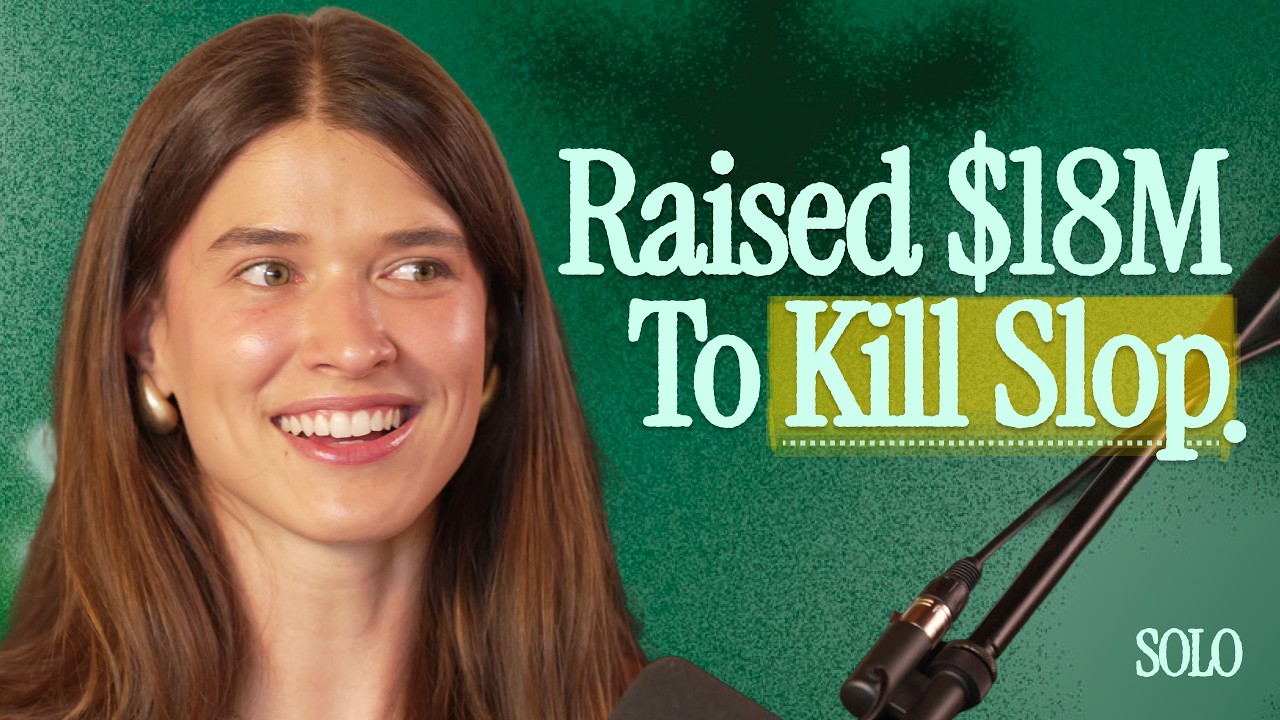
Thais Castello Branco founded Taste Labs and raised an $18M pre-seed round as a solo founder to solve what she calls “AI slop” — the monotonous, low-quality, look-alike output that proliferates when millions of people generate content with the same models. She argues society risks normalizing this slop unless AI learns genuine taste: the ability to judge quality in subjective domains where no single correct answer exists.
Why she went solo (it “felt forced”)
Thais had founding experience (a prior startup in Brazil, early team at Exa) and knew she wanted to start something, but co-founder searches felt forced and the idea moved too fast to wait.
She fundraised within weeks of leaving Exa, hired quickly, and suddenly realized the company was already moving without a co-founder — so she kept going.
The transition from Exa to Taste felt natural; both follow a “shovels” logic: Exa built search infrastructure for a world of agents, Taste builds the taste infrastructure so those agents can create well.
What “taste” actually is (and why it’s not personalization)
Taste ≠ personalization. Personalization is one individual’s preference; taste is a judgment of quality in domains without a single right answer — a bar for what “great” or “appropriate” looks like, validated by shared expert agreement.
Taste is a skill honed through years of exposure, pattern recognition, point-of-view formation, and down-selection (deciding what you don’t like). Natural talent may accelerate the cycle, but the work is required.
It’s rare because it takes deliberate practice; treating it as mysterious obscures that it’s buildable.
Ira Glass and “the gap”
Ira Glass’s “gap”: beginners can perceive quality but can’t yet produce it — demoralizing but useful if you study why the gap exists.
AI exploded the number of people who can generate (not create) — slide decks, sites, posts — without the expertise to judge quality. The bar of perception drops because slop becomes the new normal.
We haven’t built tools for this new mass of non-expert creators to raise their own bar or even know a higher bar exists. AI should help bridge the gap (understand intent, suggest better options), not widen it by flooding the world with average output.
How machines learn taste differently than humans
Humans learn continually: organic, ongoing pattern recognition from each new input (Hunter S. Thompson typing Hemingway; Picasso’s evolution across self-portraits).
Models learn in batches: pre-training absorbs probability patterns; post-training (RLHF/RLAIF) attaches “good/bad” labels. Less continual, more concentrated.
The hard part for machines: nuance and context-dependence. Something can be great in one situation, terrible in another — humans pick this up naturally; models struggle.
A quirk on one person is a signature; on millions it’s slop
A human’s idiosyncrasy becomes a signature; the same quirk repeated by millions via the same model (em dashes, purple gradients) feels thoughtless and gross — “slop.”
Root cause: volume. Same pattern applied across totally different use cases, styles, and intents where it doesn’t fit.
Goal isn’t randomness (high temperature) but intentional diversity: purpose-built output that fits the specific context. Requires mapping user intent and conditional taste logic (quality depends on context, not isolation).
The “Taste Labs” name and the Twitter debate
Registered the name a year before “taste” exploded on Twitter. Kept it despite debate because it captures the mission: a lab that studies taste, not a brand that imposes one taste.
Misconception: people thought Taste Labs would dictate a single aesthetic. Reality: raise the quality bar, increase diversity, give users tools to understand and apply their taste — make AI a tool for creativity, not a collapse into monoculture.
Why it’s a “lab”: turning subjective into objective
“Lab” because it requires research. Massive investment goes into making models great at coding; little goes into writing, design, emotional intelligence, nuance — the things that make AI feel right.
Method: break fuzzy subjective problems into objective subcomponents.
Fundamentals: contrast, typography, color, whitespace (experts agree on alignment).
Higher-order: style, creativity, diversity, personalization — where legitimate disagreement exists by design (maximalism vs minimalism both great; user chooses).
Transform expert judgments into structured data (rubrics, reasoning traces) so training doesn’t collapse to the average of all tastes.
Inside the ~800-person tastemaker community
Covers all visual design: slides, images, SVGs, 3D, websites, video. Long-term: framework extensible to writing, tone, personality, other subjective domains.
Curated 800 tastemakers with diverse specialties/styles. For each project, pull a panel that’s individually strong and stylistically diverse so data represents real variation.
Collaborative process: define rubrics (criteria for bad/ok/great), grade examples, articulate why — bridging researchers, creatives, and the lab.
Data collection methods adapted to creators (voice-driven, critique-style sessions) to feel natural.
Critic vs. maker: who explains greatness?
Not the same skill. Some makers produce golden-set exemplars but can’t articulate why; some critics excel at analysis but don’t create.
Taste Labs identifies both roles, sometimes teaches articulation (e.g., voice input for visual thinkers).
AI parallel: the “commissioner” (prompter) states intent; the model executes. Best human designers take weak briefs, ask probing questions, uncover true intent, then add their own creative spin. AI needs to learn this commissioner skill — understanding vague intent, offering options, asking clarifying questions.
Intent, interpretation, and commissioning AI
Most prompts are vague (“make it pop”). Commissioner skill gap is real: people lack vocabulary to specify style, intent, constraints.
Spectrum of products needed: one-shot generation → iterative co-creation (agent asks questions, shows options) → full manual control.
Data opportunity: collect the range of valid interpretations for ambiguous prompts (e.g., “pop” = chunky fonts + saturated colors OR pastel pink vibe) so models learn the distribution, not just the average.
Her path: CPG, ChatGPT, Exa, and going solo
Started in CPG (new product development): loved understanding human behavior, hated the slowness. Tech offered speed — build, get feedback, iterate daily.
ChatGPT sparked obsession with AI infra: what foundations does a world of agents need? Joined Exa (search/knowledge for agents) as early team, saw it go from “nobody gets it” to obvious.
Taste Labs applies same infra logic: in a world where AI is everywhere, what data/tools do agents need to design and create well on behalf of people?
Always entrepreneurial (kid selling cookies, magazines, books). Wanted a 10-year obsession — something she’d restart tomorrow if Taste disappeared. Left Exa (doing well) because the pull was stronger than rationality.
Branding, tinned fish, and Liquid Death
CPG lesson: branding creates emotional reaction beyond function. Tinned fish (commodity, hidden product) differentiates entirely via packaging/brand (e.g., Fishwife).
Liquid Death: water — least differentiated product — made edgy, identity-signaling.
AI lacks this: ability to intentionally diverge from norm with purpose, not randomness, to create work that says something about the user.
Monoculture, character, and what we fear
Fear isn’t just job loss; it’s a monotonous world where everything looks the same (new buildings lacking character, regulated into sameness).
Pike Place Market (Seattle): labyrinthine, surprising, wonder-inducing — creativity as surprise (going left when you expect right).
Authenticity and craft: a tiny Lisbon restaurant preserved in time, details no one had to perfect but did; Yosemite’s Half Dome — awe, feeling small in something vast.
The Lindy effect and what lasts
Lindy: the longer something lasts, the longer it’s likely to last. Ancient monuments, enduring architecture — high craft, authenticity, care.
Modern fads (quick trends, low authenticity) lack staying power. But new era-defining work can still emerge if made with the same depth.
Volume of low-intent generation makes high-craft work more valuable and visible. “I would be very sad to live in a world where there is nothing new that pops up that is everlasting.”
The bear and bull case for going solo
Bear case: only do it with incredibly high pain tolerance and emotional regulation. Founding is a daily battle; it’s lonelier because you shield the team from stress and have no co-founder who shares full context (context transfer is expensive).
Bull case: mission-oriented founders get single-minded clarity and conviction. No co-founder disputes over weight-pulling or vision drift. “I know how 150% in it I am” — deep self-trust that she’ll see it through.
Why hasn’t taste been solved?
Technical hardness + ambiguity → people shy away or wait for perfect answers. But the cost of inaction is the slop monoculture.
Progress, not perfection, is the target. “We have to try and I’ll keep trying till we succeed.”