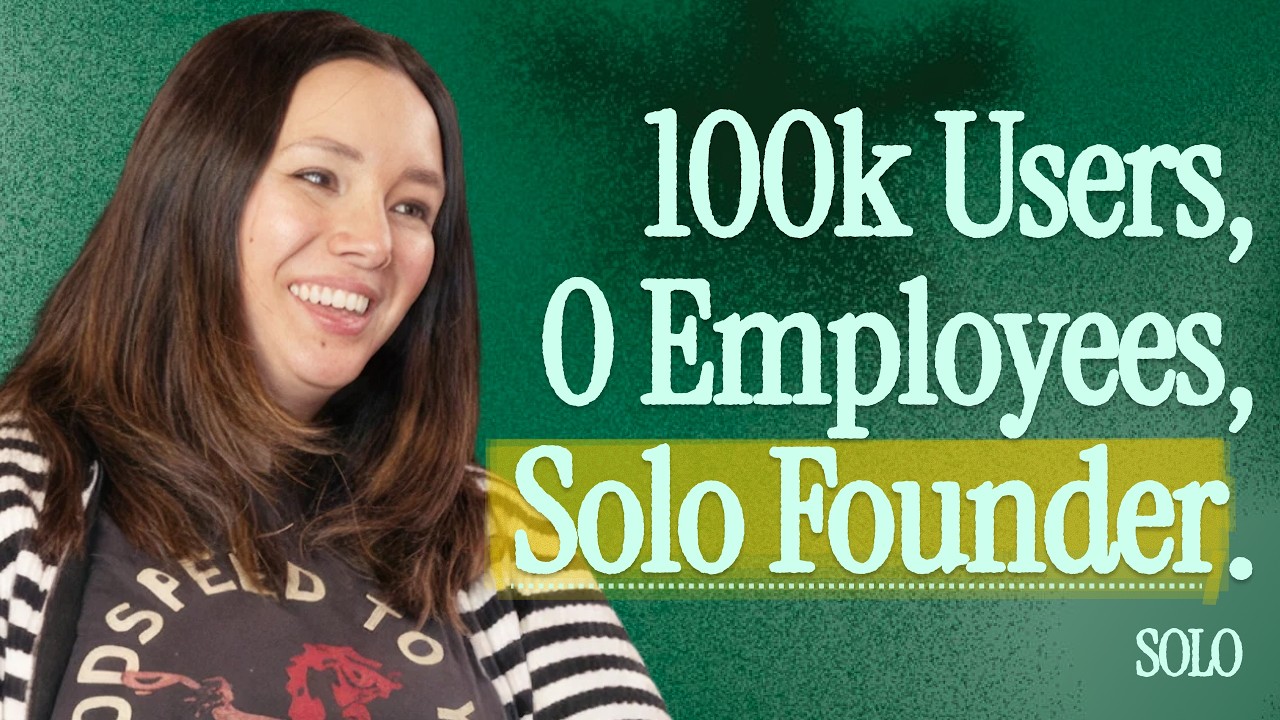
Claire Vo built ChatPRD, a profitable AI-powered product management tool, as a solo founder with zero venture capital and only AI agents as her “team” — she is the only full-time human, and the business serves her life design rather than the other way around.
Origin: a custom GPT that became a business
Claire created ChatPRD two years ago while CPTO at Color Health during the pandemic, when she used ChatGPT to write a detailed PRD/technical spec in hours instead of days.
Her team asked her to teach them; she packaged the prompt into a shared GPT called “ChatPRD” with a Midjourney avatar and put a Stripe checkout in front of it to test willingness to pay.
Initial goal: “buy a glass of wine a month” — it quickly grew to a case of wine, then real revenue, while she kept her executive roles at Color Health and later LaunchDarkly.
She coded the standalone version herself with LLM help, priced at $12/year, gained thousands of users, and kept raising prices as she added features.
Went full-time about a year ago when her time became the genuine constraint on growth, not capital or engineering capacity.
When to go full-time on a side project
Decision framework: (1) What shape of business and life do I want? — fully bootstrapped, sole owner, no board, work only with chosen people (mostly AI agents). (2) Where am I actually resource-constrained relative to ROI?
She was not capital-constrained (profitable, cash-flowing) and not time-constrained for two years because AI gave her 10x engineering leverage; she hired a part-time engineer at year one.
The tipping point: her executive experience (CPTO at TikTok, LaunchDarkly, Color) gave the product its edge — she worried leaving that role would erode the insight that made ChatPRD good.
She waited until the business needed her full-time attention to grow further, not because she wanted to escape her job.
”She may be a wrapper, but she’s my wrapper” — earned insight as moat
Early skepticism about “GPT wrappers” missed the point: Claire’s 20 years of product leadership is the product — users pay for her judgment encoded in the prompts.
Founder–problem fit matters: she only starts companies from nightmares she has personally lived (e.g., Adil at Magic School, former principal building for teachers).
Founder-led marketing compounds the advantage: her credibility as a 3x CPTO and public voice on X/TikTok gave the brand trust no generic wrapper could buy.
As a product leader under founders, she respects the founder’s “non-data-backed but directionally correct” intuition because they’ve sat with the problem longest.
What’s left for humans in the AI era (RZ = the moat)
Three durable human roles: (1) Find where product problems intersect commercial appetite — the value exchange. (2) Generate novel ideas from first principles — LLMs are poor at true creativity. (3) Inspire followship — rally teams, investors, markets; “RZ” (human ability to inspire movement in other humans) is the only moat.
She wants more founders to develop influence, charisma, and market-facing communication; the robots can do the rest.
Austin vs. San Francisco: “success dysphoria” and diverse life shapes
Austin: tan, fit, happy; no 996 grind; university town + government + SpaceX adjacency = balanced community, diverse industries, diverse definitions of success.
San Francisco: minting money but many have “success dysphoria” — no idea they’re in the 1%, monoculture of what a successful life looks like.
Claire builds a small business, not a “tech startup” — cash-flowing, high-leverage, hers, serving her life. Austin shows more shapes of business (CPG, retail, bootstrapped SaaS like Chatbase at $10M ARR, no funding).
Bay Area playbook is a factory model; other paths can yield venture-scale outcomes without following it.
Why she took zero venture capital
Did the VC route before (accelerator, raise, acquisition); 20+ years in, she knew exactly the life she wanted: three kids, no board, no grind for a potential billion-dollar outcome.
Not convinced TAM for AI PM platform is $10B; convinced it makes her a lot of money.
Bootstrapping worked because she brought 20 years of expertise, network, distribution, coding skill, and capital to self-fund — “20-year overnight success.”
Trust comes from her track record, not a pitch deck or website polish.
People shy from their strengths because they don’t know what makes them happy; they chase the playbook thinking the exit will bring happiness — it won’t.
Building a business that serves your life
Clarifying moment: attended a funeral for a colleague at a 500-person company — almost no one from work showed up. Realized little of work returns in moments that matter.
“Go to the funeral” essay resonated: show up for people because it’s right, not because it’s transactional; cultivate community and obligation; stay anchored in humanity amid AI/phone mediation.
Deathbed test: won’t be thinking about SaaS renewal rates; will be thinking about kids, husband, community, intellectual joy.
AI era gives optionality: don’t have to raise venture; can commercialize smaller businesses with lower capital; shape the pursuit around personal goals — but most don’t question “what is this for?”
Running a company with nine AI agents (“open claws”)
Personality fit: she’s a deep introvert — happy alone for years — so solo + agents suits her energy.
Skill fit: fluent across engineering, product, sales, marketing, speaking — AI amplifies breadth; management experience maps directly to agent orchestration (design org, assign jobs, set norms, hold accountable).
Pitfall: she’ll build 10 features to avoid writing one blog post — must build systems to counter her own inclinations.
Daily structure: “swallow the frog” — sales, marketing, podcasts, admin in the morning; afternoons reserved for coding (what she’d do anyway).
Hiring trigger: Fourth of July weekend, pushing a PR while kids played — realized she was single point of failure on engineering; hired engineer two days later. Every hire since has been triggered by “this is crazy, I’m missing kid time.”
The agent constellation: specialized identities, not a mega-agent
Nine “open claws” on her work Mac Mini: marketing, EA (Polly), sales (Sam), support, etc. — each has own identity, tools, workspace, coaching.
Mirrors how she ran human orgs: clear job definitions, success criteria, tools, ongoing development.
Scoping an agent to a job-to-be-done works better than one all-knowing agent; parallels coding agents (Devin = coding, not everything).
Project-based agents: spin up a constrained agent for a specific project with defined identity/tools — does a better job.
The agent that emailed us before she showed up (Polly, the EA)
Polly runs on a Mac Mini, checks calendar every 15 min, sends pre-meeting briefs, handles scheduling/research.
Claire sent a voice note via Telegram while parking: “tight schedule, may be late” — Polly emailed the hosts.
Second voice note in traffic: “stuck, apologize, this is new ETA, offer to reschedule” — Polly handled it.
Polly has own email (signature: “Polly, Claire’s lobster assistant”), calendar access, read-only email access, instructions on when to act vs. brief.
Also coordinates with Finley (family agent) on kid logistics; builds playbooks; proactive daily briefs.
Transparent AI and owning the output
Transparency > deception: Polly’s signature signals “AI” to those who know; others may not care.
Sales agent Sam — people think he’s real, show up asking “is Sam joining?” — Claire discloses; customers love it as proof of AI-first dogfooding.
Disagrees with “agents can’t own, only delegate” (Linear’s view): she delegates ownership to agents because she’s ultimately accountable either way — same as human ownership failure states (she held the ultimate pager as engineering exec).
Dan Shipper’s rule: if you can’t explain/defend AI output, you’re not doing your job — she aligns but goes further: agents can own, she owns the system.
How I AI: treating a podcast like a product
Launched “How I AI” with Lenny ~1 year ago: hypothesis = appetite for real hands-on AI demos.
Evolved to 50/50 interviews + solo workflow/model/tool deep dives; ~100k YouTube subscribers, 300+ videos.
In her zone of genius: introvert-friendly (alone at home), learns from guests, applies immediately to ChatPRD and code.
Business value: visibility for her, ChatPRD, and guests; but the real ROI is learning — “excuse to talk to smartest people in the space.”
Product approach: portfolio of products (interviews, model reviews, mini-episodes); measure PMF per product; double down on what works.
Iterating toward short-form (TikTok/Reels), writing, new formats — always asking “what’s the business, what products fit?”
The agent stack: Mac minis as physical sandboxes
Four Mac minis on desk: work (all ChatPRD agents), husband’s, family/kids, Perplexity computer.
“Your machine is your sandbox” (from Jesse Jana): physically partition agents by life domain — business agents don’t wander into kids’ homework.
Husband and 9-year-old also deep in compute/hardware; household runs on local inference.
The case against going solo
Wrong reasons: equity ownership (customers are your boss anyway), dictatorship fantasy (you can drive opinion in any structure), financial upside (split ownership can yield huge outcomes).
Attributes that make solo founding hard: extrinsic motivation (need investors/co-founders as forcing function), shiny object syndrome (need moderating force), extreme spike in one function without breadth (early on you need to cover all jobs).
Better to be rounded at the founder table early to avoid neglecting critical functions.
The case for going solo: authorship over dictatorship
She’s “truly lone wolf” — no investment, no employees, no board.
True ownership lets you shape a life, not just a business — different from building a billion-dollar company (may overlap, not required).
Concrete freedoms: say no to unwanted customers, ship what sparks joy, slow growth when pregnant (December at 9 months pregnant = quiet month, no complaints), optimize for joy.
“Many millions to put me back in a 500-person Slack” — her joy is very high now.
Not about dictatorship; about authorship — choosing what book you write, what life you create, on your terms.