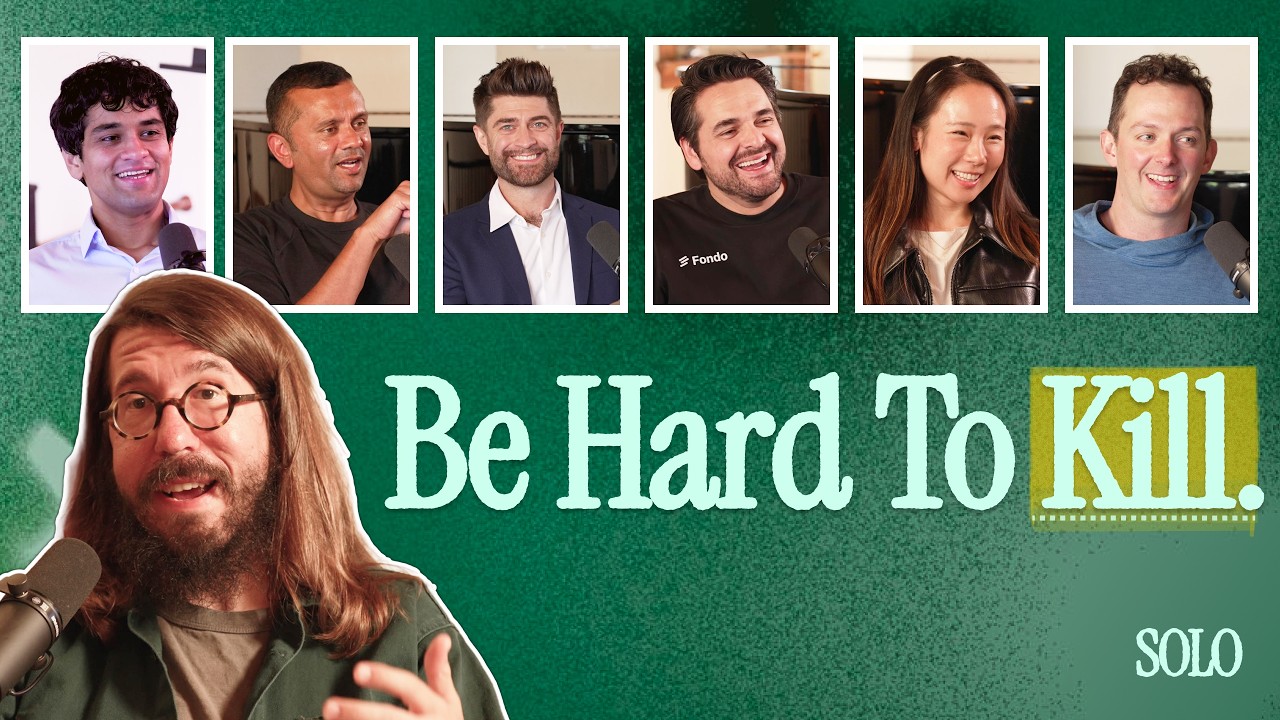
This episode of the Solo Founders podcast compiles highlights from conversations with six successful solo founders — Rahul Sonwalkar (Julius AI), Sunil Rajaraman (Hamlet), Jimmy Douglas (Plug), David Phillips (Fondo), Minn Kim (Lighthouse), and Michael Grinich (WorkOS) — to examine what it actually takes to build a venture-backed company alone, covering the misconceptions that lead people to solo founding for the wrong reasons, the necessity of original insight, the advantage of going against orthodoxy, using constraints as a filter, the rise of AI-enabled service businesses, and why founders must do sales themselves.
Solo founding for the wrong reasons backfires
Many people start solo because they don’t want a boss or don’t want to convince a co-founder, but solo founders still have many “bosses” — investors, employees, partners, customers — and must convince all of them.
Rahul Sonwalkar (Julius AI) notes the misconception that solo founders can just command people; smart people won’t listen just because you told them to — you have to convince them, and the best work comes from people who are genuinely excited about the mission.
Convincing power comes from a unique, personal connection to the problem; copying another startup’s idea signals no original insight and leaves you understanding only superficial elements.
Original insight is the non-negotiable foundation
Sunil Rajaraman (Hamlet): if you don’t have an original insight, don’t work on it — “original” means an insight on that industry no one else has, informed by your personal experience, not that you’re the only one in the world working on it.
Without original insight, copying leads to a cycle where competitors copy each other while neither actually understands the deep reasons the business works; Magic School succeeded because its founder was a high school principal building at the right moment, and copycats only grasped surface-level features.
For solo founders especially, the insight must be yours — co-founded companies can have one partner hold the insight, but a solo founder has no such fallback.
Going against orthodoxy and outlasting everyone else
Jimmy Douglas (Plug) left Tesla’s billion-dollar used EV division to build Plug; the business model they actively avoided (becoming a licensed wholesale car dealer) turned out to be the only one that produced exponential growth — unique sellers per quarter jumped from ~16 to 429 after the switch.
Conventional wisdom exists for good reasons, but sometimes the thing everyone says will fail is exactly what works; when you finally hit the right model, results often appear shockingly fast after long periods of nothing working.
Solo founders are “hard to kill” — with no co-founders to lose conviction or leave, the only thing that stops you is you; that resilience buys time to iterate until something clicks.
Constraints as a filter: the Fondo story
David Phillips (Fondo) had $40,000 in the bank and ran every idea through a filter: can I do this solo? Can I get it off the ground with this capital? Am I the domain expert? Can I empathize with the customer? What tools do I already have? What has the highest likelihood of working without raising more money?
Fondo (bookkeeping and tax prep for startups) rose to the top; previous ideas pursued with co-founders were random relative to this, but his background made him uniquely suited to solve this specific problem.
Being forced to apply a strict constraint filter surfaced the idea he was actually built to execute.
Services businesses now scale like software
Minn Kim (Lighthouse) argues the old rule “professional services don’t scale” stopped making sense around 2021: knowledge work (legal, accounting, advisory) lives in people’s brains as processes, and once you decouple and break down those processes, they can be executed by software consistently.
Lighthouse scales a service firm helping talent immigrate to grow the U.S. economy; customers interact with results, not the software — the software runs internally, removing the need for customers to adopt new tools.
AI accelerates this: services that previously required many humans in the loop can now be delivered with far fewer, creating a wave of service businesses that scale with software-like margins.
Founders must do sales — it’s writing and performing your jokes
Michael Grinich (WorkOS) has done sales longer than almost any solo founder; even when hiring a sales leader, he framed it as finding a core collaborator, not handing off sales.
Sales is the ultimate distillation of company value to the market — “like writing your jokes and performing them on stage”; if you only write jokes and never perform, you miss the whole thing (like reading about sex vs. the reality).
Stepping away from sales early robs you of customer interactions and learnings; every founder on the podcast credits direct sales for critical product and market insights.
The proof only comes from getting on stage: testing material, seeing what resonates, ditching what doesn’t, and learning what gets the laugh, the confusion, or the rejection.