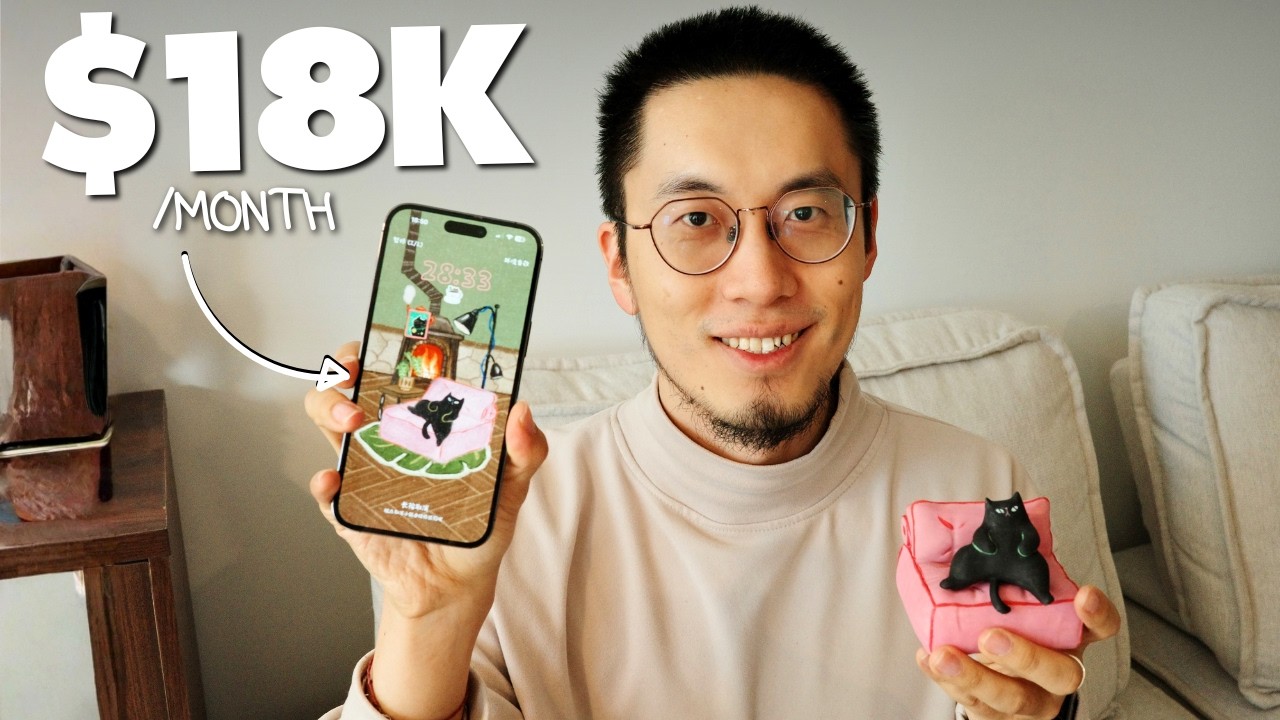
Ryan, a former product designer who left a $200K job, built “Cat on Chair” — a playful, cat-themed Pomodoro timer — with his girlfriend using AI coding tools; the free app with premium upgrades now generates ~$18K/month and has 127K downloads across 8–9 months, driven by organic virality in Chinese/Taiwanese markets and expanding globally.
Ryan’s background and transition to indie development
Ryan worked as a product designer at tech startups but felt he was wasting his potential doing only design work.
He quit his job to build his own business; this is the first app he has released.
AI coding becoming viable for iOS development (around a year ago) gave him the path to ship an app himself, turning his design skills into a complete product.
His girlfriend, an illustrator and Animal Crossing fan, became his co-creator, contributing the visual style and game-inspired mechanics.
The app: Cat on Chair — concept and core experience
A Pomodoro timer where a cat jumps onto a chair when you start focusing and leaves a “gift” when the session ends; failed sessions yield “trash” instead.
Customization layer inspired by Animal Crossing: collectible cats, furniture, backgrounds (including animated ones), each with backstory-driven codes.
Interaction details: tap the cat or say its name to trigger a meow animation; timeline shows focus history with stickers; includes a to-do list.
The girlfriend’s distinctive illustration style gives the app a handcrafted, artistic feel that stands out from generic productivity tools.
Emotional resonance: a user reported that after her cat passed away, finding a similar-looking cat in the app felt like seeing her cat again.
Business metrics and monetization
~127K total downloads; ~$80K revenue over 8–9 months; ~$18K in the 30 days leading up to April 13.
Free download with pro features unlocked via lifetime ($29.99), annual ($19.99), or family share (up to 6 people); lifetime plan drives most revenue.
Peaked at #3 in free productivity apps and #11 in all free apps in Taiwan.
Primary markets so far: Chinese and Taiwanese users (via RedNotes/Xiaohongshu); now targeting English-speaking/global audiences.
Building the app: timeline, tools, and AI-assisted development
Started May 2025; basic Pomodoro timer working within weeks; first full version ready by August.
Launched August 27 after ~1 month of beta testing with dozens of RedNotes users; ~3,000 downloads in week one.
Post-launch stability issues (data sync bugs, etc.) persisted until December–January.
Tech stack: ChatGPT Pro for coding; RevenueCat for paywalls/subscriptions (~$200–300/mo); ASO optimization tool ($10/mo); Droids for user feedback (free).
Ryan credits AI for letting him go from designer to builder without traditional engineering background.
Growth and distribution: organic virality
Initial traction from girlfriend’s existing RedNotes following (illustration audience).
Small viral moments on RedNotes early on; major breakout when Instagram influencers featured the app in “app collection” posts — one hit 2M+ views.
A user in Taiwan reshared on Threads, triggering a second viral wave that doubled downloads and revenue overnight.
Growth has been almost entirely organic/word-of-mouth; no paid acquisition discussed.
Why the app works: differentiation through playfulness and craft
Pomodoro timers are a crowded, feature-saturated category; innovation comes from wrapping the core mechanic in a cohesive, personality-driven experience.
Design philosophy: replicate the physical experience of having a cat nearby while working — calming, healing, playful.
Gamification borrowed from games (Animal Crossing): collection, customization, progression, and surprise rewards motivate retention.
The girlfriend’s unique illustration style creates a visual identity that AI-generated or template art cannot replicate.
Users perceive the app as handcrafted and personal, not “vibe-coded” or generic, which fuels sharing and emotional attachment.
Advice for designers and builders
Start from an app you already use or care about; study competitors’ App Store reviews and social media deeply.
Remix mechanics from other industries — especially games, which are engineered for motivation and retention.
Lean into your unique skill set: Ryan’s design background and his girlfriend’s illustration made this specific app possible only for them.
If you lack an illustrator, use AI to develop a distinctive visual style that sets the app apart.
Keep trying and stay consistent; it took years to find the right idea and a couple of attempts to build it — building with AI is not automatically smooth sailing.
Pat and Gus reflections: building unique apps that leverage your edge
The standout lesson: build from your existing skills — Ryan’s design eye and his girlfriend’s art created a product only they could make; a data analyst, writer, or engineer should ask what unique angle their background enables.
The app’s growth felt “random” but likely stemmed from its handcrafted, non-generic feel — people shared it because it felt special and personal, not like another AI-generated utility.
Ryan built it because he wanted it to exist, not with revenue expectations; that intrinsic care translated into a product people wanted to talk about.
Encouragement to ship something you care about, even if imperfect — the iOS bootcamp (linked in description) helps take an idea to a live App Store app.