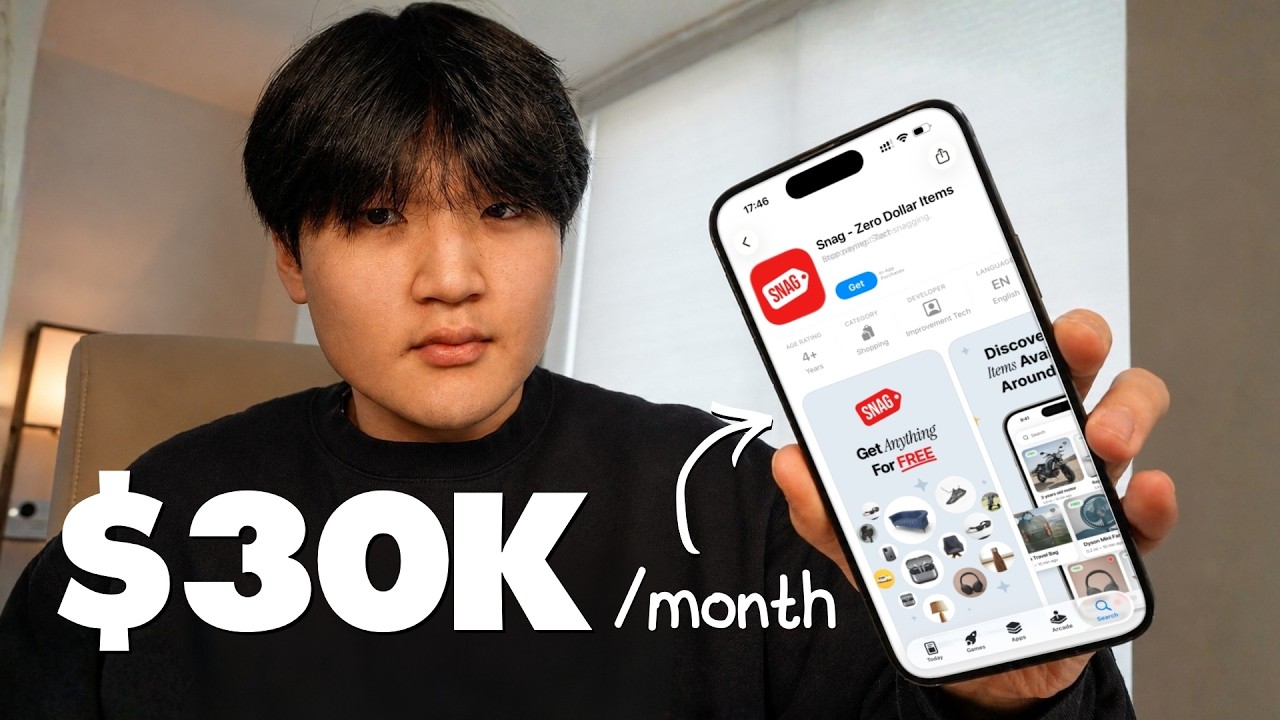
Benji, a 20-year-old NYU student, scaled his app Snag to $30K/month in under 4 months using a repeatable system he developed after building over 45 apps in the past year. This episode breaks down his exact process for going from idea to revenue quickly, covering his build workflow, distribution strategy, and the playbook he would follow if starting a consumer mobile app from scratch today.
Products and Offerings
Snag is an app that helps people find free items near them, launched by Benji and his team at 10X Studio.
It offers weekly, monthly, yearly, and one-time subscriptions.
It has over 100,000 authenticated users, 9,000 conversions, and over $80,000 in total proceeds.
Pillar was Benji’s first app, a self-improvement app that scaled to 11,000 users with zero CAC before he stopped due to shiny object syndrome.
HeightGPT was his second app, which he used as an example of how a copied idea can succeed with a better user interface, marketing, and funnels.
Metrics and Financials
Snag reached $30,000 in monthly recurring revenue (MRR) within 4 months of launch.
The app has over 100,000 authenticated users and 9,000 conversions.
Total proceeds are over $80,000.
Snag has around 3.3K ratings on the App Store, which serves as important social proof for consumer apps.
For UGC campaigns, every 100,000 views typically generates $1,000 to $2,000 in direct subscription profits.
A specific UGC video that got 240,000 views was highlighted as a successful example.
On Meta ads, a test campaign for one creative spent around $3,000 total before the return on ad spend (ROAS) became negative.
Strategy and Growth
Overall Vision and Positioning: Benji focuses on building a single product that can scale over time with a great team, moving past his earlier “shiny object syndrome” of building many apps without focus.
Primary Growth Engine: The core growth method is running UGC (User-Generated Content) campaigns at scale and then turning the best-performing creatives into paid ads on Meta.
Reach out to a large number of creators, interview them to filter for those with “virality built in,” typically achieving a 10% conversion rate (9-10 good creators per 100 interviewed).
Put selected creators on a monthly retainer plus a CPM (cost per mille) structure.
Test their videos; if a video gets over 50,000 views, it is a strong candidate to run as a paid ad on Meta.
Set up test campaigns on Meta ads, starting at around $50/day, and scale up gradually (e.g., $50, then $100, $200, $300) if the ROAS is greater than one or the CTR is high.
Monitor for ad fatigue due to diminishing marginal returns on Meta ads, and continuously pump out more creatives to test and find the most optimal ones.
Key Tactic for Ideas: Reverse-engineer the value proposition first by starting with marketing, then design the app to attract a user in 3 seconds. Use YouTube and Twitter for inspiration to find underserved pain points, or use Sensor Tower to find apps making a lot of money and copy them but make them 10% better.
Key Tactic for Value Proposition: Focus on a simple, high-value proposition. For Snag, users pay a few dollars a month to access products worth hundreds of dollars, leading to a high conversion rate.
Tech Stack and Infrastructure
IDE: Cursor
AI Coding: Claude Code Max is used to code the entire app.
Domain Hosting: GoDaddy
Email Marketing: Loops is used to send emails to churned users to convert them back.
Paywall A/B Testing: Superwall
Analytics: Mixpanel is used to track the onboarding process.
Design: Figma
Backend: Supabase is used to host everything.
Other: An Apple Developer account is required.
Lessons and Advice
Build Process: The entire process of building a good app (without the backend) takes around 4 to 5 hours. The workflow is: reverse-engineer the value proposition, wireframe and design in Figma, feed designs to Claude Code in the IDE, and code it.
Step-by-Step Playbook for a Consumer Mobile App in 2026:
Find a Scalable Idea: Focus on an idea you can implement properly. A good product that provides real value converts at a higher rate and retains users without needing much marketing.
Start Building: Open your IDE and use Claude Code to build the app. For beginners, single-use-case apps (like API wrappers) are fine. Ensure the app functions, has user authentication for App Store approval, and can be built in 4-5 hours.
Distribution: If you have no money for UGC creators, film videos yourself (Benji filmed thousands for previous apps). Find an editor to edit at scale and run them as paid ads. The ability to create content and get views on platforms like TikTok is a critical skill.
Iterate on the Product: Focus on generating real value to increase LTV (Lifetime Value) and lower CAC (Customer Acquisition Cost). Business is a transaction of value.
Direct Advice to Founders: “Create your own luck” by iterating, learning from mistakes, and improving yourself. This leads to meeting great people (like Blake Anderson, who Benji learned from), which leads to great opportunities. Surround yourself with ambitious people, as “you are the average of the five people you surround yourself with.”