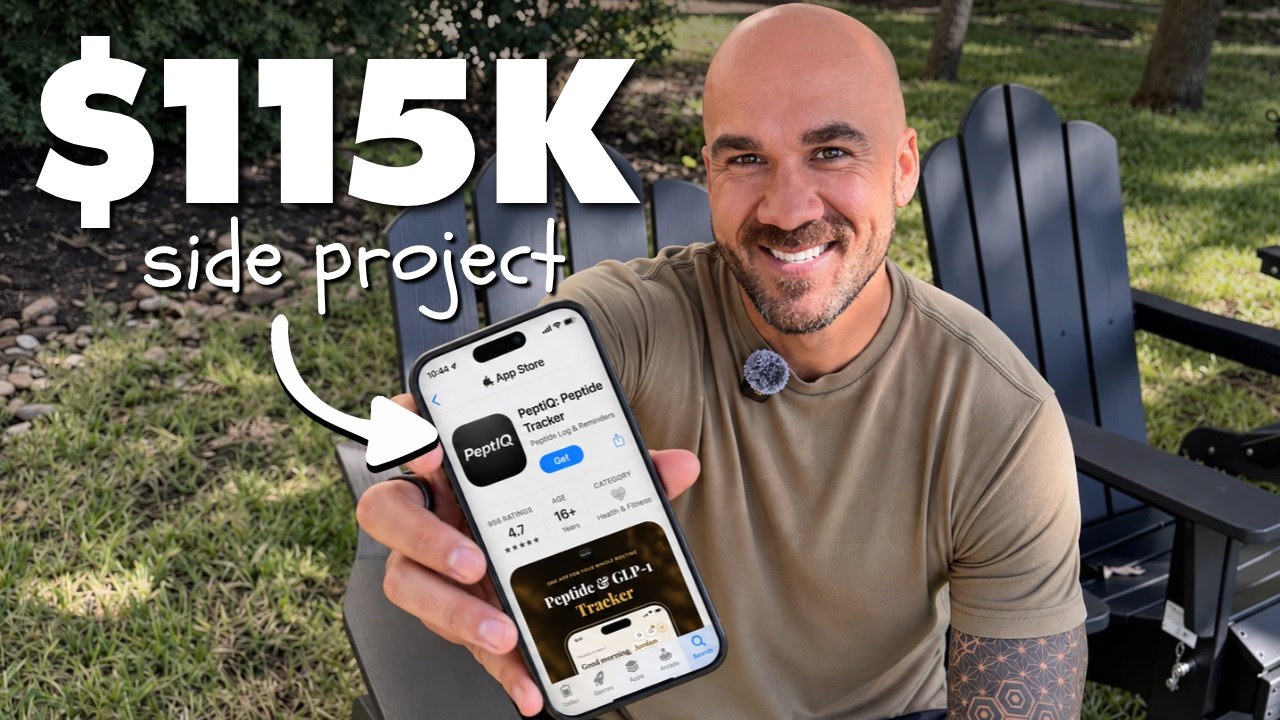
Chris Chase, a software engineer with 25 years of experience and a fractional CTO, built Peptide IQ as his first solo app and grew it to $14,000 MRR and $115,000+ annual revenue in nine months while working full-time.
Chris’s background and path to Peptide IQ
Started programming in the MySpace era, building an app that generated ~$40,000/month as a high school student.
Now serves as a fractional CTO leading overseas engineering teams across web, mobile, QA, IT, and DevOps.
Peptide IQ was his first venture building an app for himself rather than for clients.
Peptide IQ product and business metrics
A tracker for all things peptides with a hard paywall: $30/month or $130/year.
As of recording: ~1,400 active subscriptions, $22,000 revenue over 28 days, ~$15,000 MRR, 70 active trials.
Target users are primarily 45–55 years old, a demographic less likely to rely solely on AI chat interfaces.
Market validation and differentiation in a saturated category
Did not invent a new category; entered a space with dozens of existing GLP-1 and peptide apps.
Validated demand by observing the success of GLP-1–focused apps (used for weight loss) and seeing hockey-stick growth in Google search trends for peptides.
Differentiated by researching competitor reviews, Reddit discussions, and user complaints to find gaps — then building features that addressed those unmet needs.
Believes incumbents move slowly; a solo founder can differentiate and ship faster.
Technical implementation and build timeline
Built the MVP in about one week using “vibe coding” (AI-assisted development).
Growth strategy: SEO and content marketing as the primary engine
Invested early in a marketing website structured for SEO, knowing “the best time to plant SEO seeds is yesterday.”
SEO took 6–7 months to pay off; now drives ~70% of clicks and revenue at near-zero marginal cost.
Over 12 months, blog articles generated 590,000 clicks from Google search.
Argues SEO is not dead — it works when the target audience (here, 45–55-year-olds) still uses Google rather than AI-first tools.
Also submits sitemap to Bing (partnered with OpenAI) for additional indexing at no cost.
Content creation tactics and tooling
Sources article topics from recurring questions on Reddit and other communities where the target audience discusses peptides daily.
Produces content via three channels: writing himself, using AI for a majority of articles, and hiring freelance writers.
Embeds functional tools directly into articles (e.g., a peptide reconstitution calculator) that capture leads by prompting users to save data into the app after creating an account.
Technical SEO basics: proper schema markup, semantic HTML, fast load times, no broken links.
Uses SEMrush and Ahrefs to audit own site and reverse-engineer competitors’ top-performing pages and keywords.
App features and AI integration
Core features: dosing schedule with upcoming/last dose views, community section, blood-work logging, journaling, drug-interaction checker, educational guides (reconstitution, protocols).
AI assistant is not a generic ChatGPT wrapper; it ingests the user’s contextual data — protocol, dosing frequency, missed doses, Apple Health metrics, blood work — to answer personalized questions like “how can I improve my current protocol?”
Advice for founders starting today
Build something you’re genuinely passionate about; it won’t feel like work and you’ll move faster than incumbents.
Identify where you can differentiate in an existing market and execute quickly — large competitors are often slow to adapt.
Start SEO and content early; the compounding returns arrive later but become a durable, low-cost acquisition channel.