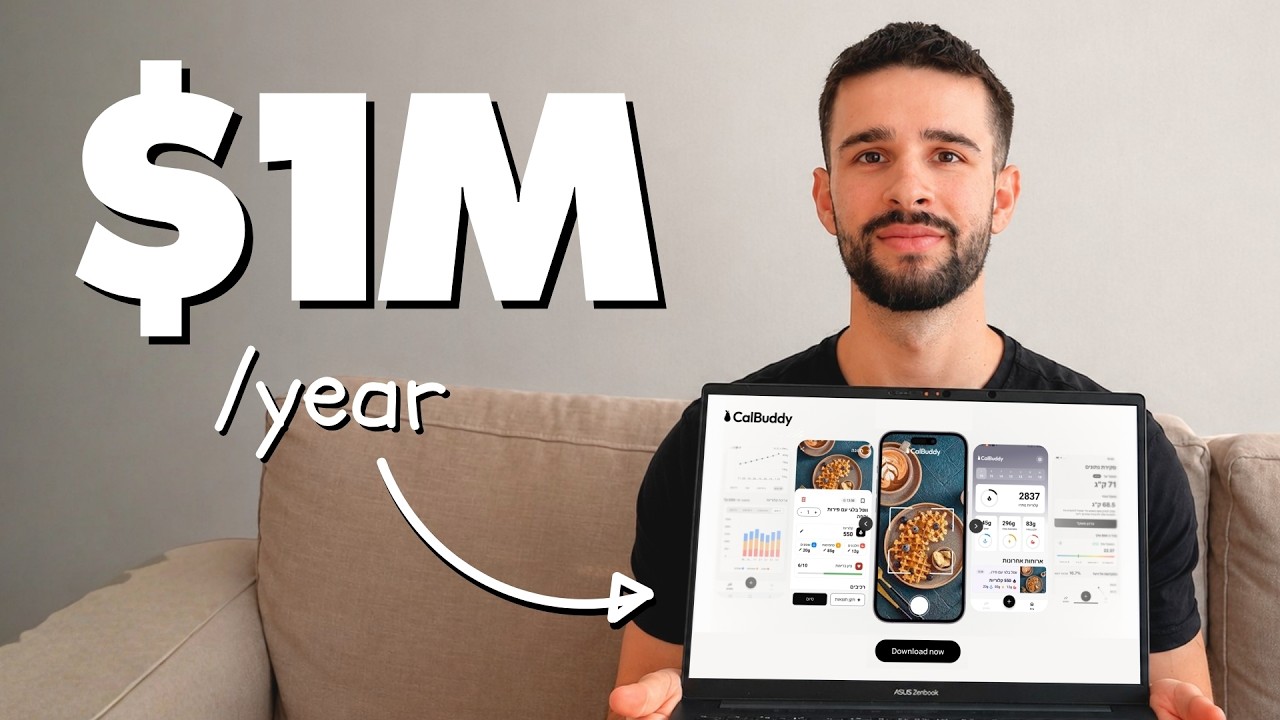
Tomer, a former marketer with minimal coding experience, built an AI calorie-tracking app localized for Israel in Hebrew, launched it in June 2024, and grew it to over $80,000 per month within a year by cloning the proven CalorieAI concept and executing a low-cost paid-ad strategy followed by revenue-share influencer partnerships.
Founder background and motivation
Tomer worked in marketing for other businesses but found it boring and wanted to build his own product.
He heard a podcast with Zach, founder of CalorieAI, who described scaling to over $1 million per month.
Tomer realized the app didn’t exist in Israel, and because fitness and nutrition is a massive niche everywhere, a smaller local market could still support a significant business.
Finding and validating the idea
In March 2024, Tomer was actively searching for an idea; the CalorieAI podcast made the localization opportunity click immediately.
He originally planned to target the US but saw that being first to localize a proven winner in his home market was the simplest zero-to-one move.
He chose calorie tracking because the niche is huge enough to work even in a small country like Israel, and he knew the space well personally.
Building the app as a non-developer
Tomer had only high-school coding experience and self-taught basics; he is not a professional developer.
Cursor (AI code editor) had just launched; he used it to build a working version with all core features in 2 weeks.
From first line of code to live on the App Store took about 2 months total.
The coding was fast; the delays came from Apple Developer Program enrollment and App Store review cycles.
Product differentiation through localization
The core product is nearly identical to CalorieAI: photograph food, get calories and macros in seconds.
Differences are language (Hebrew) and small modifications for how Israelis actually eat and talk about food.
Tomer emphasizes the real differentiation is brand and distribution: anyone can clone the app in 2 weeks with Cursor, but acquiring users cheaper than competitors creates a cash-flow advantage that funds further growth.
Growth strategy: paid ads then influencer partnerships
Tomer’s marketing background let him evaluate channels efficiently; for Israel, paid ads won because CPMs are significantly lower than in the US, allowing profitable campaigns with less testing and capital.
He studied viral content from US calorie apps and Israeli fitness creators, adapted those creatives for ads, and reached ~$20K/month in 4 months.
Once he had traction and social proof, he shifted to influencers to build a defensible brand.
Influencer revenue-share model
Big influencers would cost a fortune per post; Tomer proposed a revenue-share deal instead, aligning incentives: the more the app earns, the more they earn.
He waited until $20K/month to negotiate, giving him leverage for better terms than a 50/50 split from day one.
The agreement specifies content deliverables and filming/recording days per month to keep influencers on schedule.
Because influencers own a slice of all Israeli revenue, they promote the app organically beyond contracted posts (TV appearances, interviews, etc.).
Tomer got lucky knowing one major Israeli fitness influencer personally, which helped close the first deal.
Tech stack and monthly costs
Claude for coding and AI agents across the business: $200/month.
PostHog for product analytics: $20/month.
RevenueCat for subscription management: included in stack (price not specified).
Supabase for database and storage: $35/month.
Expo for in-app updates: $100/month.
Key advice and broader implications
Tomer’s advice: don’t be afraid of what you don’t know; have the self-confidence that you’ll figure out every setback and new skill, because you must never become the constraint holding the business back.
Pat and Gus highlight that localization is a massive, underused opportunity: most Starter Story viewers are outside the US, and markets in many countries remain wide open for proven ideas.
The “clone and localize” model works across industries (restaurants, cars, etc.) and will keep working because new technologies (like food-scanning AI) create fresh proven concepts to adapt.