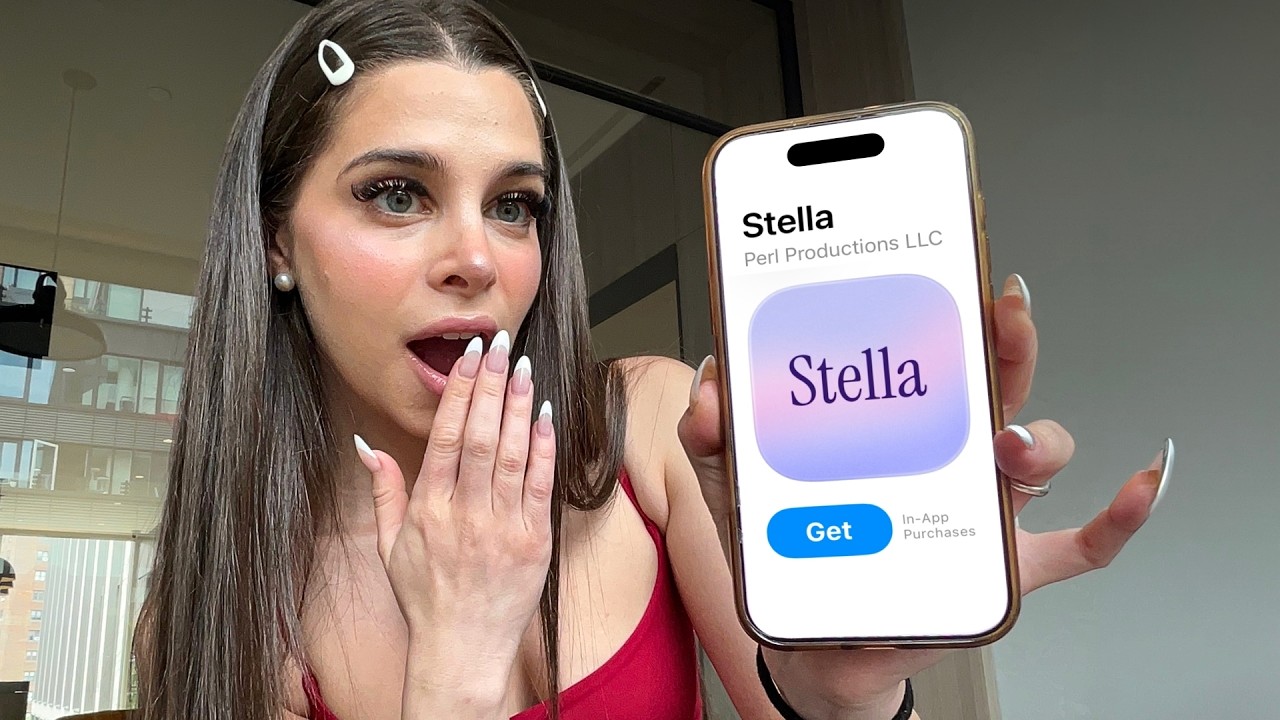
Sarah Pearl (known as Hot High Priestess) built Stella, a manifesting app that generates custom AI visualizations and daily affirmations, reaching over $300,000 MRR within two months of launch with 12,000 paying customers and 200,000+ downloads. She attributes the speed and scale to a combination of personal-brand distribution (1.2M Instagram, 2.8M TikTok followers, 1B+ TikTok views), AI-assisted development that removed the technical barrier, and a product insight rooted in female-specific needs that male founders typically overlook.
The app: Stella
Stella creates personalized audio visualizations spoken from the user’s “future self” who has already achieved their stated goals, plus daily custom affirmations tied to those goals (e.g., “Today I’m looking at the App Store and seeing my app hit number one”).
Users enter their dreams and desires; the app uses AI to generate unique visualization scripts and affirmation streams, delivered as audio they can listen to repeatedly.
The product is intentionally minimal — no feature bloat — which Sarah says reflects solving one sharp problem well rather than building a kitchen-sink app.
Conversion is unusually high because her audience is pre-sold on her authority; she estimates MRR is actually $350–360k, slightly above the $300k figure shown in the Stripe dashboard.
Sarah’s background and path to the idea
Always entrepreneurial with an intuitive grasp of virality; her first three TikTok videos went viral while she was in college studying to be a teacher.
Monetized social media first, then launched a TikTok Shop brand doing seven figures a month, giving her experience across multiple creator-business models.
Spotted the consumer-app opportunity when AI tooling (Claude Code, Cursor, Google AI Studio) made it possible to “vibe code” an MVP in days without traditional engineering skills.
The specific idea came from personal frustration: she listened to meditations/visualizations daily but found nothing that generated custom content for her exact goals — a gap she realized AI could fill instantly.
She explicitly notes most men would not have built this app because they don’t experience the same daily rituals or emotional needs; that blind spot is the “unfair advantage” of female founders in this wave.
Technical build: speed over perfection
Stack: Claude Code (primary), Google AI Studio (significant assist), standard iOS deployment.
MVP built in roughly 2 days; full app to launch in 2–3 months.
Core philosophy: speed is the #1 ingredient — whip up an MVP, test, iterate. The faster you ship, the sooner you find product-market fit.
She emphasizes that the technical barrier has effectively collapsed for non-technical creators, which is why the next wave of builders will be distribution-first, not code-first.
Distribution and virality: the real moat
“Women dominate distribution” — the majority of influencers and content creators are women, and biologically/communally women command attention and build community instinctively.
The best product doesn’t win; the best-known one does. With AI removing the build barrier, distribution becomes the decisive competitive advantage.
Her viral engine: pick a niche, study the top-performing content in that niche, reverse-engineer the psychological triggers (save, share, repeat), then recreate winning formats endlessly.
Signature format: affirmation videos with a “repeat for 7 days” or “listen 3x” hook → drives saves/repeats → algorithm boost → viral reach. At the peak moment, she inserts the app as the natural solution (“How do I remember all these? Use Stella”).
Uses ManyChat on Instagram: “Comment ‘download’ for custom affirmations” → auto-DM with app link + request for a review (boosts App Store ranking).
Balances two video types: pure viral (high reach, lower conversion) and demo/feature videos (lower reach, higher conversion). The sweet spot is content that does both.
Created a brand-new TikTok post-launch that hit 40k followers in months; another spam account at 700k+. She argues virality is a learnable skill, not a one-time audience asset — she could start from zero today and rebuild distribution in 3–4 months.
The “next wave” thesis: women will dominate consumer apps
Three converging forces: (1) AI eliminates the coding barrier that historically excluded non-technical founders, (2) women already own distribution/attention on social platforms, (3) women experience vast categories of unsolved problems (manifestation, tarot, horoscopes, cycle tracking, fertility, etc.) that male founders rarely notice or prioritize.
Predicts a flood of $100k–$1M+ MRR consumer apps built by women who pair content-first audience building with AI-assisted product development.
Notes a cultural friction: women using AI face harsher online backlash (“canceled”) than men; she reframes hate as algorithmic fuel — her most controversial videos are her highest-performing.
Marketing playbook: content first, product second
Works backwards: create content and distribution first, let the audience reveal the product gap via comments (“I wish this existed,” “I struggle with this”), then build the app that slots naturally into the content.
This avoids the classic founder trap of building in isolation then struggling for users.
Stella succeeded because it invented a new category (custom AI visualizations) rather than copying existing apps — she urges founders, especially women, to pioneer unsolved problems instead of clone-and-tweak.
Advice to aspiring builders
“Spite is the greatest motivation” — pain and disbelief from others provide the most durable fuel; difficult chapters are actually the luckiest because they generate maximum drive.
Build distribution before product. Content is the research lab; the app is the answer to the questions your audience is already asking.
Innovate, don’t imitate. The copy-paste epidemic in the app store means me-too products drown; category-creating products compound.
Master virality as a repeatable skill, not a lottery ticket. Study psychology of saves/shares/repeats, then systematize recreation of winning formats.