-
Chris
- Background and origin story
- Wanted to work for a cool bike brand in 2019 while in university, applied for a working student app developer role despite having no coding experience.
- Got rejected but was motivated to learn app development after the company praised his enthusiasm.
- Avoided the saturated to-do list app market, built a wish list app instead after using Excel to track his own wishes and finding no existing user-friendly option.
- Launched Wishlists as a side project with no team, no funding, and zero initial marketing.
- Pivotal moments and turning points
- 2019: Started building Wishlists.
- 2020: Released the first version of the app.
- 2021: Landed his first app developer job specifically because of his work on Wishlists; the initial codebase was messy so he could not ship updates, prompting plans to relaunch.
- July 2023: Graduated university, secured a full-time app developer role starting in October, giving him 2 months of free time to work on Wishlists.
- October 2023: Launched Wishlists 2.0, hit 100k total registered users.
- 2024: Balanced full-time app developer job with Wishlists side project.
- Early 2025: Negotiated a 4-day work week to dedicate more time to Wishlists.
- July 2025: Quit full-time job to work on Wishlists full-time (2 months prior to the interview).
- Business growth, current status, or exit details
- Now runs Wishlists as a full-time business, generating $150k in annual revenue.
- No exit or acquisition discussed.
- Background and origin story
-
Products and Offerings
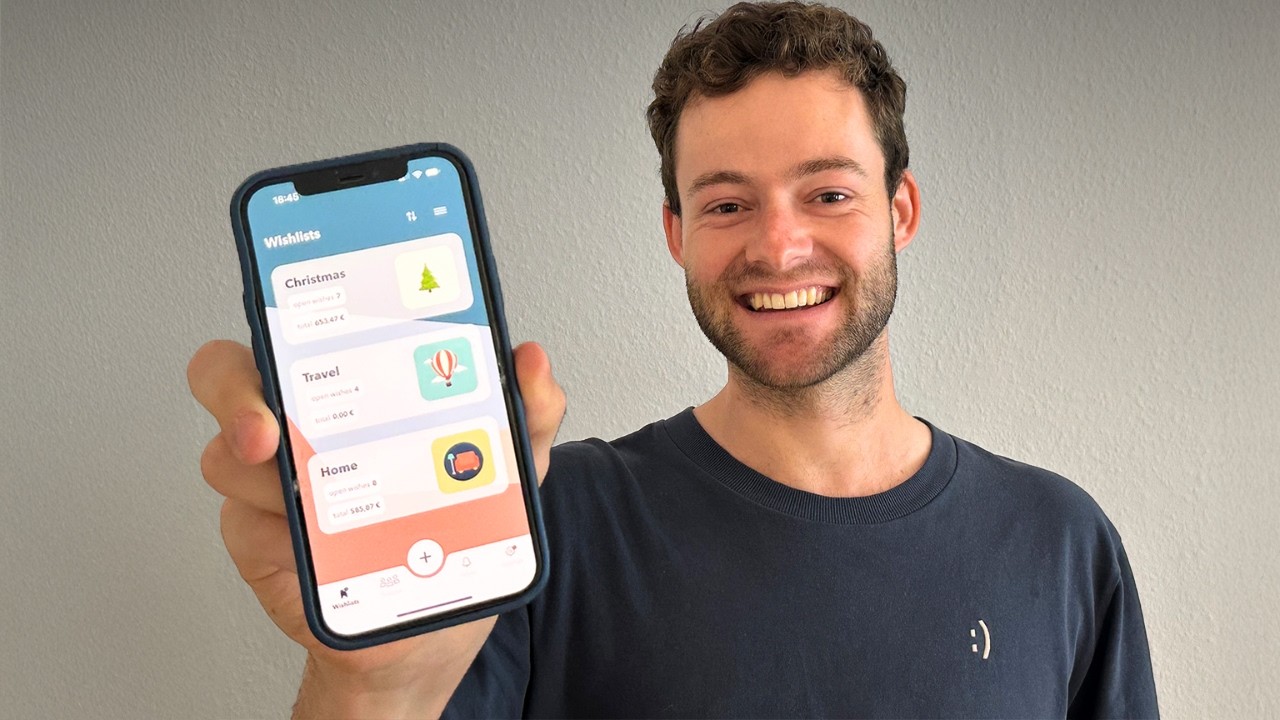
- Core product: Wishlists app
- Simple tool to create and manage wish lists (e.g., for holidays like Christmas), add notes, and set list visibility (public/private).
- Supports manual wish entry or auto-import of products via links (e.g., Amazon) that automatically convert to affiliate links.
- Monetization: In-app purchases for premium features (e.g., custom wish list images), affiliate commissions on product links added through the app.
- Supporting tools, side projects, or experiments mentioned
- No additional side projects or experiments mentioned beyond Wishlists.
- Core product: Wishlists app
-
Metrics and Financials
- Revenue figures, user counts, and financial milestones
- $150k annual revenue run rate.
$6k average monthly revenue in low season, 5x that amount ($30k) in high season.- 1.1M total registered users, 110k monthly active users (MAU).
- 4k+ paying customers.
- Hit 100k registered users in October 2023 with the launch of Wishlists 2.0.
- Software costs and resource efficiency
- 99% profit margin, only ongoing costs are server expenses.
- Exit or acquisition specifics
- No exit or acquisition discussed.
- Revenue figures, user counts, and financial milestones
-
Strategy and Growth
- Overall vision and positioning
- Positioned as a simple, user-friendly alternative to generic note apps for tracking wishes, focused on solving a personal pain point (lack of visually appealing wish list apps).
- Prioritizes user satisfaction over early monetization, aiming to grow via word of mouth and organic App Store ranking.
- Primary growth engine or method
- Organic App Store reviews and word of mouth; no standard marketing or marketing budget used.
- Key tactics, channels, or strategic steps
- Asked friends and family for early reviews to boost App Store ranking.
- Triggered in-app review prompts only after users completed positive actions (e.g., adding or fulfilling a wish).
- Built responsive support system: saved all user emails and feature requests from launch, notified individual users when their requested features were shipped or bugs fixed.
- Only asked users for App Store reviews after they provided positive feedback on updates.
- Side project management tactics: Worked 1 hour before work on admin (support, analytics), 3 hours after work on development (colder months), used commute time for small tasks, prioritized personal relationships, focused on development in winter months (fewer outdoor distractions), participated in working holidays with peers in the field.
- Overall vision and positioning
-
Tech Stack and Infrastructure
- Tools, platforms, and technical approaches referenced
- Flutter (cross-platform development kit)
- Cursor (IDE)
- ChatGPT (AI tool)
- Firebase (backend, analytics)
- RevenueCat (in-app purchase management)
- Thrive (user feedback)
- OneLink (deep links)
- Selfesk (accounting tool)
- Notable technical decisions, trade-offs, or architecture choices
- Chose cross-platform Flutter to build for multiple app stores efficiently.
- Used Firebase for backend and analytics to minimize server management overhead.
- Built and maintained the app solo with no team or external funding.
- Tools, platforms, and technical approaches referenced
-
Lessons and Advice
- Direct advice given to other founders
- Be honest with your employer about your side project: it is mutually beneficial, as you learn relevant skills at work and gain end-to-end experience via your side project that improves your work performance.
- Use small pockets of free time (e.g., commutes) for side project work, but prioritize friends, family, and personal relationships.
- Use winter months wisely for development, as there are fewer outdoor distractions.
- Participate in working holidays with peers in your field to boost motivation and maintain mental health.
- Start small with a real problem you or someone else experiences: saturated markets can be tweaked (e.g., wish list app instead of to-do list app).
- Set realistic early goals: aim for a random stranger to download your app, rather than targeting huge revenue early.
- Prioritize users over monetization: monetization can come later, focus on building something users love first.
- Don’t overcomplicate: you don’t need to build the next Facebook or raise VC funding, even a prettier version of an existing app is a valid project.
- Build for users: if they like the product, they will share it and leave positive reviews.
- Be responsive to user feedback: notify users when their requested features or bug fixes ship, only ask for reviews after receiving positive feedback from users.
- Hard-won insights and key takeaways
- Side projects are low-risk: worst case, you learn new skills and keep your full-time job.
- App Store reviews are critical for organic ranking, and timing review prompts to positive user actions drives higher-quality feedback.
- Balancing a full-time job and side project is a marathon, not a sprint: Chris took 6 years to grow Wishlists to full-time income, compared to modern “vibe coding” weekend launches.
- Direct advice given to other founders