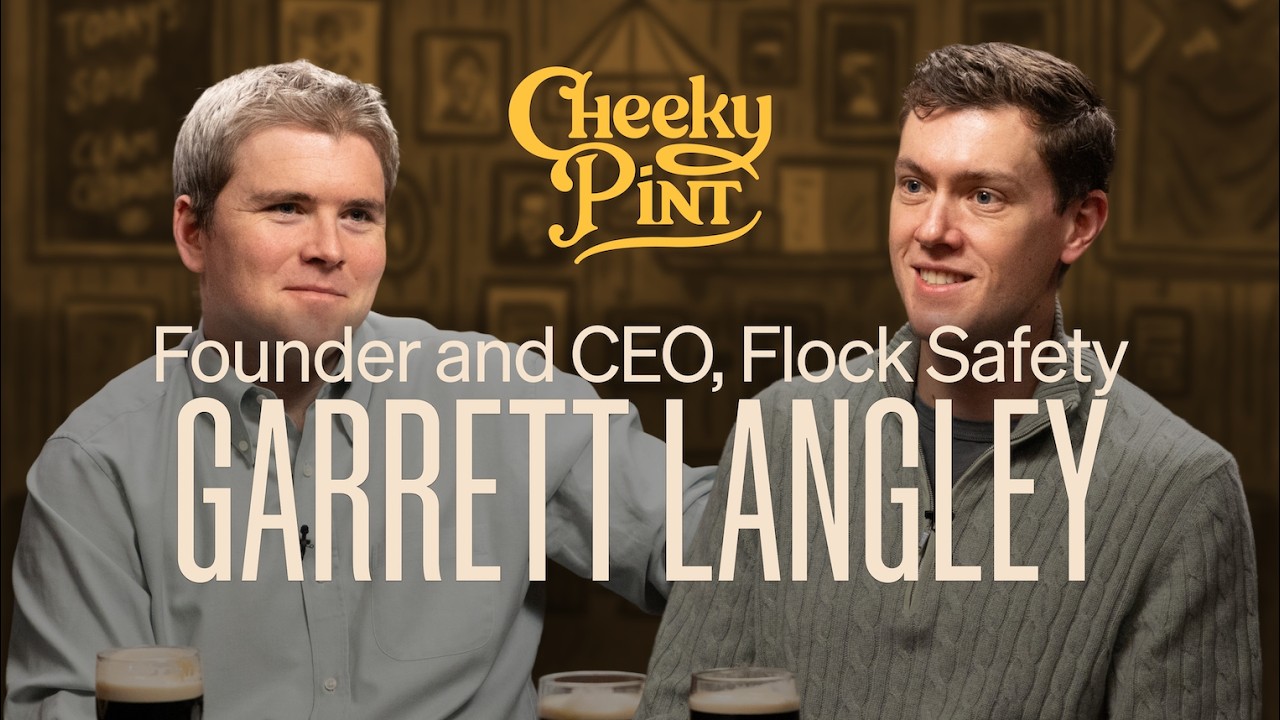
Flock Safety is a company that builds technology to help solve crime, starting with license plate-reading cameras and expanding into drones, AI-powered investigation tools, and a software platform that integrates citywide camera networks. Founded in 2017 by Garrett Langley after a firearm was stolen from a car in his Atlanta neighborhood and police had no leads, Flock grew from a neighborhood project into a $500M ARR business covering over 50% of the US population across 6,000+ cities. The company’s core insight was that most security systems focus on individual properties, but safety is a community-level problem that requires shared data across neighborhoods and agencies.
How Flock works
The original product was a solar-powered, 5G-connected camera that reads license plates on public roads, designed to work without existing infrastructure like fiber or power
The engineering challenge was running computer vision on solar power, which ruled out GPUs, so the team had to optimize edge processing carefully
Cameras are installed on Flock’s own poles, requiring permits, trenching, and concrete—the company pulled 77 permits per day last year and may be the largest general contractor in America
The only moving part is an IR-cut filter that switches between day and night modes, which wears out after a few hundred thousand cycles
The system maintains “hot lists” of stolen vehicles and wanted persons, integrating directly with the FBI’s NCIC database and local law enforcement lists
When a car is reported stolen locally, it appears on Flock’s system immediately, but takes up to 24 hours to propagate to the national FBI database via CSV files sent over FTP servers
Flock makes this real-time, which matters because a stolen car can travel far in 24 hours
The platform now includes FlockOS, which integrates cameras from any manufacturer across a city, and FreeForm, a search tool that lets operators query footage using natural language descriptions like “white Converse sneakers”
A recent example: a 911 call reported someone bleeding on the street, with the only clue being the suspect wore white Converse. The operator searched nearby cameras, found the individual, pushed video to the nearest officer, and made an arrest in about 17 minutes—a case that likely would have gone cold otherwise
Flock also builds drones that launch automatically from docking stations in response to 911 calls, reaching scenes in under 70 seconds compared to a 7.5-minute average police response time
Drones fly at 400 feet, making them inaudible and invisible to suspects, enabling safe tactical apprehensions
Primary use cases: ending dangerous high-speed vehicle pursuits, responding to 911 calls (many of which turn out to need no officer), and search-and-rescue with thermal cameras
A city like San Francisco needs roughly 12 drones to cover the entire area, since each can cover a 30-square-mile radius
Drones default to pointing cameras at the horizon during transit to avoid privacy concerns, and are only dispatched based on specific triggers like 911 calls or gunshot detection, not flown continuously
The US law enforcement landscape
America is unusual in having highly localized law enforcement—about 17,000 cities, each with their own police force—unlike most countries that have a single national force
This creates coordination problems: criminals cross city and state lines freely, but agencies historically shared information only by phone and fax
Cloud storage for law enforcement data was illegal in Florida until 2022 and Maryland until 2023
Flock’s platform enables cross-agency collaboration, like a human trafficking bust that led to 76 arrests across four states, coordinated through the system
Law enforcement is chronically understaffed, with some departments at 40% staffing levels, making force multiplication through technology essential
There’s a tension between local trust in police and distrust of federal agencies, leading some states like California to legislate restrictions on law enforcement collaboration with federal authorities
Flock has to navigate this by sitting in the middle, enabling collaboration where legally permitted and respecting restrictions where they exist
Crime trends and technology
Crime surged dramatically during COVID, with homicides increasing 3-4x in many cities, driven largely by young males (16-22) escalating social media disputes into violence
The violence was heavily linked to online behavior: Instagram disputes leading to shootings, a subculture that recruits through lifestyle content on TikTok, Instagram, and Snapchat
Crime has since dropped back toward pre-COVID levels in most cities, though major cities still have significant problems
The most impactful technology for solving crime has been cell phone data (CDRs—cell data records), which triangulate location from tower connections
Criminals almost always carry their phones; Flock solved a case where a killer left their phone at home but was caught because their car was tracked on Flock cameras from LA to San Francisco and back
Drones are now a major asymmetric threat: criminal groups use them to case homes (flying with night vision to check if anyone’s home), smuggle contraband into prisons (payloads of 10-30 lbs carrying phones, drugs, guns), and operate with impunity because law enforcement is legally prohibited from shooting them down
South American cartels fly illegal drones through affluent Virginia neighborhoods to scope out homes for burglary
Law enforcement has only recently been allowed to fly beyond visual line of sight, while criminals have been doing it for years
Body cameras, initially pushed by police skeptics, have largely exonerated officers in most cases where foul play was alleged, revealing that many incidents involve mental health issues rather than misconduct
Flock’s cameras similarly provide objective data, shifting policing from targeting “dangerous neighborhoods” to focusing on specific stolen vehicles and crimes in real time, which has improved community relations in cities like Oakland
The corporate business
Flock’s corporate segment generates over $100M ARR and is the company’s fastest-growing business, focused on retail, healthcare, and logistics companies with large physical footprints
The focus has shifted from asset protection to employee safety over the past three years
When an employee is terminated, they can be automatically added to a localized hot list so security is notified if they return to campus
Executive protection uses vehicle tracking to flag when a vehicle visits both a CEO’s home and corporate headquarters on the same day, suggesting the executive’s identity may be compromised
A notable case involved criminals stealing multi-million dollar robotic surgical arms from hospitals by showing up in fake uniforms and convincing clinical staff they were repair technicians
Flock connected the healthcare provider with federal authorities since the equipment was being exported internationally
Organized retail crime has shifted from storefronts (CVS locking up products, In-N-Out leaving Oakland) to distribution facilities, where loads are larger and the crime is more sophisticated
One Eastern European group bought a legitimate freight broker company, won bids with low prices, loaded trucks with product, drove away, and dissolved the company—stealing $7 million in a single day
Liability is complicated because insurance coverage depends on where in the delivery chain the theft occurs
Privacy and civil liberties
Flock operates on public roads where there is no constitutional expectation of privacy for license plates, but the company acknowledges the controversy around physical-world surveillance being more visible than digital tracking
Langley argues that people already allow extensive location tracking through phone apps and data brokers, but accept it because it’s invisible
Every action in Flock’s system is audited and stored in perpetuity, with audit logs publicly available
The company advocates for data retention limits (7 days for live video, 30 days for license plate data) to prevent abuse while preserving investigative value
Flock does not do facial recognition, partly because it’s politically controversial and banned in thousands of US cities
Langley argues for a nuanced approach: facial recognition and other advanced tools should be permitted for serious crimes like homicides and crimes against children, but not for minor offenses like shoplifting
The company has a full team of constitutional attorneys who review new products before launch to ensure they comply with the Fourth Amendment
For drones, this means not flying them continuously (which was ruled an unconstitutional search in the Baltimore Carpenter case) and defaulting camera orientation to the horizon during transit
Competitive landscape
Flock competes primarily with Motorola Solutions ($90B market cap, 120 years old, dominates land mobile radio with 80% global market share) and Axon ($40B market cap, started as Taser, now does body cameras, dash cameras, and software)
Every city is a competitive battleground against both companies
Motorola’s radio contracts are enormous—San Francisco County’s contract is worth $200M—and Langley sees an opportunity since the radios are over-engineered for rare disaster scenarios
Axon entered the license plate reader market as a direct competitor to Flock
The market has attracted many VC-backed competitors, but Langley believes consolidation is inevitable because the buyer universe is finite (a finite number of cities and police departments)
Motorola has done 40 acquisitions in two years, Axon did five last year, and Flock did one
Flock’s hardware business required massive upfront capital expenditure (the “J-curve”), and the company expanded too quickly into too many products and customer segments
The core camera business is now profitable and generating hundreds of millions in operating cash flow, but newer products (drones, people-focused cameras, trailers) are at the early, cash-burning stage
The company has paused new hardware product development to focus on scaling existing lines
Hardware and supply chain lessons
Hardware forecasting must be done 12-18 months in advance and at the geographic level, not just product level, because installation requires local permitting and labor
The company once wildly overproduced and had warehouses full of unsold product
Every hardware design decision is a “one-way door” costing millions of dollars and locking in the design for 5-10 years, unlike software where changes are reversible
Supply chain risk is a full-time team’s job: a capacitor that goes up 4x in price because Apple chose it for a future iPhone can force a complete redesign
The company risk-purchases the cheapest, highest-risk components early and designs products with multiple substitute parts for critical components
Even non-cutting-edge components like capacitors and memory are affected by AI data center buildouts and consumer electronics demand
Field operations are the largest cost: a third of the company digs holes, drives bucket trucks, and maintains equipment, with driving being the biggest expense in repairs
The company uses predictive maintenance, replacing parts proactively when nearby rather than waiting for failures
International expansion
Flock is mostly focused on the domestic US market, which Langley believes can support $5-15B in revenue
International expansion is complicated by hardware localization, government nuance, and competition from subsidized Chinese manufacturers like Hikvision
In a major Mexican government deal, Flock lost to Hikvision despite offering better technology and data sovereignty (domestic data storage) because Hikvision’s price was roughly 10x lower, likely subsidized by the Chinese government
This mirrors China’s strategy in Africa, where they built 5G infrastructure at low cost with 100-year bonds, effectively giving the Chinese government access to those countries’ data
Even in NATO countries and Australia, Chinese-manufactured cameras dominate because of low prices
What’s next
Flock’s long-term goal is not just solving crime but preventing it, because every arrest represents a failure—a victim, a person entering a broken prison system, and enormous societal cost
The company launched the Thriving Cities Fund, investing in local businesses (restaurants, nail salons) in cities that adopt Flock’s platform, creating jobs for 16-year-olds who might otherwise turn to crime
The fund generated 21% IRR last year, and Langley wants to deploy hundreds of millions to billions of dollars this way
Langley is exploring products or programs that give non-violent, opportunistic criminals a second chance without prison, since incarceration almost guarantees they’ll become violent and reoffend
He hasn’t figured out what this looks like yet—it might not be software—but sees it as essential for a for-profit company that genuinely wants to reduce crime and prison populations
The vision is to expand Flock’s role from the middle of the crime timeline (detection and investigation) to both ends: prevention before crime happens, and rehabilitation after