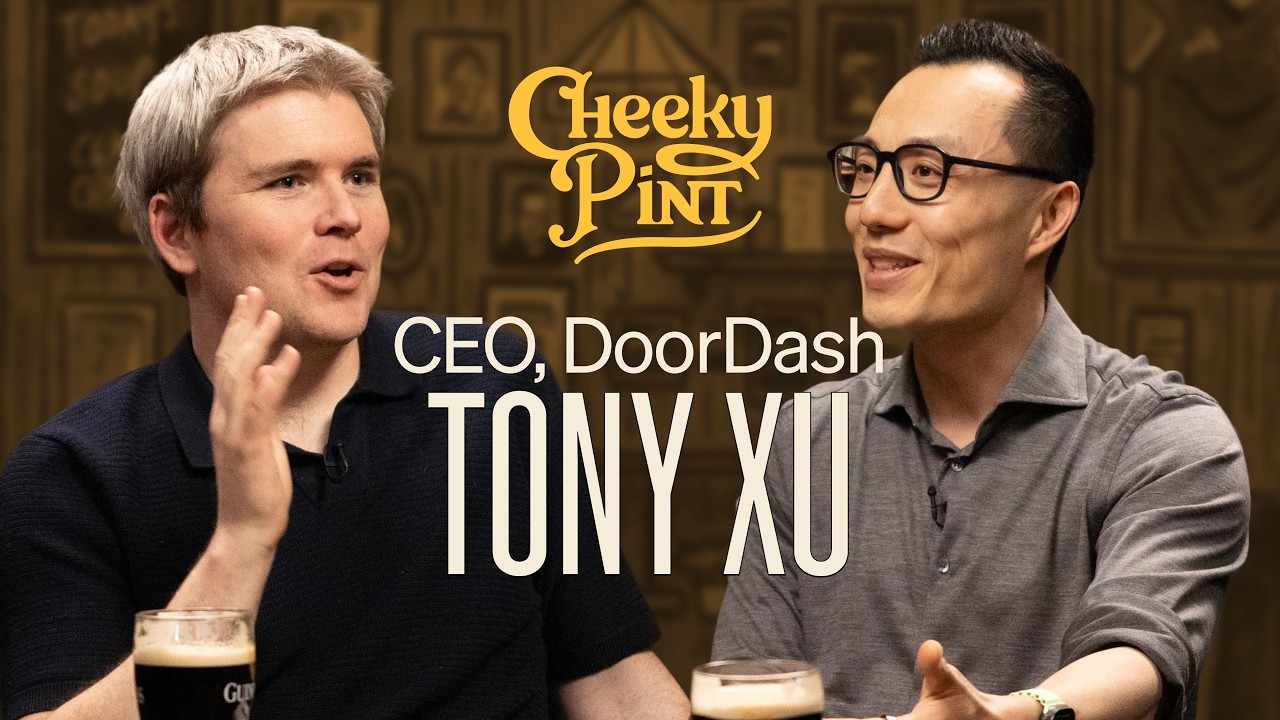
Tony Xu, co-founder and CEO of DoorDash, discusses the company’s journey from a Stanford side project in 2013 to America’s dominant food delivery platform, and shares his views on the restaurant industry, delivery technology, and the future of commerce.
DoorDash now serves over 100 million annual customers, has expanded into grocery, retail, and financial products for gig workers, and recently acquired Deliveroo for European expansion and SevenRooms for restaurant CRM and reservations.
Xu’s central thesis across the conversation is that winning in delivery and restaurants comes down to retention and reliability — getting the multivariate product experience right (restaurant selection, delivery speed, cost, quality, customer service) so that customers return organically, even without discounts.
Why DoorDash won the delivery wars
Food delivery is a multivariate challenge: customers judge on restaurant selection, delivery speed, food quality, cost, and error recovery — all simultaneously.
DoorDash’s early advantage was building systems to measure and optimize across all these dimensions, then proving higher retention and frequency of use than competitors.
A key constraint became a strength: between 2016–2018, DoorDash had very limited funding relative to peers, forcing the team to grow organically through product quality rather than marketing spend.
Once they demonstrated superior retention, they raised capital and aggressively acquired customers, leveraging an unfair advantage.
Customer obsession as demonstrated through actions, not slogans:
In 2013, with less than two weeks of cash runway after a Stanford football game where every order was late, DoorDash refunded all customers — costing over 40% of the bank account — and delivered cookies at 5 AM the next morning.
During COVID, DoorDash was the only platform to cut commissions by 50% (over $100 million in cost) when not yet profitable, and spent millions on national TV campaigns urging people to order from restaurants (which average only 17 days of cash on hand).
The company offers Dashers fuel savings of $1.40–$1.90 per gallon during periods of high gas prices.
Why food delivery is bigger in China than the US
Eating out is as affordable as cooking at home in China, due to retail and grocery market dynamics — so almost nobody cooks.
Lower labor costs and mass labor availability make delivery nearly as cheap as picking up food yourself.
Extreme urban density: China has dozens of cities with populations over million and density exceeding Manhattan, making delivery logistics far more efficient.
Deep commercialism: China has over 7 million restaurants (vs. ~1 million in the US), and restaurants aggressively diversify into merchandise, cookbooks, and other revenue streams.
Rising incomes have spread consumer spending beyond the Eastern Seaboard to cities across China, expanding the addressable market.
Restaurant industry trends
Staffing is the perennial #1 challenge — labor costs only rise, pushing restaurants toward the extremes of the service-to-manufacturing spectrum rather than trying to do both dine-in and takeout equally.
Restaurant count keeps growing despite difficulty: in the US, the number of restaurants has increased in nearly every year over the past 60 years. Consumers’ appetite for restaurants is insatiable.
Scaling is extremely hard: even popular, well-known restaurants struggle to open location two due to difficulty raising capital and obtaining permits.
Permitting has gotten worse on average in the US, though fast-growing southern cities like Phoenix, Austin, and Dallas are exceptions where construction-friendly regulation correlates with restaurant growth.
Consumer spending has flipped: in the 1950s, Americans spent ~75–80 cents of every food dollar on groceries; today it’s roughly 60 cents on restaurants/takeout and 40 cents on groceries.
Ghost kitchens have remained relatively small because:
Small restaurants can’t attract enough delivery-only customers to justify the staffing costs.
Large brands face high opportunity cost — they’d rather open another full restaurant that serves both in-store and to-go orders than a delivery-only kitchen.
Restaurant IP and why chains are hard to replicate
Large QSR brands (McDonald’s, Chick-fil-A) possess deep process innovation IP: consistent quality across thousands of locations, custom equipment, service training, and staff retention.
Chick-fil-A employees often stay for 20–30 years, and the company has a hospitality training checklist that includes floors clean enough for a baby to lick.
Chick-fil-A is among the highest-grossing fast-casual restaurants per square foot, driven by extremely high customer retention, low acquisition costs, and operational efficiency.
Long-lived small restaurants have IP rooted in committed teams with a standard of excellence — similar to what makes startups special.
Scaling quality is exponentially harder than it appears: one test of a healthy-tasting burger brand generated split reviews (“great” vs. “inconsistent”), illustrating how difficult it is to maintain quality, service, production, pricing, and packaging simultaneously at scale.
This is why there’s no “Chipotle of Neapolitan pizza” or Indian food — the difficulty of keeping taste, temperature, and speed consistent grows exponentially with group size.
Technology’s impact on restaurants
Delivery dramatically improves margins: a restaurant nets ~10 cents per dollar on dine-in but 3–5x that on takeaway orders, since food/packaging costs are similar but the same labor and rent serve both.
Customer relationship management is still incomplete: restaurants lack unified visibility across online and in-store orders, and staff turnover (averaging every other day) destroys institutional knowledge of regulars.
Building a “regulars” concept — retained customers who are recognized and prioritized — is the key to great consumer business but remains unsolved for most restaurants.
DoorDash is working on this by combining its dataset with SevenRooms’ in-store booking data to give restaurants a 360-degree view of guests.
Loyalty and the regulars problem
Airlines have created irrational lock-in through loyalty programs; restaurants have not achieved anything comparable.
The challenge is frequency and variety: people eat 20–25 times per week across many different restaurants, unlike coffee (daily same shop) or travel (infrequent same airline).
Even someone’s favorite cuisine might only be eaten once a month.
DoorDash sees an opportunity to use its platform data (tens of millions of monthly customers, various visit frequencies) to help restaurants identify and reward regulars across the full spectrum of their dining behavior.
Delivery modalities and the future of fulfillment
Before discussing vehicles, the catalog problem must be solved: tens of millions of items in every city are not cataloged or structured. Knowing what’s available, where, and when it will be ready is a prerequisite to any delivery technology.
Great logistics requires systems and setup, not heroics.
Created because existing sidewalk robots were too slow and no suitable partner emerged. DoorDash explored partnerships but found everyone focused on robotaxis.
About one-tenth the size of a car, travels up to 20 mph, operates on roads, bike lanes, and sidewalks — the only vehicle in the world that does all three.
Features modular, configurable compartments (heating/cooling capable), a custom sensor stack, on-device compute, and an LED screen for human interaction.
Currently testing in Arizona. Can do hundreds of hundreds of deliveries per charge.
Designed for suburban environments (deliveries under 5 miles, parking challenges) and certain dense urban areas.
Includes an “autonomous development platform” — the routing algorithm that decides which orders go to Dot vs. humans, including mixed routes where Dot handles one leg and hands off to a Dasher.
Drones are better suited for longer-distance orders. DoorDash has been running drone deliveries outside the US (e.g., Australia) and plans to expand to Europe and the US.
Trust, safety, and fraud
DoorDash processes billions of orders per year, making one-in-a-million incidents a statistical certainty.
Online fraud (stolen credit cards) is now well-handled through large transaction databases and partnerships with Stripe Radar.
Offline fraud (“friendly fraud”) is much harder: customers claiming orders never arrived, Dashers claiming items were already picked up when they weren’t. These have physical components that are difficult to verify.
Countermeasures include: Dasher GPS tracking, DoorDash’s own mapping system (built to track the final feet to an apartment door), delivery photo requirements, and customer behavior profiling.
Safety systems beyond fraud:
SafeChat: monitors in-app messages and flags verbal altercations, which precede 90%+ of physical confrontations.
Real-time alert system for active threats (e.g., shootings) that notifies all nearby Dashers, consumers, merchants, and local law enforcement — in one Manhattan incident, DoorDash was the first to report to NYPD.
New products and missions
DoorDash Tasks: a platform for small real-world tasks (e.g., checking in-store inventory, product placement audits). Started as an internal project to map where items are located in cities using Dashers, then expanded to serve retailers and CPG companies. Also helps Dashers earn more.
Going Out and Reservations: DoorDash is entering the reservations space, starting with restaurants, using SevenRooms’ infrastructure.
Xu believes no restaurant should have to own their own reservation technology — it should be platform-agnostic and optimized for the restaurant’s objective function (profit growth, new locations, customer type).
Discovery is a major unsolved problem: people find restaurants through Instagram, LLMs, friends, and other fragmented sources. Most restaurants still struggle to generate their own demand.
On no-shows: Xu agrees with Tock’s deposit philosophy in principle, but notes implementation depends on the restaurant’s capacity constraints — high-end restaurants with limited seating benefit more than high-volume ones.
B2B software mission: DoorDash wants to help businesses build their own omni-channel presence through products like DoorDash Drive, Storefront, and SevenRooms — not just send them customers.
European expansion and Deliveroo acquisition
DoorDash and Deliveroo are fundamentally similar businesses; the acquisition extends DoorDash’s model internationally.
Key differences in European markets:
Logistics: Cities like London lack grid-like layouts, are older, and are not designed for vehicles. Non-auto transport dominates in central London.
Regulation: Each country (and sometimes city) has its own regulatory framework, even within the EU.
Payments: More card types and greater payment complexity than the US.
Retail concentration: European retail is more concentrated (fewer, larger players per category) compared to the fragmented US market. This affects inventory management, SKU counts, and store sizes.
Higher service standards: Concentrated retail categories (pharmacies, apparel) tend to have more consistent, higher-quality service — Xu contrasts Boots (UK) with CVS/Walgreens (US), and notes prepared meals are far better and more prevalent in UK grocery stores.
Stablecoins, AI, and the future of commerce interfaces
Stablecoins are most compelling for two use cases:
Cross-border payments to 100+ countries, where stablecoins already outperform traditional methods.
Scalable crypto payments for agents and API consumption — the motivation behind Stripe’s Tempo blockchain initiative.
AI-driven commerce: Xu agrees that natural language ordering (“order what we got on Sunday”) is the direction, but emphasizes that the interface question is open — text chat may not be the right modality for all purchases.
The cautionary tale: Google Food Ordering (2015–16) drove lots of traffic from Google Search/Maps but couldn’t retain customers because it couldn’t solve post-checkout problems (driver communication, delays, out-of-stock items).
The lesson: regardless of surface (DoorDash app, AI assistant, third-party platform), the provider must solve the end-to-end job or retention will fail.
Personal notes
Xu’s favorite food is Taiwanese cuisine, eaten once a month or every two months.
He misses tea sandwiches, prepared meals, cookies, and tea variety from the UK/Ireland — all of which he finds superior to US equivalents.
One of the privileges of running DoorDash, he says, is interfacing with passionate business owners in every city and learning about the unique IP and craft behind each one.