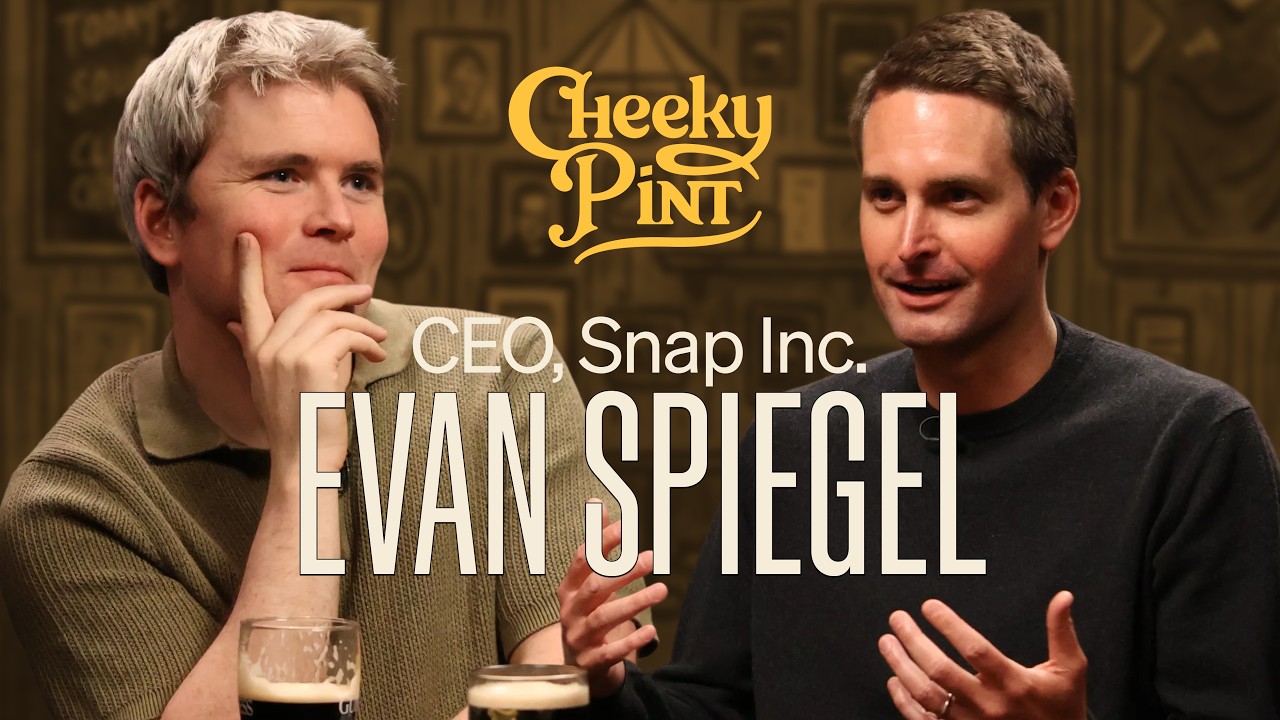
Snap is entering what CEO Evan Spiegel calls a “crucible moment” in 2026, simultaneously approaching a billion monthly active users, nearing net income profitability, preparing to ship its Specs AR glasses to consumers for the first time after 12 years of development, and transforming its entire business with AI.
Specs: Snap’s AR Glasses
The vision and why glasses: Spiegel believes computing has been isolating for decades — pulling people into screens rather than bringing them into the world. Specs aim to deliver the capability of a high-end spatial computer like Apple Vision Pro in a see-through glasses form factor, enabling shared real-world experiences like playing chess across a table, building Lego together, or watching content side by side.
Technical challenges: Fitting a full computer into a pair of glasses requires solving extraordinary miniaturization, power, and thermal problems. Snap owns every layer of the stack — developer tools (Lens Studio), rendering engine (Lens Core, honed over a decade on low-end phones), a custom Linux-based operating system (built from the ground up because Android is too bloated), and its own optical engine including the waveguide and projector.
What moves to glasses first: Large-screen use cases — TV, desktop display, laptop — are the earliest candidates, since glasses can provide any size screen anywhere. But Spiegel is more excited about net-new experiences that didn’t exist before, like playing laser tag with kids or placing dinosaurs in the backyard.
The smartphone’s role: Spiegel doesn’t think we’ll move beyond the smartphone entirely. Instead, the phone becomes a legacy device while glasses handle screen-based use cases and new spatial experiences. He also envisions a future where AI agents do most computing work and people simply monitor their progress through glasses.
VR vs. AR: Spiegel is skeptical that fully immersive VR (like Vision Pro) will be widely adopted long-term because humans are fundamentally social and don’t want to be shut off from the world. He sees pass-through VR as a poor fit for how people actually want to interact. Glasses that let you see the real world and each other will win.
Adoption ramp: Specs will launch to consumers later in 2026, initially appealing to early adopters — the kind of passionate technology enthusiasts who bought the original $8,000 Macintosh. They won’t be that expensive, but the early audience will be evangelists who build Lenses and show friends.
Why camera glasses failed: Snap learned the hard way that camera-only glasses (like early Spectacles) weren’t 10x better than the next best alternative — the phone. They also lacked an operating system, couldn’t understand the world, and couldn’t run applications, making them easy to undercut on price with no platform moat.
AI Transforming Snap’s Business
Code generation: More than two-thirds of new code at Snap is now written by AI. The rate of improvement in coding models has been extraordinary.
Lens Studio going agentic: The developer tools for building AR experiences are becoming increasingly agentic, enabling anyone to build almost anything and see it in the real world incredibly quickly. This overcomes the traditional App Store lock-in moat that has protected incumbents.
Bespoke software era: Spiegel believes the “killer app” concept is becoming a mirage. Because software is so easy to build now, the future is bespoke — people will build custom tools for their own needs and share them. This is a fundamental paradigm shift from one-size-fits-all software.
Core Business: Messaging, Camera, and Monetization
Competitors: Snap primarily competes with other messaging services, and secondarily with other cameras — when a moment happens, do you capture it with the Snap camera or your lockscreen camera? Over a trillion selfies were captured on Snapchat in a single year.
Revenue streams: Two major sources — advertising (including Promoted Places for driving retail foot traffic, with closed-loop measurement) and direct revenue (Snapchat+ subscription, now at 25 million subscribers and over $1 billion annual run rate).
Snapchat+ and AI costs: The subscription gives access to AI editing tools and bespoke features. As Lenses become more computationally expensive, direct revenue becomes a more natural way to monetize heavy AI usage.
Product ideas from the community: Spiegel’s email is public ([email protected]), and he receives constant feedback. The Snapchat+ model lets the team build features that passionate users specifically request, which they couldn’t justify building for the whole user base.
Snapchat’s Design Philosophy
Close friends, not big networks: Snapchat proved that the value of a messaging service isn’t about the total network size — it’s about who you actually talk to, which is typically a very small group. Most daily conversations are with a spouse, close friends, or immediate coworkers. This broke the social media model where more friends meant more engagement.
Separating social from media: Spiegel argues the biggest mistake in social media was combining friend communication with public content in a single feed. This created perverse incentives to add more friends for content, which eventually made people uncomfortable posting. Snapchat separated these: messaging with close friends, plus moderated publisher/creator content through Discover.
Ephemerality: The vast majority of life is ephemeral, and Spiegel believes technology will mirror this — most communication disappears, and people save what’s important. Most messaging platforms now offer retention settings that delete conversations by default.
Anti-network effects: Social networks can have diseconomies of scale. As Facebook and Instagram grew, people added friends until they didn’t know who was seeing their content, which inhibited posting and accelerated the shift to public content over friend content. Snapchat avoids this by being private — no public comments on stories.
Content moderation: Snap has moderated all public content since launching Discover, initially with humans and now with AI. Spiegel argues the focus should be on content-level moderation (e.g., anorexic content violates guidelines and shouldn’t appear) rather than just algorithmic tweaking, though First Amendment concerns make this harder in the US.
Kids, Teens, and Screen Time
No blanket policy: Spiegel believes every child is developmentally different and parents should make individual decisions. His own 15-year-old got a phone early because of co-parenting logistics. The key is cultivating healthy balance.
Concern about AI adoption: Spiegel is more worried that young people won’t learn to use AI tools than that they’ll use screens too much. In a time of dramatic AI change, it’s imperative that young people adopt these tools.
Australia’s under-16 ban: Spiegel criticizes the ban as poorly implemented — it only covers a handful of apps, doesn’t operate at the OS level, and doesn’t account for kids without government IDs. Parents already have robust controls through Apple’s OS-level settings, which is a more resilient approach.
Snapchat’s mental health impact: Independent studies (from Australia, the Netherlands, and the US) have found Snapchat is associated with positive well-being and relationships, unlike TikTok or Instagram which show negative associations. Spiegel attributes this to Snapchat being built around real friendships, which is the number one predictor of positive mental health.
Distribution and Running the Business
Distribution is king: As AI makes it easier to build software, distribution becomes even more valuable. Snap’s billion-user platform is a major advantage for launching new services — where previously they couldn’t spare 15 people for a new app, now half a person can build and distribute something through Snapchat in a day.
Product development process: Spiegel spends a couple of hours a week with the design team reviewing hundreds of ideas at various stages — sketches, whiteboard concepts, working prototypes. Designers are increasingly shipping code directly. Selection involves open debate with no formal filter process. Some ideas get shelved and revisited years later.
Culture: Snap’s culture is a managed dialogue between design, engineering, product management, and data science — not dominated by any single function. This mirrors the founding partnership between Spiegel (design-leaning) and Bobby Murphy (engineering-leaning).
Streaks story: Spiegel initially hated Streaks and fought to kill them for years because Snap is anti-metric (almost no user-facing numbers). He changed his mind after hearing from users who maintained Streaks through major life changes — moving across the world, divorce, new jobs — as a daily connection with their closest friend. It’s the digital equivalent of getting out of the house.
Norway and Hardware Supply Chain
Norway was first: Snapchat’s first traction anywhere was in Norway, not the US. The hypothesis is that Norway had both high-end device penetration (iPhones) and affordable, high-quality internet connectivity — both essential for a photo/video-heavy app in 2012. Norway remains a Snapchat leader 15 years later, which Spiegel attributes to the culture’s prioritization of close family and friend relationships.
Hardware supply chain: Snap builds its most IP-sensitive and sophisticated components (like waveguides) in the US and UK, in-house, sitting directly next to R&D. This enables fast iteration cycles and has allowed them to lead on display technology. Hardware is also easier to protect with patents compared to software in the age of AI.