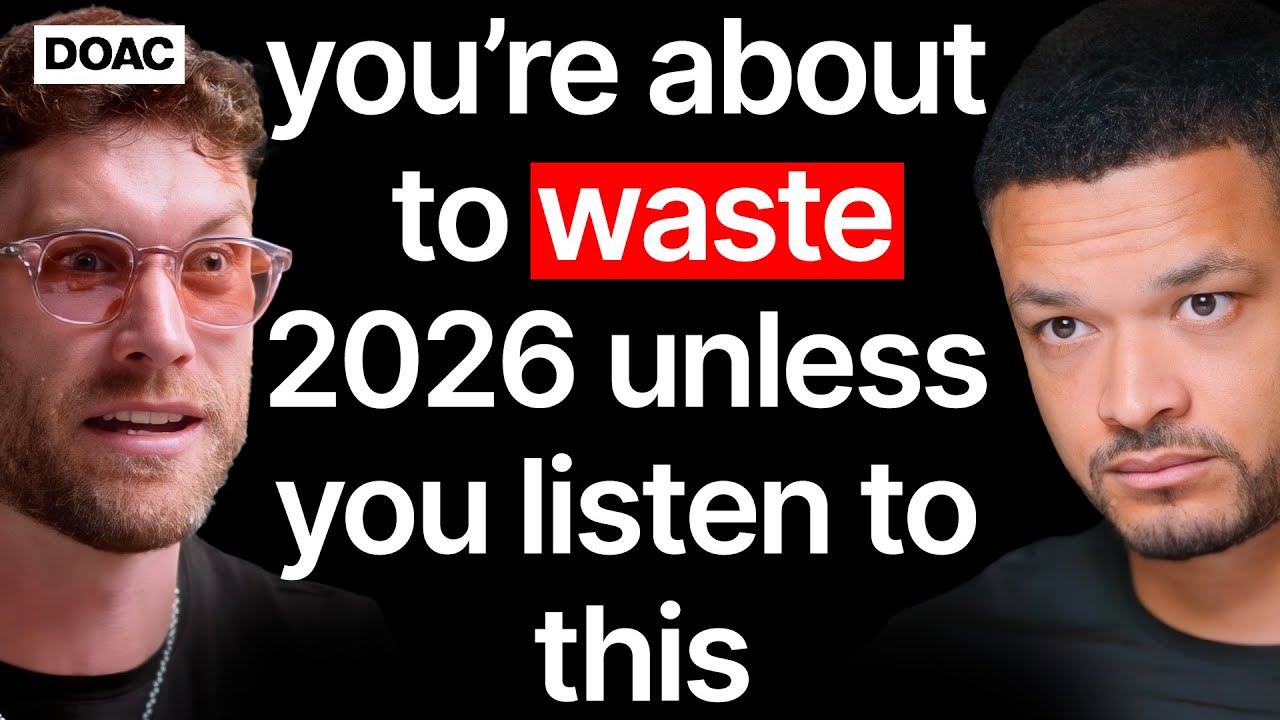
Chris Williamson joins to discuss how to make 2026 your best year by choosing the right goals, understanding why most resolutions fail, and confronting the deeper emotional patterns that hold people back. He draws on lessons from his own life, his podcast interviews, and behavioral science to offer a framework for meaningful change — one that balances ambition with self-compassion, subtraction with addition, and striving with presence.
Why Most New Year’s Resolutions Fail — and Why This Time of Year Still Matters
9% of people keep their New Year’s resolution for the full year; 23% quit by the end of the first week, and roughly half quit by the end of January.
There are two camps: those who say there’s no difference between January 1st and any other day, and those who value a culturally appropriate moment to pause and reflect.
Most people already spend enormous time ruminating about the past and worrying about the future — but in an unstructured, involuntary way.
The period between Christmas and New Year is a natural downtime when life slows, making it a useful scheduled opportunity to do structured reflection and planning.
The real question isn’t whether the date is magic — it’s whether you’re going to carve out time to reflect at all. If not now, when?
How to Choose the Right Goal
The single best question to determine your goal: “What would have to happen by the end of 2026 for me to look back and consider it a success?” This usually narrows down to only a few things.
You can become anything behaviorally, but not everything. The key constraint is that in order to pick something up, you have to put something down.
Setting the bar unrealistically high does not increase performance. Your workload capacity doesn’t expand just because you pile more onto your plate.
Assume you can do no more than you’re doing now. You can swap activities, but you can’t simply add more. This forces honest tradeoffs.
Most goals at this time of year ask for more time or energy (start running, go to the gym) without considering what gets subtracted (less Netflix, less phone time, less socializing).
Two powerful diagnostic questions:
“How would I spend my day if I wanted to make 85-year-old me as miserable as possible?” — then ask how much of that you’re already doing.
“If my life was a movie and the audience were watching, what would they be screaming at the screen?” — the answer is usually obvious (leave the relationship, quit the job, speak up).
The Deferred Life Trap
Many people live under the deferred life hypothesis: the belief that life hasn’t truly begun yet, that the current phase is just a prelude to the “real” life that starts once certain conditions are met.
In reality, this prelude is the whole thing. People run toward a horizon that keeps receding, effectively running toward the end of their life.
“I will be enough when…” is the underlying thought pattern — when I lose the weight, when I get the promotion, when I find the partner. This creates a provisional life where happiness is always on the other side of the next achievement.
Problems are a feature of life, not a bug. There will never be a time when there are no problems. Waiting for problems to disappear before living fully is a recipe for never living at all.
Less striving would likely increase happiness, but this is an “unteachable lesson” — most people have to achieve the thing and discover it didn’t fix the internal void before they believe it.
The Region Beta Paradox and the Parable of the Mexican Fisherman
Region Beta Paradox: If you’d walk a mile but drive two miles, you’d paradoxically cover the two miles faster. This means worse situations can be better than mediocre ones because they galvanize action. People stuck in “comfortable complacency” — a job that’s fine, a relationship that’s meh, an apartment that’s okay — often stay stuck indefinitely because things aren’t bad enough to force change.
The Parable of the Mexican Fisherman: An American businessman tells a fisherman to scale up — get a bigger boat, build a factory, export globally — so that he can eventually retire and do exactly what he’s already doing: fishing in the morning and spending afternoons with family. The lesson: you can spend your whole life climbing a ladder only to realize it was leaning against the wrong wall.
Both concepts warn against sacrificing hidden metrics of success (peace of mind, time with family, health) for observable ones (salary, title, status).
Hidden vs. Observable Metrics of Success
Observable metrics are what others can see: job title, salary, bank balance, house size, car, fame.
Hidden metrics are what actually determine quality of life: peace of mind, time with family, health, ability to be present, quality of sleep.
People routinely trade hidden metrics for observable ones — taking a longer commute for a higher salary, or a more stressful job for a better title — without realizing the hidden cost.
Commute length is one of the most correlated statistics with happiness. Longer commutes reliably make people more miserable, yet people accept them for observable gains.
The Highest-ROI Habits and Resolutions
No phone in the bedroom at night — charge it outside. This single change is described as an instant 15% quality of life increase. It improves sleep, eliminates the dopamine scroll trap before bed, creates a peaceful morning routine, and forces slightly more productive use of time.
Morning walk (even 5–10 minutes) — even without sunlight, walking while your eyes scan left and right calms the amygdala and reduces the fear response. Morning sunlight amplifies the benefit.
No caffeine within 90 minutes of waking — your adrenal system dominates the first 90 minutes; adenosine (which caffeine blocks) isn’t the main driver yet. Pushing caffeine later can eliminate the mid-afternoon slump.
No alcohol for 6 months — alcohol’s hidden domino effect ruins sleep, which ruins eating, which ruins training, which ruins cognition. Many people don’t realize alcohol is the thing preventing them from building other good habits. The 6-month timeframe gives a finish line, which makes the challenge psychologically manageable.
10-minute walk after every meal — regulates glucose, aids digestion through contralateral movement, and reliably makes people feel significantly better.
Consistency over perfection in the gym — Chris’s 2017 resolution was “go to the gym every day,” which failed because one missed day ended the streak. In 2018, he changed it to “consistency in the gym” with the rule: never miss two days in a row. One miss is an error; two misses is the start of a new (bad) habit.
“You never crack it” — the most important mindset for consistency is realizing you never permanently solve a habit. You will fall off. Having a pre-planned strategy for getting back on is what matters.
Productivity Dysmorphia
Productivity dysmorphia is the inability to see or acknowledge your own output. It sits at the intersection of burnout, impostor syndrome, and anxiety.
Many high achievers wake up every day feeling behind — as if they’re in “productivity debt” and only a perfect day can drag them back to zero. They never feel like they win.
The inner drill sergeant says: “You can rest now, but tomorrow it starts again.”
Most people in the self-improvement space are not the ones who need David Goggins screaming at them — they’re the ones who need permission to slow down.
Best productivity question: “If I could only achieve one thing today, what would it be?” It’s usually the big, scary thing — the one you’ve been avoiding by doing everything else.
The Two Main Causes of Procrastination
You don’t know what to do — the next physical action is undefined. Solution: break the task into absurdly small steps (put pants on → sit at desk → open email client → write one sentence). Borrow from David Allen’s “Getting Things Done” methodology.
You know what to do but don’t know how — this is a skill issue, not a motivation issue. Solution: Google it, ask ChatGPT, call a friend who knows Excel. It’s fixable.
A third, deeper cause: fear of what you’ll find out about yourself if you try. Never trying protects you from the pain of failure. Cynicism (“nothing will get better”) is often just fatalism dressed up as pragmatism.
The Lonely Chapter
The lonely chapter is the period where you’ve outgrown your old friend group but haven’t yet built a new one. You’ve changed your dialect so much that you no longer speak the same language.
This happens when you stop drinking, start going the gym, begin meditate, or pursue any growth that your current circle doesn’t share.
It’s not a value judgment — it’s a structural reality of personal growth. Your old patterns bring validation; your new ones bring uncertainty.
Every hero’s journey in movies shows unwavering conviction after the commitment is made. In reality, the entire journey is steeped in doubt, self-pity, and uncertainty. No one promises glory on the other side.
Resisting equilibrium is work. Jeff Bezos’s final shareholder letter quoted Richard Dawkins: living things must constantly work to maintain their differentiation from their environment. The moment you stop, you revert to the mean. This is why change requires energy budgeting — you must save energy elsewhere to fuel the effort of staying atypical.
What to Look for in a Partner
Psychological stability is the most predictive trait for relationship success: after an emotional disturbance, how long does it take them to return to baseline? Someone who spirals for days over a cancelled flight is very different from someone who recalibrates within hours.
Other key traits: conscientiousness (they think about you specifically), moderate agreeableness (a “yes, and” person), and moderate openness (willing to try new things, but not so open that wandering eyes become an issue).
Aim for a relationship that feels like a safe harbor — a place where you’re loved for who you are, not what you do.
For men seeking partners: the gym is the most reliable way to increase attractiveness. Beyond that, go where the kind of person you want to be with actually spends their time, and find activities where you have a competitive advantage.
For women: cultivate receptiveness. Many men are terrified of approaching (especially post-MeToo). Clear, obvious signals of interest help. And if a man approaches and you’re not interested, don’t mock him — you’re damaging the next woman’s chances.
Modeling What It Means to Be a Good Man
Both Chris and Steven Bartlett have significant influence on young men. Chris consciously tries to model balance — showing that feeling big emotions is not weakness, that suppression isn’t strength.
He’s worked hard to become someone he’d want to be friends with, moving from emotional suppression to openly crying on stage every night.
Having kids is described as an “unteachable lesson” — you can’t understand the meaning it brings until you do it. Both hosts acknowledge they’ll never feel ready, but their “regret brain” (projecting forward 50 years) tells them it will be the most meaningful step.
The population decline is driven by: reliable contraception, women’s socioeconomic emancipation, a multiplicity of life directions (making it harder to find someone on the same timeline), and mimetic behavior — people model what they see around them. If cultural icons (K-pop stars) model celibacy, birth rates drop. If cultural figures model family, they rise.
Stop Taking Life So Seriously
No one is getting out of this game alive. In three generations, no one will remember your name. This should be liberating, not depressing.
Life is inherently ridiculous and guaranteed to end. You might as well enjoy the ride.
Type A people have a Type B problem — insecure overachievers need to learn how to relax, not work harder. But this gets little sympathy because a miserable but successful person looks better off than a content but struggling one.
We need a “parasympathetic Goggins” — someone who teaches you to give yourself a break, to log off at 6 PM, to enjoy a beach holiday without guilt.
Your emotions are legitimate. The lesson Chris took from his hardest year: denying yourself your feelings doesn’t help. Shaming yourself for being scared creates an infinite regress of negative emotions (fear → shame about fear → anxiety about shame → bitterness about anxiety). The first emotion was the situation’s fault; all the rest are self-inflicted.
Chris’s Hardest Year
Chris spent much of the previous year battling toxic mold poisoning from his home in America, which attacked his energy, mood, and cognition — the three things he derives his self-worth from.
He described it as a “personal curse” — forgetting how to tie his shoes, forgetting friends’ names, going to bed at 7 PM and waking up exhausted because his cortisol rhythm was inverted.
His only two goals for the year: don’t let the show drop, and fix his health. He accomplished both, barely, and largely in silence.
The experience forced him to find self-worth beyond achievement — in kindness, resilience, and “boring victories” like being gentle with himself or enjoying a small moment.
“The best men are those who have been broken.” The year broke him but connected him to a deeper truth about what actually matters.
Closing Thoughts
Agency — the belief that you can impact your surroundings — is the most important component of human joy and endeavor. The opposite is helplessness: life happens to you rather than you happening to life.
Use the free annual review template at chriswilliamson.com/re to structure your reflection. It includes all the key questions discussed: what would make 85-year-old you miserable, what would success look like, what emotions are you avoiding, what thoughts did you repeat too much?
Don’t wait. Life is happening now. As Jean-Paul Sartre said: “I’ve led a toothless life. I have never bitten into anything. I was waiting. I was reserving myself for later on. And I’ve just noticed that my teeth have gone.”