John Kiriakou is a former CIA officer who spent 15 years in the agency, first as an analyst covering Iraq and later as a counterterrorism operations chief in Pakistan after 9/11. He became nationally known for blowing the whistle on the CIA’s torture program in a 2007 ABC News interview, which led to his arrest, $2 million in legal fees, bankruptcy, and 23 months in federal prison. He pleaded down from three espionage charges to a single lesser charge under pressure. He says he would do it again and is currently seeking a presidential pardon from Trump.
What the CIA Actually Does — and Gets Wrong
The CIA’s core mission is to recruit spies, steal secrets, and analyze intelligence for policymakers. But Kiriakou argues the agency is not as competent as it believes: it has missed virtually every major global development since its founding in 1947, from the fall of the Berlin Wall to 9/11. It is good at day-to-day updates for the president but poor at big-picture strategic analysis.
The President’s Daily Brief (PDB) is the CIA’s most important written product, delivered every morning to the president. It has levels of urgency: routine, priority, immediate, flash (wake the president), and critic (we are at war, scramble the jets — this was the level on 9/11).
Kiriakou was 25 years old and the most junior person in the Oval Office when George H.W. Bush asked his advisors what to do about Iraq’s invasion of Kuwait. Everyone turned to him. He briefed the president, vice president, national security adviser, and CIA director. He says his friends would never have believed it.
How CIA Recruitment Actually Works
The CIA uses a process called the asset acquisition cycle: spot, assess, develop, recruit. Officers look for people with access to valuable information and then build relationships to turn them into sources.
Kiriakou personally recruited an al-Qaeda fighter in Pakistan by sitting in a coffee shop every morning for weeks, making eye contact, nodding, then eventually talking. The man revealed he was lonely, had never met his son, and wanted to go home to Cairo. Kiriakou bought him a first-class plane ticket, gave him cash, and got the intelligence he needed. When asked why he cooperated, the man said: “You’re the first person who ever asked me about my family.”
95% of people who become spies do it for money. The remaining 5% are motivated by love/family, ideology, revenge, or excitement (the “James Bond” types).
The CIA can offer virtually any incentive to a foreign source: green cards, tax bill relief, relocation to a third country, and millions of dollars in cash. After 9/11, Kiriakou says the counterterrorism budget was essentially unlimited. He personally authorized a $10 million reward for the capture of Abu Zubaydah (paid to Pakistani intelligence). Another source received $25 million for information leading to a high-ranking terrorist. That source was told to pick a new country to live in and was relocated there.
The CIA is legally prohibited from operating domestically or recruiting American citizens. However, it debriefs American business leaders and security officers who travel to denied areas like North Korea.
Training, Lying, and “Sociopathic Tendencies”
The CIA actively seeks people with what it calls “sociopathic tendencies” — not full sociopaths (who have no conscience and are uncontrollable), but people comfortable operating in legal, moral, and ethical gray areas. Kiriakou says he has such tendencies and that most CEOs are sociopaths too.
Officers are trained in lying and lie detection. The CIA has the highest divorce rate of any US government entity — upwards of 80% — partly because of the culture of deception. Kiriakou’s own marriage collapsed because of the secrecy and midnight operational calls.
In one case, Kiriakou was ordered by headquarters to seduce an extremely unattractive female foreign intelligence officer to recruit her. He was told to “take one for the team.” He refused, and his boss ultimately backed off, saying to just develop her normally. Kiriakou notes that sleeping with assets is against the rules but does happen; officers who do it are pulled back to the US and put in a “penalty box.”
The CIA once used sextortion — setting up an ayatollah with a prostitute in a room with hidden cameras — but it backfired when the target asked for copies of the photos. The agency concluded that coercion does not produce productive long-term intelligence relationships. The Russians and Israelis still use extortion; most other services do not.
MK Ultra and the CIA’s History of Experimenting on Americans
From roughly 1952 to 1975, the CIA ran MK Ultra, a program of experiments on American citizens. It began because Chinese disinformation in 1951 falsely claimed the Russians were developing LSD as a mind control weapon. The Chinese actually had the program; the Russians did not. The CIA panicked and started its own LSD research.
The CIA first dosed its own employees with LSD without their knowledge. Several committed suicide, including one who jumped from a hotel window. The program then moved to dosing strangers in public.
Under Operation Midnight Climax, the CIA hired prostitutes in San Francisco to lure men to safe houses, where they were drugged with LSD and observed through one-way mirrors. The goal was to erase and rebuild personality, plant false memories, and test mind control.
The CIA also released a virus into the atmosphere in San Francisco on a heavily foggy day to test whether it would make people sick. Eleven people showed up at emergency rooms with a rare upper respiratory infection. The agency considered this a success.
In 1973, the CIA director ordered the mass destruction of MK Ultra files despite a direct order from the Church Committee not to destroy any documents. He was held in contempt of Congress and fined $150. About 15% of the documents survived by accident.
Digital Surveillance and Vault 7
Kiriakou warns that no personal device is secure. The NSA, CIA, FBI, and every major intelligence service in the world — British, French, Chinese, Russian, Israeli, Iranian — can intercept communications.
The 2017 Vault 7 leaks from WikiLeaks, based on tens of thousands of classified documents from a disgruntled CIA software engineer, revealed that the CIA can: remotely take control of a car’s computer system to crash it or drive it off a bridge; turn a smart TV’s speaker into a microphone even when the TV is off, broadcasting room audio back to the CIA; and plant false evidence (e.g., leaving Cyrillic-language digital traces to frame the Russians) when hacking foreign systems.
Kiriakou says this is old technology — the agency could do this when he was first hired. He believes it is happening now to ordinary people.
Law enforcement no longer needs a warrant to access your metadata. They can simply buy it from carriers. Harvard law professor Harvey Silverglate argues in Three Felonies a Day that the average American unknowingly commits three felonies every day due to overcriminalization, meaning the government can target anyone by digging through their data.
Sleeper Agents
Sleeper agents are people taken from birth and trained to impersonate another nationality. Russia is the only known country that uses them systematically. A child born in Russia is raised in a simulated American town, taught English with an American accent, fed American culture, and given a stolen identity from a deceased American infant’s birth and death records. They enter the US on a legitimate American passport and may live undetected for decades before being activated.
Kiriakou interviewed a former East German sleeper agent on his podcast. Raised as an American, sent to New York at age 20, he worked at a restaurant supply company, married, and had a daughter. When his daughter was born, he realized this was what life was actually for. He ignored an activation order. A stranger on the subway whispered a death threat. He immediately turned himself in to the FBI and became a prolific source.
A woman in Kiriakou’s neighborhood was outed as a Russian sleeper agent about a year ago. She had been an elementary school teacher. She was traded back to Russia in exchange for two Americans.
How Many Spies Are in the United States?
Kiriakou estimates 50,000 to 60,000 intelligence officers (CIA, foreign services, and undercover operatives combined) are active in the United States. With a population of 330 million, that means roughly 1 in 6,600 people is a spy. Since the average person meets 3,000 to 10,000 people per year, statistically you are likely encountering at least one spy annually.
If you work for a defense contractor — Northrop Grumman, Lockheed Martin, Boeing — your chances of encountering a foreign intelligence officer are roughly even money. The three biggest threats to US defense secrets are Russian, Chinese, and Israeli operatives.
There are an estimated 10,000 foreign spies in Washington, D.C. alone.
The Israeli Intelligence Services
Kiriakou considers Israel’s intelligence services the most impressive in the world. Mossad (foreign intelligence) and Shin Bet (domestic security) operate with no rules and will kill anyone. He interacted with them throughout his career and found them to be “miserable” — they constantly try to recruit CIA officers and even tried to recruit him on his very first day by noticing his Jewish surname.
The FBI has identified 187 undeclared Israeli intelligence officers spread across the US, mostly at defense contractors. The US gives Israel 95% of its defense secrets (F-35s, advanced missiles), and Israel steals the remaining 5%.
In the 2024 pager operation, Israel bought a Hungarian pager company, inserted explosives into pagers ordered by Hezbollah, and detonated them simultaneously across Lebanon, decapitating the organization’s leadership. They then bombed apartment buildings where surviving leaders lived, killing everyone. Kiriakou calls it a work of genius, though totally illegal.
During the 12-day war with Iran, Israel recruited starving Afghan refugees in Iran (over 2 million, denied medical care and welfare) for $200 a month to report the locations and cell phone numbers of Iranian generals and nuclear scientists. Israel geolocated the phones and killed virtually all of them. When Iranians ordered officials to stop carrying phones, they forgot to tell the bodyguards — so Israel started killing bodyguards instead.
Was Jeffrey Epstein a Spy?
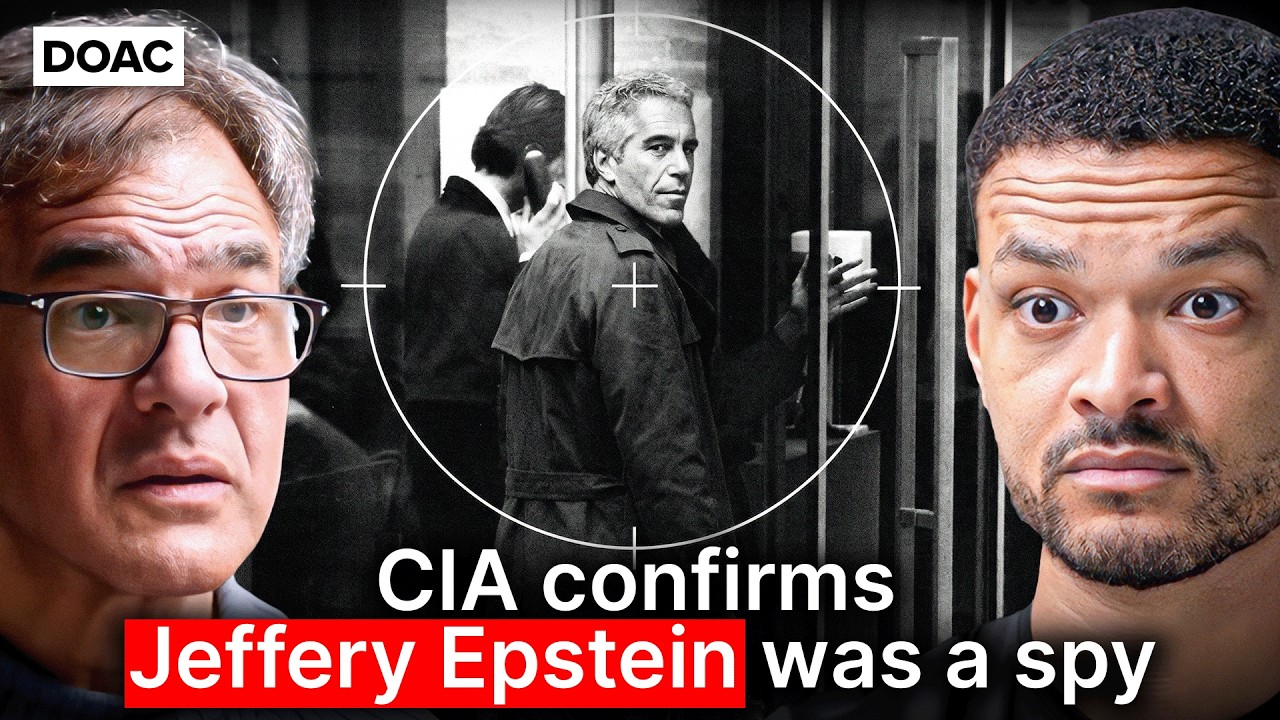
Kiriakou is confident Epstein was an Israeli spy. He describes Epstein as a classic “access agent” — someone recruited not for their own information but for their proximity to powerful people (presidents, CEOs, royalty). Epstein’s island estate had hidden video cameras in every room, including bathrooms, used to collect compromising material on guests.
Only the Israelis and Russians routinely use extortion as an intelligence tool. Epstein’s 2006 sweetheart deal — six months of house arrest for child sex crimes carrying a five-year mandatory minimum — was ordered by the attorney general, which means the president himself intervened. Alex Acosta, the prosecutor who made the deal, later said he was ordered to do so.
Kiriakou debated Alan Dershowitz (Epstein’s attorney) and former Mossad chief Danny Ayalon on Piers Morgan’s show. Dershowitz claimed Epstein would have told him if he were a spy, but Kiriakou pointed out that no president would go easy on someone for being a foreign spy — they would have “hung him from a tree.” Ayalon deflected with “who knows?”
China as the Long-Term Adversary
Kiriakou believes China, not Russia, is the real long-term adversary of the West. China is patient, planning 25 years ahead, while the US is constrained by four-year election cycles.
China steals technology through PhD students in the hard sciences at American major universities. Kiriakou is “1,000% sure” these students are spying, citing frequent arrests and prisoner trades. They are always PhD candidates in hard sciences.
Instead of military conquest, China builds influence by funding infrastructure — highways, airports, hospitals, electrical grids — in developing countries using its massive trade surplus. Kiriakou says China essentially owns Africa.
China’s immediate goal is reunification with Taiwan. Even American policy acknowledges Taiwan is part of China. Trump told the New York Times that whether China takes Taiwan is “ultimately up to Xi” and that he would be “very unhappy” if China changed the status quo, but he doesn’t think Xi will act while he’s president. Kiriakou believes if China invaded Taiwan, the US would not send soldiers to fight — it would rush to protect Japan, South Korea, Australia, and the Philippines instead.
China wants the US to bankrupt itself on military spending. The US now spends more on defense than the next eight largest countries combined — $1 trillion under Trump, requesting $1.5 trillion next year. Interest on the national debt is now the third-largest government expenditure. Meanwhile, China spends on infrastructure: bullet trains, pristine airports, roads without potholes.
Venezuela, the Monroe Doctrine, and a Multipolar World
The US recently sent a Delta Force team into Venezuela to seize President Maduro on narcotics charges. Kiriakou argues this invocation of the Monroe Doctrine (claiming the Western Hemisphere as a US sphere of influence) inadvertently gives China and Russia cover to claim their own spheres — China over Taiwan, Russia over Ukraine.
He believes this marks a shift from a unipolar world (one superpower) to a multipolar world (three or more), which he personally thinks is safer.
The US Government Breaks Its Own Laws
Kiriakou’s central theme is ethics. He loves the country but argues the government has stopped obeying its own laws. The Federal Torture Act of 1946 banned torture. In 1968, an American soldier who waterboarded a North Vietnamese prisoner was sentenced to 20 years of hard labor. In 2002, the CIA waterboarded prisoners and called it legal “because we’re the good guys.”
When Kiriakou was human rights officer in Bahrain, he told the interior minister that torturing pro-democracy protesters would result in losing access to American military hardware. An hour later, the CIA station chief offered the same minister $10 million to set up a secret prison and torture prisoners for the CIA. The minister listened to the CIA.
Kiriakou is proud that the McCain-Feinstein anti-torture amendment passed in 2014. John McCain said on the Senate floor it was because of Kiriakou’s revelations. Kiriakou says this made the prison sentence worth it.
Personal Life and Recovery
Kiriakou struggled with depression his entire life. After his second divorce, he was in his 50s, a convicted felon, unemployable, unable to get out of bed, worried about rent. He decided to stop feeling sorry for himself, telling himself: “You’re right, they’re wrong, they’re criminals.” He built an independent career as a writer, columnist (syndicated in 212 small-town newspapers), TV commentator, and podcaster (three podcasts: The Reluctant Spy, Deep Focus, and John Kiriakou’s Dead Drop). He says life is good now.
He has applied for a presidential pardon from Trump and has high-level supporters advocating on his behalf.