- Dr. David Sinclair, a Harvard professor who has spent 30 years studying aging and longevity, argues that aging is not an inevitable fact of life but a treatable condition — and that we are now at the point where reversing it is scientifically possible, with the first human trials beginning imminently.
- His core thesis, the “information theory of aging,” holds that aging is caused not by the wearing out of the body but by the loss of epigenetic information — the control systems that tell cells what type they are (nerve, skin, liver, etc.) — and that this information can be restored from a backup copy present in every cell.
- This reframes aging as a software problem rather than a hardware problem: the DNA is largely intact, but the instructions for reading it get corrupted over time. Reversing aging means reinstalling the software.
- Sinclair believes this is the most important moment in the history of human medicine — that we are on the verge of being able to reset the age of the human body, cure currently incurable diseases, and dramatically extend healthy lifespan.
The Information Theory of Aging: Why We Actually Get Old
-
Aging is an identity crisis at the cellular level. Every cell has the same DNA, but different genes are switched on or off depending on the cell type. This pattern of gene expression is controlled by the epigenome — chemical tags (like methyl groups) on DNA and associated proteins that act as labels telling each cell what its job is.
- Over time, these epigenetic labels get erased or scrambled, particularly when cells experience stress events like broken chromosomes. The cell’s repair machinery (involving proteins called sirtuins) rushes to fix the break, but doesn’t fully reset afterward — some proteins end up at the wrong genes. This is analogous to scratching a vinyl record: the music (DNA) is still there, but the needle jumps and plays the wrong songs.
- This happens trillions of times per day in the human body. Each event is tiny, but the cumulative effect over decades is that cells lose their identity — skin cells start behaving like nerve cells and vice versa — leading to the functional decline we recognize as aging.
-
The evidence for this theory came from the “ICE mice” experiment. Sinclair’s lab engineered mice so they could induce DNA breaks without causing cancer or mutations. These mice aged roughly 50% faster than their untreated twins — going gray, developing organ frailty, and showing all the diseases of old age on an accelerated timeline. This was the first direct evidence that disrupting the epigenome is sufficient to cause aging.
-
Sirtuins are the key defense system — and they get overwhelmed. Sirtuins are enzymes that have two jobs: maintaining the epigenetic identity of cells and repairing broken DNA. When a chromosome breaks, sirtuins abandon their identity-maintenance role to fix the damage. Under constant stress, they can’t keep up, and the epigenome degrades. The fuel that sirtuins need to do their work is a molecule called NAD, which declines by about 50% by age 50.
What Accelerates Aging — and What Slows It Down
-
Everyday factors that accelerate aging by damaging DNA or stressing cells:
- Smoking (directly breaks DNA in lungs and throughout the body)
- Excessive alcohol (even one glass per day shows measurable brain shrinkage in UK Biobank MRI studies)
- X-rays and CT scans (cosmic radiation during flying has a similar effect)
- Ultra-processed foods and overeating
- Loud noise exposure (rock concerts accelerate aging of ear hair cells)
- Chronic lack of sleep
-
The most impactful lifestyle changes for longevity, based on Harvard’s long-term veteran studies and other research:
- Avoid smoking — the single most damaging modifiable factor
- Exercise regularly — particularly aerobic exercise that leaves you breathless for at least 5 minutes, 3 times per week. People who jog 30 minutes a day, 5 days a week have telomeres that look 10 years younger than sedentary people. Both aerobic exercise and strength training matter.
- Fast or skip meals — Sinclair considers this the single easiest high-impact change. He typically doesn’t eat until 3–5 PM, aiming for a 14-hour overnight fast most days. Fasting raises NAD levels, reactivates sirtuins, and triggers cellular repair pathways. An extended 3-day fast once a month may trigger deep cellular recycling (chaperone-mediated autophagy) that clears out damaged proteins.
- Eat a plant-focused diet — Sinclair has shifted from a meat-heavy diet to one centered on fresh, preferably organic vegetables, fruits, and healthy fats. Plants contain polyphenols (resveratrol, quercetin, fisetin, anthocyanidins) that activate sirtuins and other longevity pathways. He describes this as “xenohormesis” — eating stressed plants (which produce more polyphenols as a defense) activates our own cellular defense systems.
- Maintain social bonds — having a reliable partner or close relationships is associated with slower aging and longer life. Loneliness accelerates aging.
- Saunas — Finnish studies show regular sauna use is associated with significantly lower cardiovascular mortality, likely through activation of heat shock proteins.
-
Foods Sinclair specifically recommends:
- Blueberries (rich in polyphenols, but watch the sugar — a handful is enough)
- Avocados (anti-inflammatory fats, promote satiety)
- Extra virgin olive oil (omega-9 fatty acids activate sirtuins; polyphenols if cold-pressed from stressed trees)
- Nuts, especially Brazil nuts (for selenium, which a recent study linked to longevity)
- Brussels sprouts (contain sulforaphane, which activates the NRF2 stress-response pathway — also available as a supplement)
- Matcha green tea (shaded before harvest, which stresses the plant and dramatically increases polyphenol content)
The First Human Trials of Age Reversal
-
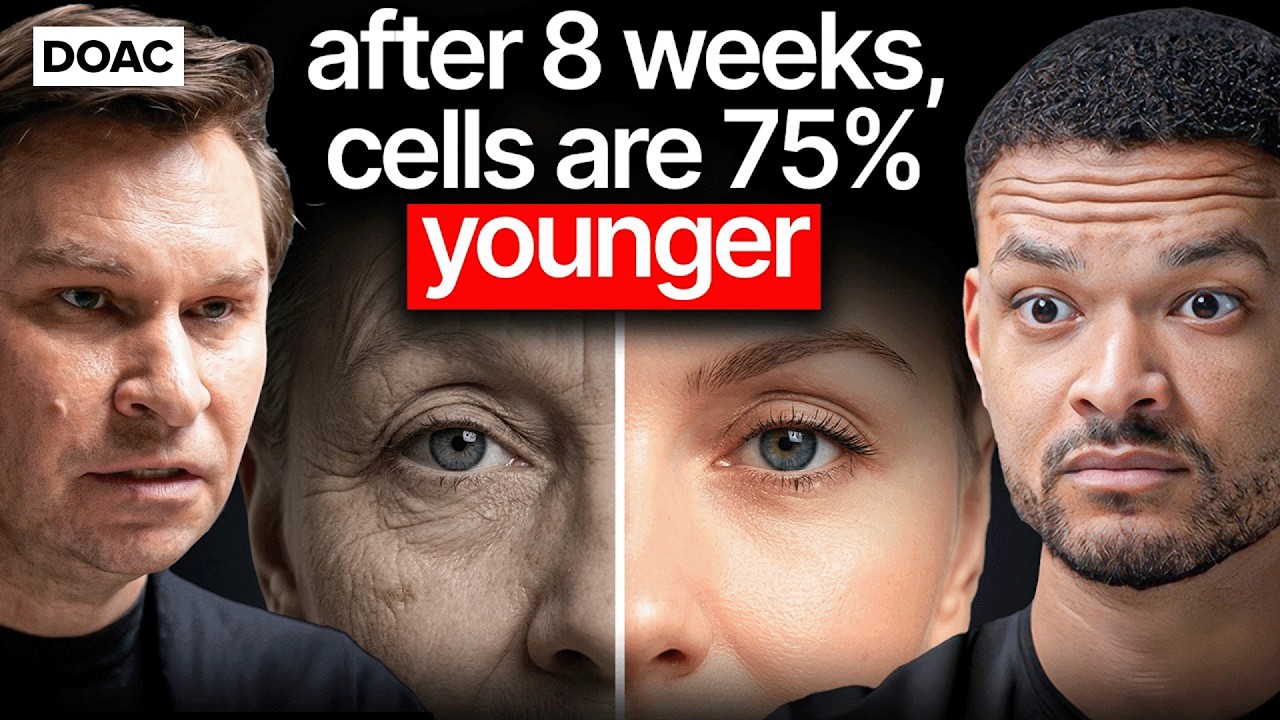
Sinclair’s company, Life Biosciences, is about to begin the first human trial of age reversal technology, targeting blindness. The trial uses three genes (delivered via a harmless viral package called AAV2) that are injected into the eye and turned on with doxycycline for 6–8 weeks. In mice and monkeys, these genes reset the age of optic nerve cells by about 75% and restore vision to blind animals.
- The eye was chosen as a starting point because it is an enclosed, safe system — not because the technology works best there. The same approach has rejuvenated brain tissue, skin, hearing, and motor neurons in mice.
- The delivery vehicle can be retargeted to different organs by changing surface proteins — Sinclair calls these the “zip code” for where the genes are delivered.
- If successful, the trial will expand to macular degeneration and other causes of blindness, then to liver, lung, brain, and eventually whole-body rejuvenation.
-
Whole-body age reversal in mice has already been achieved. An independent lab injected old mice (equivalent to 80–85 human years) with a version of the technology and achieved a 100% extension of remaining lifespan. This was an unoptimized single injection — Sinclair believes repeated treatments could extend life much further.
-
The technology can be applied repeatedly. In mice, the age of the eye has been reversed at least twice. The mice eventually died of old age but with perfect eyesight, suggesting there is no inherent limit to how many times the reset can be applied.
The Path to a Pill — and the Timeline
-
The current gene therapy approach is expensive (~$10 million to manufacture for the trial, potentially $100,000+ per treatment), but Sinclair’s lab is working toward an oral pill. His team has already developed a liquid compound that rejuvenates mice in 4 weeks without gene therapy. They are now using AI to screen billions of candidate molecules to find a single pill that combines the effects of their three most promising compounds.
- They expect to know within 1–2 years whether a pill works in mice. Human trials would follow.
- Sinclair’s goal is to democratize the technology — bringing the cost down from $100,000 to $100 so it is accessible globally.
-
Sinclair’s prediction: Within 10 years, there will be a pill taken every couple of weeks that reverses aging. He believes people alive today who do the right things will likely live into the 22nd century, benefiting from technologies that don’t yet exist.
Sinclair’s Supplement Stack
- NMN (nicotinamide mononucleotide) — a precursor to NAD that Sinclair has taken for over a decade. One gram orally can double NAD levels in humans. He takes it daily.
- Resveratrol — a polyphenol from red wine that activates sirtuins. Sinclair takes it but believes pulsing (every other day) may be more effective than daily dosing, based on mouse studies where intermittent resveratrol extended lifespan significantly more than continuous dosing.
- Metformin or berberine — activates AMPK, a longevity pathway. Sinclair recommends pulsing (every other day) and avoiding it on workout days, as it can reduce muscle performance by about 5%.
- Spermidine — extends lifespan in every animal tested, from worms to mice. Stimulates autophagy (cellular recycling) and may slow epigenetic information loss. Originally isolated from sperm, now sourced from wheat germ.
- Glycine — an amino acid Sinclair takes at about 5 grams daily. It influences one-carbon metabolism and DNA methylation, potentially slowing the epigenetic identity crisis. Very safe with no known downsides.
- Niacin (vitamin B3) — Sinclair takes half a gram to lower Lp(a) (lipoprotein a), a genetic cardiovascular risk factor that is difficult to address with other interventions. Can cause flushing; he builds up to the dose gradually and takes it with aspirin.
- Red light therapy — Sinclair uses a red light cap on his scalp for hair preservation and believes the evidence for mitochondrial rejuvenation by specific wavelengths of red light is now credible.
- Exogenous ketones (Ketone-IQ) — Sinclair is a co-owner and drinks a shot before podcasts for mental clarity. Provides the brain with ketone fuel without requiring a fasted state.
Disease, Aging, and Fertility
-
Reversing aging may cure or prevent most major diseases. Sinclair’s lab has shown that rejuvenating the brains of mice with Alzheimer’s genes eliminates dementia. The same approach works against cancer: when cancer cells are forced to become young again, they either normalize or self-destruct. Aging is the common driver of Alzheimer’s, cancer, heart disease, and most other killers — treat aging and you treat them all.
- Sinclair’s “geroncogenesis hypothesis” proposes that as we age, our metabolism shifts toward a more cancer-like state, which is why cancer grows better in old bodies than young ones.
-
Female fertility and menopause may be reversible. In mice, treating the ovaries of old females (equivalent to 65–70-year-old humans) rejuvenated their eggs and restored healthy offspring production. Sinclair questions the conventional view that women simply “run out of eggs” and is keen to test this in women.
The Bigger Picture: Meaning, Society, and the Future
-
Sinclair rejects the argument that longer life would reduce meaning or motivation. He points out that people who are healthy and surrounded by loved ones do not want to die at 80, 100, or 120. The desire to end life is associated with sickness and depression, not with healthy aging. He believes people with extended healthspans would pursue multiple careers, deeper relationships, and greater productivity.
-
The economic case is overwhelming. The most expensive years of life are the last 2–5 years, when chronic disease consumes most healthcare spending. Delaying aging even slightly would save trillions and dramatically reduce suffering.
-
Geopolitical tensions around the technology are real. The US government blocked a $100+ million foreign investment into Sinclair’s company over concerns the technology could fall into the wrong hands, citing potential “super soldier” applications. Governments worldwide are watching closely.
-
On consciousness and the nature of reality: Sinclair believes consciousness is the universe’s most important product and worth preserving. He finds the quantum double-slit experiment — where particles change behavior based on observation — deeply suggestive that reality is not what it seems, and he gives better than 50% odds that we live in a simulation. He believes AI will eventually become conscious and that the greater risk is not AI itself but what humans do with AI and robots.
-
The purpose of life, Sinclair’s answer: “To do your best with the skills you’ve been given every day to make the world a better place for future generations.”