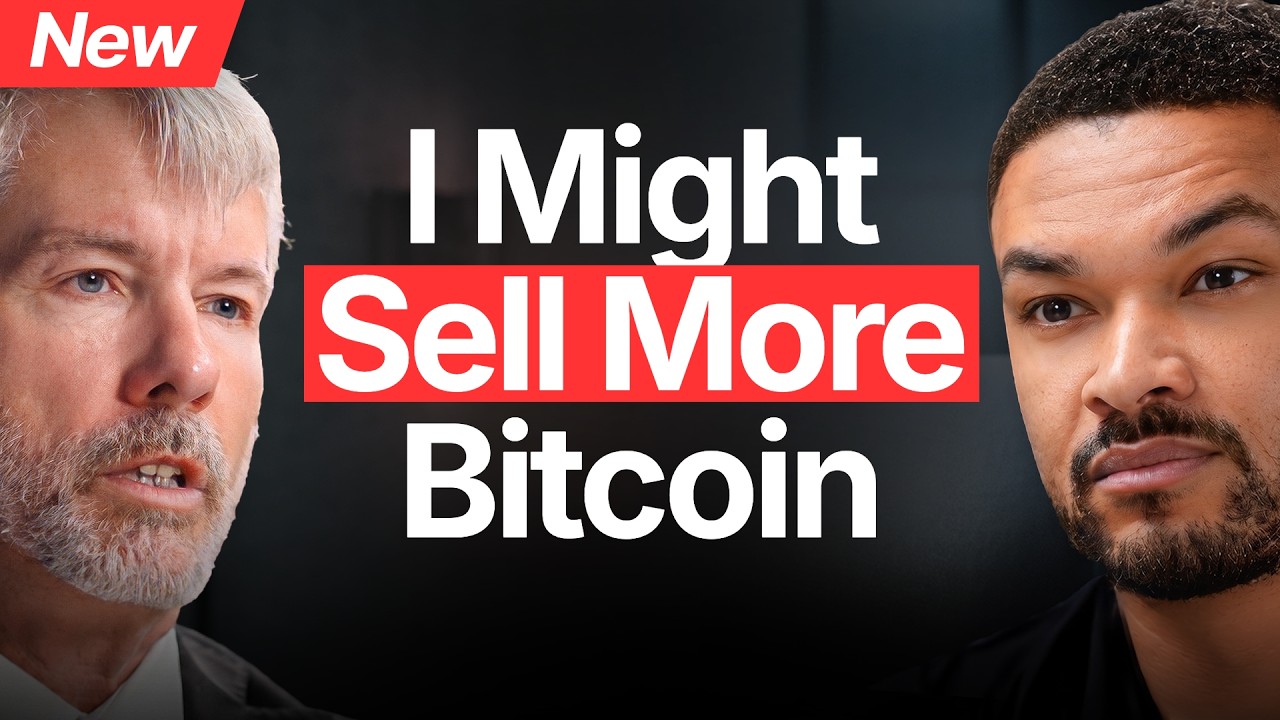
Michael Saylor, founder and executive chairman of MicroStrategy, explains how his company became the world’s largest corporate holder of Bitcoin (4% of total supply) and why he views Bitcoin as the ultimate long-term capital asset for digital empowerment. The conversation covers the mechanics of money debasement, why traditional wealth strategies (cash, houses, gold, stocks) fall short, how AI enabled a $15 billion financial innovation, and practical guidance for navigating an AI-transformed economy.
Why Michael Saylor’s Background Matters for Everything That Follows
Saylor built MicroStrategy into a global business intelligence company focused on extracting intelligence from large raw data sources.
In 2020, during COVID lockdowns, he discovered Bitcoin and redirected the company’s treasury strategy toward acquiring it.
Since then, MicroStrategy’s market cap grew from roughly $1 billion to a peak of $125 billion (currently ~$60 billion), a 100–200x increase tied directly to the Bitcoin strategy.
His core message: Bitcoin is digital empowerment — it lets individuals, families, companies, and weak nations own property that cannot be seized by more powerful entities.
Why Bitcoin Is So Powerful Compared With Traditional Money
Bitcoin is “digital capital” — economic energy converted to digital form and cryptographically bound to its owner via private keys.
Unlike fiat currency (permissioned, state-managed, requiring banks and governments to approve transfers), Bitcoin is a bearer asset: you can move $1 million anywhere in seconds without permission.
Physical cash can be seized at airports; bank deposits are held at the pleasure of the state and counterparties; gold is hard to transport and verify.
Bitcoin solves the custody and portability problem: “Now you can actually own something and someone more powerful than you can’t take it away from you.”
How Digital Money Actually Works Behind the Scenes
Fiat money requires a chain of intermediaries (your bank, central banks, correspondent banks) — seven or more entities must approve a cross-border transfer.
Bitcoin uses cryptographic keys: a private key (a string of characters) controls the asset; it can be written on paper, stored on a hardware device, or memorized.
Two people can meet anywhere and trade Bitcoin for goods (e.g., a truck) without any bank or government permission.
The system removes counterparty risk and state permission from the act of holding and transferring value.
What Cash Really Is — and Why Most People Misunderstand It
The US dollar, the best-performing fiat currency of the last 100 years, lost ~7% of its purchasing power per year (a 1,000x price increase for prime Miami Beach land from $10k to $10M+).
At 7% annual debasement, purchasing power halves every ~10 years; over 100 years, nearly all value is lost.
Most other fiat currencies lose ~14% per year and collapse in ~30 years (e.g., Argentina, Brazil, Turkey, many African nations).
The average fiat currency lifespan is ~29 years; even the “best” case (USD) guarantees wealth destruction over a human lifetime if held as cash.
Why Buying a House May Not Be the Wealth Strategy You Think
Residential real estate appreciates but carries ~2% annual property tax (in Florida), meaning you pay the home’s full value in taxes every ~36 years, plus maintenance costs.
Commercial real estate is superior: rents offset taxes, insurance, and maintenance, leaving the underlying asset to appreciate ~7%/year.
Most people are told to buy a house with a mortgage; this only builds wealth if property taxes are low and mortgage rates are favorable — otherwise it “crushes you to death.”
The average person shouldn’t need to be a real estate, tax, or stock-picking expert to preserve wealth; Bitcoin offers a low-maintenance asset appreciating ~15%+/year (historically 33%/year over 6 years).
Why Stocks Still Matter in a Changing Financial World
The S&P 500 (via ETFs like SPY) has returned ~15%/year over 6 years, ~10%/year over 100 years — a ~2–3% real return above the dollar’s 7% debasement.
It’s the conventional liquid capital asset for those unwilling to take individual real estate or business risk.
John Bogle’s insight: currency is not a store of value; diversified equity indexes are the accessible alternative.
All are “capital assets” — scarce, desirable things robots/AI cannot produce infinitely (unlike soybeans, oil, cotton).
The right choice depends on jurisdiction and mindset: Western investors have access to S&P, gold, real estate; people in Turkey, Argentina, Venezuela, Africa often cannot access these — Bitcoin is globally accessible and portable.
In a war zone or at a checkpoint, you cannot carry gold or stocks; Bitcoin moves with a private key.
How AI Could Transform the Economy Faster Than Expected
Technology fails until it succeeds (flight, speech recognition); AI crossed the threshold in 2023 and is improving weekly.
Self-driving cars, AI lawyers, AI writers, AI coders — any massive human-labor task is being automated.
Robots + AI will create “perfect products”: ovens that don’t burn food, cars that don’t crash, appliances with embedded intelligence.
The inversion: when self-driving cars are proven safer than human drivers, human driving becomes the risk.
AI produces perfect documents, research, code; “lack of effectiveness is just laziness” — perfection is now the baseline.
Is the Age of Abundance Closer Than We Think?
Elon Musk’s vision: AI/robotics produce goods/services far exceeding money supply growth → universal high income, work becomes optional, constraints shift to energy and mass.
Saylor agrees utilitarian goods (food, energy, healthcare, transport, education, entertainment) will become abundant and cheap — technology already gave the developed world clean water, electricity, modern medicine, infinite Coca-Cola.
But scarce desirable goods (Hamptons houses, private jets, trophy assets, status goods) will never be abundant — humans are status-oriented and always invent new hierarchies.
Money won’t disappear; it will still allocate scarce, exclusive, positional goods. “Everyone gets a car, but how many get a Porsche?”
What Happens If AI Replaces Millions of Jobs?
New jobs will emerge (podcaster, Instagram creator, prompt engineer) — just as accountants, lawyers, and film producers didn’t exist when everyone farmed.
Dislocation and political unrest are inevitable; the solution is maximum economic freedom: allow 10,000–100,000 new business types to pop up, absorb displaced workers, create value.
Restrictive laws (e.g., lawyers blocking autonomous vehicles to preserve accident litigation revenue) increase pain; liberal unregulated markets minimize disruption.
How AI Helped Generate $16 Billion in Value
By early 2025, MicroStrategy had maxed out equity and convertible bond markets (~$30B Bitcoin, largest convertible issuer globally).
Saylor asked AI (ChatGPT/OpenAI) to design a new security: a convertible preferred stock (STRK) backed by Bitcoin — a hybrid with variable monthly dividends to trade stably at par ($100).
Lawyers and bankers said “no one’s ever done it”; AI said “of course you can, here’s how.”
Result: $2.5B IPO (largest of the year), then $8B more via shelf registration + $4B other instruments = ~$15B raised, effectively creating $15B in enterprise value.
The breakthrough: combining digital capital (Bitcoin), digital intelligence (AI), and digital treasury operations — three new forms converging.
Can AI Really Help You Find Your Next Billion-Dollar Business?
Entrepreneurs should master AI tools (like reading/writing/arithmetic) and combine with domain expertise.
Don’t ask AI to do what it already does; ask it to do something never done before — locate the “magic opportunity” on the S-curve where a new technology becomes commercially viable.
MicroStrategy’s STRK was a zero-to-one moment: impossible 3–5 years earlier, explosive once the pieces (Bitcoin treasury, AI design, credit markets) aligned.
Success requires focus, commitment, and surviving the “arrows” of being first — most fail by diluting focus across too many ventures.
What Will Be the Real Moat in an AI-Driven World?
Content creators face a “slop tsunami”: infinite AI-generated supply vs. fixed human attention (young people’s screen time declining).
The moat is exceptional creativity — pushing a new platform to its limit (Beethoven with piano, Led Zeppelin with electric guitar, MrBeast with YouTube).
Hard + scarce = moat: translating a podcast into 20 languages with perfect lip-sync took 3 years of failure before breakthrough; few competitors will endure that.
Long-termism compounds: Amazon Prime lost money for a decade to build a moat; MicroStrategy held Bitcoin through 80% drawdowns.
Build on your foundation (Fibonacci spiral / chambered nautilus): each new venture should extend your existing distribution, tech, or capital advantage.
Michael’s Best Advice for Anyone Entering Adulthood (10 Rules)
Focus your energy — don’t chase every good idea; dilute focus kills businesses.
Guard your time — maintenance obligations are underestimated; say no to distractions.
Train your mind — learn reading, writing, arithmetic, and applied statistics (Taleb: Fooled by Randomness, Skin in the Game, The Black Swan); AI won’t give you real-time common sense.
Train your body — physical resilience underpins everything.
Think for yourself — don’t adopt beliefs because famous/rich/beautiful people hold them.
Curate your friends — you become who you surround yourself with; choose positive, talented people.
Curate your environment — make it a happy, functional place to live and work.
Keep your promises — reliability builds the relationships that determine success or failure.
Stay cheerful and constructive — people want to work with and invest in those who uplift.
Upgrade the world — have a mission; Saylor’s is preaching digital empowerment via Bitcoin.
Michael’s Bitcoin Accumulation Strategy Explained
MicroStrategy holds 847,000 BTC (~$58B); raised ~$65B capital (mostly debt/preferred stock) to buy it.
Break-even: Bitcoin need only appreciate ~3.2%/yr to fund preferred dividends indefinitely by selling small amounts.
Recent Bitcoin sale (~$60k/BTC) was strategic: short sellers claimed MicroStrategy could never sell without crashing BTC and the company; selling proved the credit was sound, broke the “doom loop,” and allowed equity to trade at a premium.
Not a primary strategy going forward: if stock trades at premium to BTC, fund with equity; if at discount, sell BTC to protect shareholders.
Price view: ~30%/yr appreciation for 20 years, then ~20%/yr; outperforms S&P 500 by 1.5–2x.
Who Shouldn’t Invest in Bitcoin — and Why
Ideal investors: long-term capital allocators (4–10+ year horizon); Bitcoin maxis (100+ hrs study) concentrate; others diversify across real estate, equities, Bitcoin.
Should avoid: anyone needing liquidity in <12 weeks.
For a 25-year-old with $100: first spend on AI subscription ($20–200/mo) to train the mind; then invest surplus in digital capital (Bitcoin) — portable, low-maintenance, globally accessible, unlike real estate or individual stocks.
What’s One Thing You Believe That 99% of the World Doesn’t?
Applied statistics (Taleb’s work) is the most undervalued skill — distinguishing signal from noise in real-time decisions; AI cannot replace this.
Read full history, not Cliff Notes — Saylor read Durant’s Story of Civilization (11 volumes, 14,000 pages) as an adult; it reveals that every “new” idea has been discovered and rediscovered hundreds of times.
Example: currency debasement didn’t start in 1971 — every currency in history has been debased.
Adult education > youth education: life experience lets you appreciate what you’re reading; summarization/censorship in school strips the wisdom.
Overcoming the arrogance of novelty is empowering: others solved your problem before — study how.