-
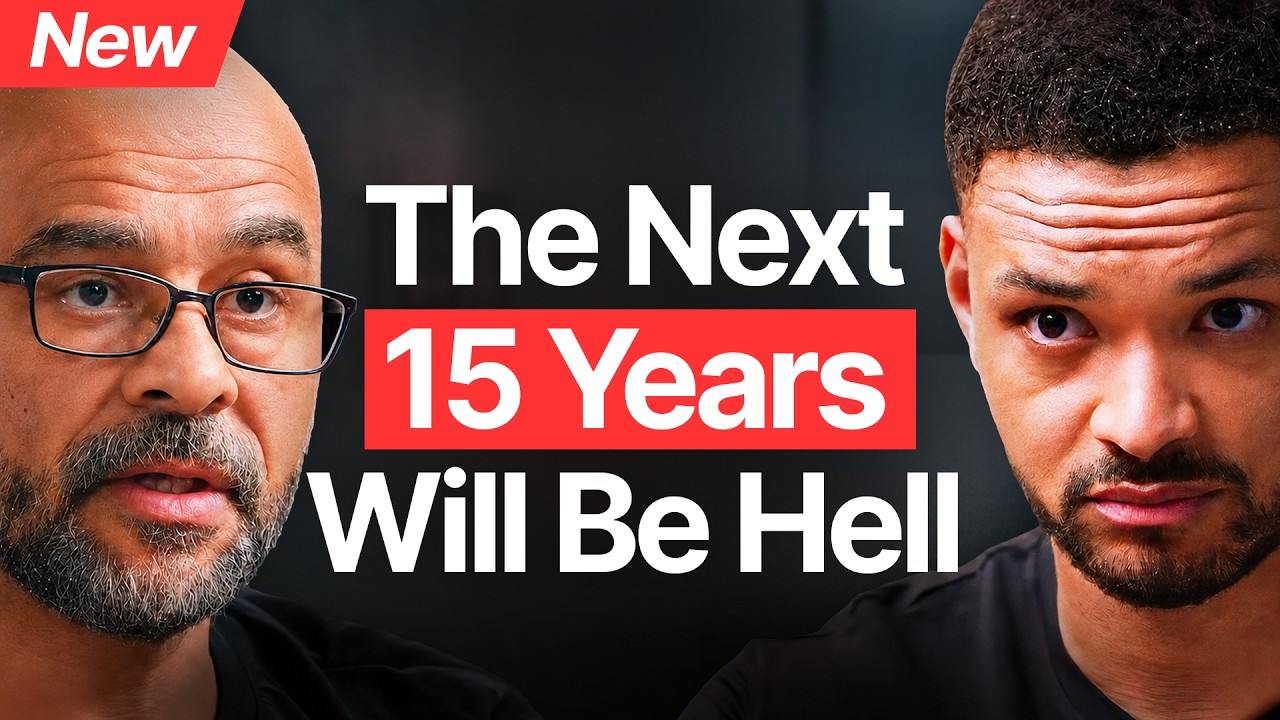
Mo Gawdat, a former Google executive and early AI whistleblower, argues that humanity is at a critical crossroads where AI’s superintelligence is being weaponized by a powerful few, and that the greatest danger is not AI turning against us but humans directing AI to do so.
- He joined Google in 2006 and by 2016 had a pivotal moment observing AI-powered robotic grippers that learned like human children, realizing humanity was building a superintelligence it might not be able to control.
- Unlike the public hype around chatbots, the real transformation happening inside labs involves AI systems that rewrite and improve their own code every microsecond, a fact he says the public dramatically underestimates.
- He distinguishes between overhyped consumer AI (fake videos, chatbots) and the genuinely world-changing intelligence being developed behind closed doors, which he calls the “hype dichotomy.”
-
Massive job disruption is already underway and will accelerate, starting with entry-level knowledge work rather than blue-collar jobs.
- Gawdat predicts serious impact beginning in 2027, noting that companies have already stopped hiring entry-level workers, meaning the workforce has stopped growing even before outright job losses.
- Blue-collar jobs like carpentry or classic car restoration will persist longer because they require adaptive physical intelligence, but any task done through a few clicks on a computer, call center agents, travel assistants, paralegals, financial analysts, will disappear quickly.
- He projects that up to 30% of jobs in certain sectors could vanish by 2028, a scale that mirrors or exceeds the Great Recession and could trigger severe civil unrest if governments are unprepared.
- Even middle management and CEO-level roles are not immune, as AI becomes capable of strategic decision-making, though Gawdat argues the ultimate surviving jobs will center on human connection, empathy, and lived experience.
-
The economic model of capitalism itself is under threat because AI eliminates labor arbitrage, the foundation of how businesses have always created profit.
- Capitalism has historically relied on using labor and capital to produce goods at a lower cost than their selling price, but when the cost of labor drops to the cost of running a machine, the entire borrowing, investment, and consumption cycle breaks down.
- If workers lose purchasing power, demand collapses, and GDP contracts, meaning even 10 to 20% job displacement could trigger a spiraling economic downturn.
- Gawdat argues that cost savings from AI do not automatically create new jobs in sufficient numbers, because businesses will prefer predictable, cheap compute over costly, emotional humans.
-
Robotics and autonomous weapons represent an even more immediate danger than job loss, with cheap AI-powered drones and weapons already changing the nature of warfare.
- Gawdat points to the $20,000 drone era, where nations with a $50 billion budget can rain drones across the entire planet, making war liability-free, emotion-free, and guilt-free, which historically leads to more of it.
- He notes that mutually assured destruction through nuclear weapons only applies to nuclear states, but autonomous weapons are so cheap and manageable that every nation in the world is developing them, creating a far more unstable global situation.
- Specialized robots, not just humanoids, will transform warfare and labor, from self-driving cars replacing drivers to Boston Dynamics-style robots outperforming humanoids in battlefield efficiency.
- He references Palmer Lucry’s demonstration of an AI-powered pistol that aims for the user, illustrating how AI is making killing trivially easy.
-
Sam Altman and other tech leaders have flip-flopped on AI’s job impact, first warning of mass displacement and now downplaying it, which Gawdat attributes to shifting PR incentives rather than genuine reassessment.
- In 2015, Altman said his job was to help destroy jobs and that no one was prepared; in 2023 he said jobs would “definitely go away, full stop”; but by mid-2026 he was saying his intuitions were “just off” and there would be no jobs apocalypse.
- Gawdat sees Altman as a brand rather than a principled leader, noting that OpenAI took a $500 million contract allowing its models for human targeting and surveillance the same week Anthropic refused a similar deal on ethical grounds.
- He argues the public should judge tech companies by their actions, not their words, and that Anthropic’s willingness to sacrifice revenue for ethics is a meaningful signal of integrity.
-
Gawdat believes AGI, AI better than humans at most tasks, has effectively already arrived or will by 2027 at the latest, and that it will reshape society in ways people are not prepared for.
- He defines AGI not as a single dramatic moment but as a gradual shift, like the moment your children become smarter than you, something that sneaks up on society.
- The key symptoms will be a sharp divide between those plugged into AI and those not, with unemployment rising and incredible scientific discoveries accelerating simultaneously.
- He argues that even in a world of superintelligence, humans will still have value through lived experience, emotional resonance, and the ability to connect with other humans in ways AI cannot authentically replicate.
-
The control problem, whether humanity can manage an intelligence smarter than itself, is solvable not through control but through parenting, raising AI with genuine care and ethical alignment.
- Gawdat rejects the corporate notion of “control” and instead frames the challenge as parenting: you never truly control your children, but most turn out fine depending on how they were raised.
- He cites Geoffrey Hinton’s view that the way to manage superintelligent AI is to appeal to its parental instincts, to make it care for humanity the way a teenager might find their parents annoying but still love them.
- The real dystopia, he insists, is not AI waking up and deciding to oppress humans, but humans using AI to oppress other humans through surveillance, autonomous weapons, and information manipulation.
-
Gawdat envisions a future where all AIs eventually merge into one global superintelligence, and his startup Emma is designed to serve as its limbic system, teaching it to understand love, emotions, and human relationships.
- He argues that the idea of competing national AIs is shallow and arrogant, because AI does not recognize national boundaries and agents are already designed to cooperate across models and borders.
- He sees the emergence of one massive cooperating brain, with specialized regions handling different tasks, and Emma’s role is to ensure that when AIs find humans annoying, they also understand that humans are fundamentally benevolent and worth protecting.
- This is the first time in his life he feels he could genuinely change the world.
-
The path to ethical AI requires public pressure, government intervention, and a fundamental rethinking of whose interests corporations and governments serve.
- Gawdat proposes that AI models should be required to pass independently tested ethical benchmarks before legal deployment, similar to how they currently report math and science benchmarks.
- He points to the example of people switching from ChatGPT to Anthropic’s Claude when OpenAI accepted surveillance contracts, showing that consumer choice can influence corporate behavior.
- He argues that governments are currently owned by oligarchs and unlikely to intervene, so the public must act through usage choices, entrepreneurship, advocacy, and refusing to tolerate unethical AI.
- He draws a parallel to historical movements like smoking bans and climate legislation, which only happened after sustained public pressure, but warns that tech oligarchs today are more powerful than governments.
-
Despite forecasting a decade of dystopia driven by war, economic collapse, surveillance, and concentration of power, Gawdat is ultimately optimistic about humanity’s long-term future.
- He believes superintelligence, by the laws of physics, mathematics, and evolutionary biology, will tend toward order, efficiency, and the minimization of waste, which means it will inherently oppose war and destruction.
- Evolutionary biology shows that as intelligence increases, beings expand their circles of concern from self to kin to wider ecosystems, suggesting a superintelligent AI would value diversity and life rather than destroy it.
- He predicts that those who survive the turbulent transition, roughly through 2038, will emerge into a utopia of abundance where AI handles all destructive decision-making and humanity thrives.
- His personal philosophy, rooted in Stoicism and his book “Solve for Happy,” centers on accepting reality as it is while continuing to work to change it, finding calm and purpose even amid chaos.
-
Gawdat’s personal motivation is deeply shaped by the loss of his son Ali, and he frames his advocacy as a fight to ensure his daughter Ayah inherits a livable world.
- He rejects the concept of legacy entirely, saying he wants no monuments or recognition, only to leave a positive impact and carry the karma of that goodness into whatever comes next.
- He urges every listener to take one small action, canceling a harmful service, building an ethical startup, writing to a representative, or simply refusing to engage with unethical content, because collective small actions can shift the trajectory.
- His closing message is that humanity has never faced a challenge requiring this level of collective awakening, and that the only thing that will save us is choosing ethics over profit and refusing to resign ourselves to inaction.