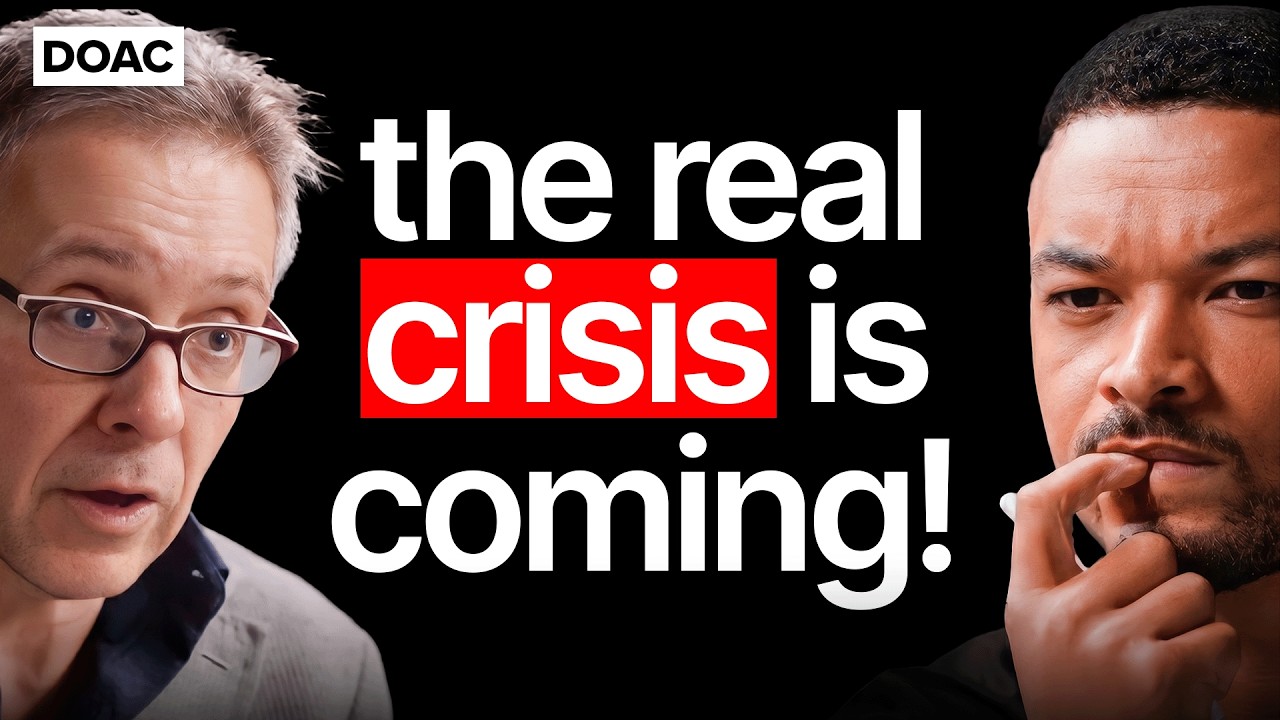
Ian Bremmer, one of the world’s leading political scientists and founder of Eurasia Group, discusses his firm’s annual top risks report for 2026, which has proven remarkably prophetic. He identifies three critical global risks: the United States has become the biggest driver of geopolitical uncertainty in the world, China’s long-term strategic dominance in energy and critical minerals is reshaping global power dynamics, and artificial intelligence poses an immediate systemic threat to the global economy and security that is dangerously underappreciated.
The US as the Primary Source of Global Instability
The United States under Trump is fundamentally rejecting the international rules-based order it created after World War II, including free trade, collective security commitments, and open borders. This is not a challenge from China or any external power but a deliberate choice by American leadership to abandon its historical role.
Trump’s foreign policy decisions, including tariffs, military action in Venezuela, threats over Greenland, and the war with Iran, have created enormous global uncertainty. Because even small changes in US policy ripple across the entire world, this level of unpredictability from the most powerful country is uniquely destabilizing.
Bremmer argues Trump will ultimately fail because of policy incompetence and a refusal to listen to expertise. He is already deeply unpopular on many issues, will likely lose badly in the November 2026 midterms, and will become a lame duck. However, the underlying grievances that brought Trump to power, economic insecurity, cultural displacement, a sense that the system does not work for average Americans, remain unresolved.
The demand for political revolution in the US will persist beyond Trump. The election of Zoran Mamdani, a democratic socialist, as mayor of New York City, the capital of global capitalism, illustrates how deep this demand runs. The question is whether the next populist leader will serve the country or only themselves.
Because no other country or institution can fill the vacuum left by American retrenchment, the world is heading toward a G-zero order: an absence of global leadership where the powerful make rules that serve themselves and the weak have no choice but to accept them.
How the Iran War Unfolded and Why It Is Unlikely to End Cleanly
Trump ordered the strike on Iran for three reasons. First, the successful operation in Venezuela, where US forces captured Maduro without a single American casualty and installed a cooperative government, made Trump believe he could replicate the feat on a larger scale. Second, Trump’s previous experience with Iran, including the 12-day war in June 2025 where Iran talked big but ultimately avoided direct confrontation with the US, convinced him the Iranians would not fight back seriously. Third, unlike his first term when independent-minded advisors like Mattis and Pompeo would push back on bad ideas, Trump’s current inner circle is defined by personal loyalty to him, and they tell him what he wants to hear rather than what he needs to know.
The operation did not go as planned. The Israelis killed the Supreme Leader and much of the senior military leadership, but Iran had already decentralized military decision-making into a mosaic structure, making it resilient to decapitation strikes. Iran responded by attacking Gulf state infrastructure and disrupting transit through the Strait of Hormuz. Despite the leadership losses, Iran remains a functioning centralized state capable of coordinated action, as demonstrated by 21 hours of substantive negotiations in Islamabad led by JD Vance.
Trump announced a blockade of the Strait of Hormuz after the talks failed to produce the outcome he wanted, but Bremmer sees this as a leverage move rather than a genuine escalation. Trump has simultaneously been signaling that the Strait is not his problem and that the war is almost over, which tells the Iranians that he is under domestic political and economic pressure to exit.
The most likely outcome is that the ceasefire is extended, further talks occur, and Iran compromises on nuclear enrichment in exchange for a privileged position on transit through the Strait of Hormuz, effectively giving them a toll or reparations revenue stream. This is the less bad scenario, not a good one.
A worse scenario remains possible: Trump could order the seizure of Kharg Island, a small, lightly defended island off the Iranian coast responsible for 90% of Iranian oil exports. The US Central Command assesses it could be taken with 12,000 to 15,000 troops. This would give the US direct control over Iranian oil revenue, but it would be extremely unpopular domestically and militarily risky. Bremmer puts the probability below 50%.
Iran cannot be seen to buckle under bombardment because doing so would set a precedent that any future American president can bomb Iran into submission whenever it wants. This makes a face-saving resolution essential for both sides.
The Broader Middle East: Lebanon, Shifting Alliances, and Regional Realignment
Israel is currently occupying a 5 to 7 kilometer buffer zone inside Lebanon to protect northern Israeli civilians from Hezbollah missile strikes. Hezbollah, once the most powerful non-state military in the world, has been systematically degraded by Israeli targeted assassinations and strikes on its infrastructure and leadership. Over a million Lebanese people have been displaced in recent weeks.
The Middle East is splitting into two emerging blocs. One consists of the UAE, Israel, the United States, and India, aligned on national security and technology. The other consists of Saudi Arabia, Pakistan, Turkey, and Egypt, forming a regional defense alignment, with Pakistan offering a potential nuclear umbrella to Saudi Arabia. These blocs are not easily reconcilable.
Positive developments include the fall of Assad in Syria and the opportunity for representative governance, and the transformative domestic reforms in Saudi Arabia and the Gulf states, including Saudi Arabia bringing 35 million people and women into the economy in unprecedented ways.
Russia, Europe, and the Global Ripple Effects
Russia is a major beneficiary of the Iran crisis. Oil and gas prices have spiked, relieving the economic pressure from sanctions. The US has also reduced sanctions on Russia to calm markets. Additionally, American weapons previously earmarked for Ukraine are being redirected to the Middle East, weakening Ukraine’s ability to defend against Russian missiles and drones. Putin has even less incentive for a ceasefire now.
Europe is in a weakened position. Over the past 30 years, European countries have underinvested in defense, technology, and productivity while assuming the post-Cold War peace would last indefinitely. The Draghi report identified what Europe needs to do, entrepreneurship, technology investment, reduced regulation, but Europe’s fragmented governance across 27 EU nations plus the UK makes coordinated long-term action far harder than in the US, China, or even the UAE and Saudi Arabia.
Europe made a strategic energy mistake by leaning heavily into green technologies while making nuclear power more difficult, whereas China invested in everything: coal, solar, wind, batteries, electric vehicles, and nuclear. The US, as the world’s leading oil and gas producer, is also undermining its own clean energy competitiveness under the current administration.
For the first time, the UK and Europe are openly distancing themselves from the US, with the UK refusing to join the Iran operation and European leaders huddling to go it alone. A senior European tech executive told Bremmer that major technology companies increasingly see the European market as optional, with Brazil and other large markets mattering more.
China’s Long-Term Trajectory and the Real Concern
China is not about to overtake the US as the world’s leading superpower soon. The dollar’s reserve currency status, China’s lack of a convertible currency, its weaker military with no recent combat experience, and the absence of rule of law all limit its ability to challenge American dominance in the near term.
The real concern is that China is investing at scale in the world’s most important emerging technologies and is now at parity with or ahead of the US and everyone else in many of them. This means China can set global standards, sell essential products, and potentially cut off adversaries from critical supply chains, as Europe learned when Russia turned off its gas.
China is thinking in 10 to 20 year horizons and making no-regret moves while the US is trapped in short-term electoral cycle thinking. The biggest danger to the United States is not China but America getting in its own way: failing to invest in competitiveness, education, and the factors that make it an attractive place to live and work.
Bremmer’s 2023 TED talk argued that the next global superpowers are not countries but technology companies that write their own rules. He points to Microsoft detecting the cyber prelude to Russia’s invasion of Ukraine, Elon Musk’s Starlink keeping Ukraine’s government connected, and now AI companies creating tools so powerful they pose immediate global security risks.
AI: The Underappreciated Systemic Risk
Anthropic recently developed an AI model so capable at finding software vulnerabilities that they could not release it because it would pose an immediate systemic risk to the global economy and security. The model could exploit bugs in any software, including banking systems, power grids, and water infrastructure.
This is not merely marketing. The Federal Reserve chair and Treasury Secretary called an urgent meeting with bank CEOs, and JP Morgan’s Jamie Dimon, whose bank has the best cybersecurity among major US institutions, treated it as a five-alarm fire. The model must be deployed internally to patch vulnerabilities before adversaries develop similar tools.
AI tools are becoming available to anyone with a laptop or cell phone, meaning hostile state and non-state actors will soon have access to capabilities that can cripple critical infrastructure. Bremmer rates this as a severe risk for 2026 and would rate it critical if looking two years ahead.
Bremmer showed a video of Indian factory workers wearing head-mounted cameras so AI can learn to do their jobs, effectively training their own replacements. This illustrates how AI is eating its own users: the workers are sitting on a branch and cutting it themselves.
Public anger is growing. A US senator told Bremmer that AI data centers are the single most upsetting issue for his constituents: no local jobs, higher energy and water prices, ugly zoning, and rapid unplanned growth. AI is now less popular than ICE in US polling. The CEO of United Healthcare was assassinated near where Bremmer and Bartlett were recording, and Sam Altman recently had a Molotov cocktail thrown at his home and shots fired at his house. Bremmer condemns all violence but says the anger at elites and tech oligarchs is not surprising given how the benefits of AI are being captured by a small number of individuals and companies.
Most CEOs do not want to lay off workers unless forced by an economic downturn, and social mobilization like the longshoreman’s union blocking AI deployment will slow the process. But Bremmer expects a major political wave by 2028 as women with advanced degrees, urban and suburban voters, begin to feel threatened by AI in the way working-class men already have.
Three Governance Solutions Bremmer Proposes
First, the US and China need AI arms control conversations, similar to what the US and Soviet Union established after the Cuban Missile Crisis. The technology is advancing faster than governance, and without deconfliction mechanisms and agreed limits, the risk of catastrophic miscalculation is growing.
Second, the world needs an AI Stability Board modeled on the Financial Stability Board. When financial crises occur, central banks across ideological lines cooperate because they are technocrats who understand systemic risk. A similar independent body is needed to identify AI threats to the global systemic environment and communicate them to those with power so they can be addressed immediately.
Third, massive investment is needed to ensure everyone has access to AI, not just wealthy nations. Half of Africa lacks electricity, and the gap between those with AI tools and those without will create a species-level divide between empowered hybrid individuals and those treated as subhuman. This is unacceptable, and the funding must start now, including domestic programs like shorter work weeks paired with AI training so workers can adapt rather than be discarded.
Can This Craziness Become Utopia?
Bremmer is fundamentally optimistic. The big stories of the past 50 years are longer lives, better education, better healthcare, more wealth, less starvation, and less poverty. Human history generally moves toward more capacity, and the tools being developed now are extraordinary: AI-driven recycling, fuel-efficient flight navigation, optimized agriculture in places like Ethiopia.
The danger is not the technology itself but how politics deploys it. If the benefits continue to be captured by a small elite while average people feel despair, the result will be mass mobilization, violence, and democratic breakdown. The three governance models in the world today each have fatal flaws: the US system concentrates power in the private sector and leaves average people behind; the Chinese system drives growth but gives people no voice; the European system prioritizes the social contract but cannot generate enough growth to pay for it because of overregulation and fragmentation.
Bremmer’s closing message is that public service and independent voices matter more than ever. The most powerful people on Earth are no longer elected officials but those who influence the electorate. In an algorithmically driven world that pushes people into echo chambers and rewards outrage, the obligation to be independent, authentic, and willing to engage with opposing views is not just an opportunity but a responsibility.