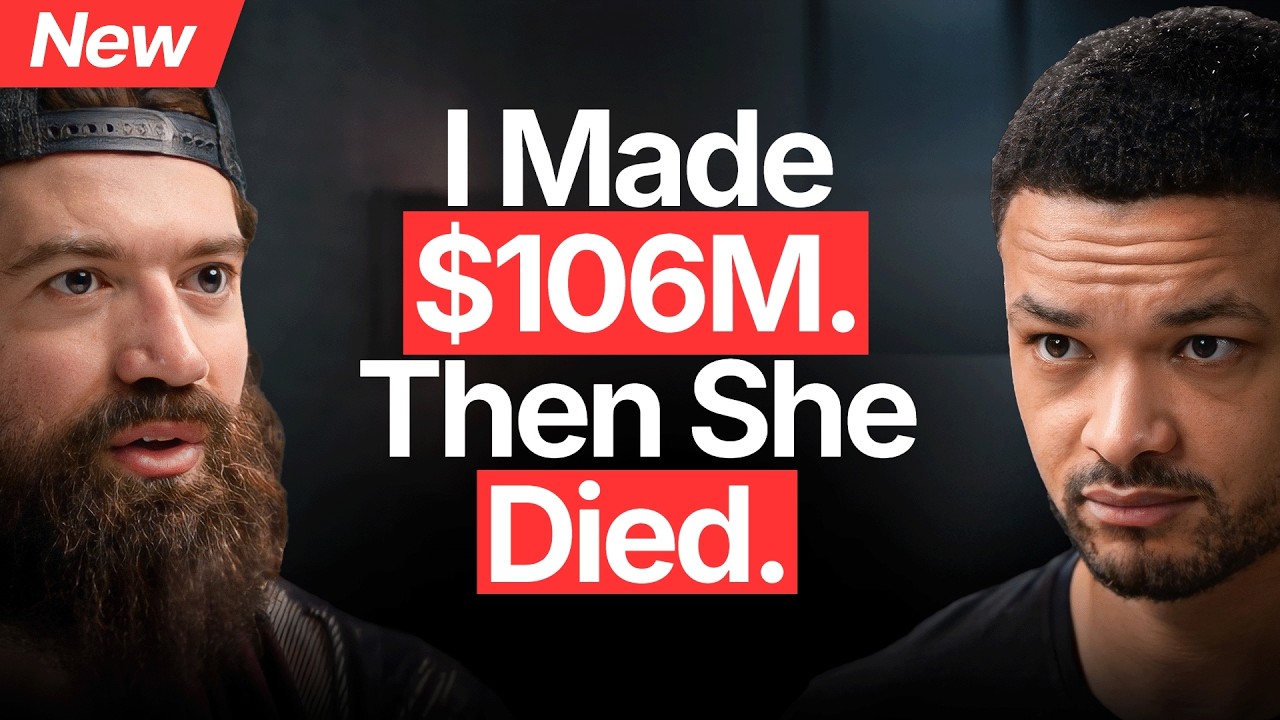
This episode features Alex Hormozi, entrepreneur and author of the “$100M” book series, in conversation with Steven Bartlett on The Diary of a CEO. They discuss how to build enduring businesses, the role of AI in entrepreneurship, long-term thinking as a competitive advantage, pricing and value creation, hiring and delegation, personal history with fear and family, partnership with his wife Leila, parenting philosophy, and a mental toughness framework developed after his mother’s sudden death.
AI and entrepreneurship: using tools without outsourcing judgment
AI is being misapplied by founders who automate non-constraint processes or build AI-native businesses the models will swallow; the test is whether AI adoption actually increases revenue.
Example: a company spent $350K to replace 11 virtual assistants ($11K/month) doing data cleaning — a three-year payback on a non-bottleneck process that didn’t solve their real constraint (demand).
Outsourcing thinking and decision-making to AI makes you dumber; Hormozi keeps his own cognition sharp by refusing to delegate the hardest thinking work.
AI cannot assume liability or ownership; someone must own the LLC, pay for tokens, and take responsibility for decisions — judgment and risk-bearing remain human moats.
In media, stakes create value: MrBeast isn’t replaceable because the $5M and Lamborghini are real; chess and F1 remain popular despite superhuman AI because humans want human stakes.
Long-term thinking changes every foundational decision
Hormozi uses a block-tower exercise: with 5 seconds you stack vertically; with 5 years you dig a deep foundation, use different materials, and build for height — the time horizon dictates the architecture.
“The fastest way to build a $10M business is not the fastest way to build a $100M business” — early speed often sacrifices the foundations needed for durability.
When Hormozi committed to running Acquisition.com “forever,” his decisions shifted immediately: he obsessed over “the factory” (systems, culture, infrastructure) rather than the prototype.
Elon Musk exemplifies this: building batteries and charging networks from scratch looked slow initially but created an unassailable moat years later.
Focus and patience are “enduring competitive advantages because they’re so antihuman” — they fight the instinct for visible, immediate progress.
Retention is the hidden engine of scale; acquisition alone hits a ceiling
Two $3M businesses: Company A keeps all 100 customers/year and adds 100 new (300 total by year 3); Company B loses all customers yearly and must sell 300 new in year 3 to reach $3M.
Company A’s economics compound — existing revenue stacks, CAC stays low, margins expand. Company B faces escalating CAC, margin compression, and a “hole in the back of the bus.”
Most $1M entrepreneurs try to “fit a billion dollars of new sales in one year” because their product isn’t sticky enough; they should have stayed longer in product-market fit.
The two symptoms of a stuck founder: (1) customers don’t stay (offer/sales motion wrong, usually underpriced), or (2) founder runs out of time (margin too thin to hire, rooted in same pricing problem).
Pricing is not about what you “deserve” — it’s what the customer will pay. Founders sell from their own wallet, undercharging because the work feels easy to them.
Hiring: the unicorn fallacy and the ego trap
Founders seek a “unicorn” — one person who replicates their exact skill set and life experience — but unicorns don’t exist.
Better: decompose the unicorn into a rhino (horn), horse (body), fireflies (sparkle) — hire specialists for each discrete function.
This mirrors relationship advice: demanding one partner be coach, therapist, cheerleader, and guru is the same category error.
Ego and fear drive the unicorn hunt: “I’m so special no one can do what I do” is an attractive lie; fear of payroll responsibility rationalizes as “I can’t trust anyone.”
Hormozi’s early hiring mistake: bar wasn’t high enough. The highest-standard person in a department should run it; standards must flow downward from the top.
The value equation: outcome, likelihood, time delay, effort/sacrifice
Value = (Dream Outcome × Perceived Likelihood of Achievement) / (Time Delay × Effort & Sacrifice).
Perceived likelihood explains why a $19 PDF loses to a $3K trainer: same effort, higher belief in result.
Time delay is the most slept-on lever: if you deliver in half the time, you disrupt any industry — customers pay a premium for speed.
Effort = things you must start doing that you don’t want to; Sacrifice = good things you must stop doing. Both are costs the customer weighs.
Amazon bets on invariants: customers will always want cheaper, more selection, faster delivery — then builds systems to maximize those variables.
Fear, starting, and the voice of others
Early entrepreneurship is 100% fear: fear of judgment, failure, uncertainty. The only way to know is to start; the fog clears only as you walk.
You must decide: do you care more about your future than what others think of your future? Someone’s version of you has to die — yours or theirs.
Hormozi belabored quitting his consulting job for 6 months; his father (an Iranian refugee who built a surgery center from Home Depot materials) urged caution: “You’re following the plan.”
He drove halfway across the country before calling his dad, knowing he’d be talked out of it. His father’s intent was protective, but his advice fit a different goal.
Fear lives in the vague; specificity kills it. Plan B in excruciating detail: “If I fail, I sleep on a couch, move home, save capital, try again” — suddenly survivable.
Most people are handcuffed to lifestyle/appearances; you’d be astonished how little you can live on if you’re willing to sacrifice short-term status for long-term freedom.
Personal history: the immigrant father who built from nothing
Hormozi’s father fled the Iranian revolution, failed French medical school twice, restarted in Belgium, completed med school, came to the US where his degree didn’t transfer, ran X-ray slides for two years, got a residency, built his own surgery center from Home Depot supplies to meet code, then survived an ugly divorce where locks were changed on his practice.
When Hormozi wanted to quit his job, his father said “Let’s not be unreasonable” — projecting his own hard-won stability onto his son’s risk.
Hormozi realized: “My dad had absolutely perfect intentions… it just wasn’t the advice I needed for the goals I had.”
The father’s later perspective: “A year, two years now… it’s nothing. When your mind, you’re not even going to remember it.”
Content strategy in the AI tsunami: reality is the moat
Supply shock: AI slop floods platforms; demand is stagnant or dipping (Gen Z usage down since 2022). Each content unit becomes less valuable.
Moat = reality. Elon, Bezos, Buffett are top influencers because they own Berkshire/Tesla/Amazon — a teacher quoting Buffett word-for-word lacks the 100-year track record.
Credibility scales with consequence: beauty tips (low stakes) → personal finance (medium) → business (high stakes, lose your company). Higher stakes = more weight on source credibility.
Hormozi’s pivot: only do what only he can do — fly 100+ million-dollar founders to Vegas for live, interactive, stakes-bearing sessions (Scaler Fail show).
For beginners: “proof of effort” substitutes for “proof of outcome.” MrBeast counting to 100K; record your 12-hour sales day, clip the best 3 minutes — compress time for viewers.
Commoditized tips/tricks with no proof = “why should I listen to you?” Authority lowers the consumer’s cognitive load; they trust Warren Buffett so they don’t have to verify.
Partnership with Leila: the single best financial decision
Hormozi: “The single best financial decision I ever made was marrying Leila.” She believed in him more than he believed in himself, especially in troughs.
She has bigger dreams than he does; when he hit “enough” financially, she pushed the vision toward building a workplace people love — which incidentally compounds wealth.
Operationally, she is the “pure operator” — the team’s loyalty sits with her; without her, he couldn’t attract/retain the talent running the current complexity.
On motivation: Hormozi struggles with apathy (“we have enough, who cares?”), not anxiety. Leila carries him through the flat spots.
For partners who aren’t supportive: figure out what you want. Trade-offs are inevitable. Arthur Brooks’ Ferrari-alone vs. Camry-with-friends test reveals what you’re actually optimizing for.
Parenting: inputs over outputs, skills over outcomes
Hormozi wrestles with defining “good parent” and “successful child” — billionaire but lonely? Happy but low impact? The output is uncontrollable.
Sibling evidence: four kids, same parents, wildly different outcomes (entrepreneur, genius employee, savant gamer, lawyer/hospitality) — environment wasn’t deterministic.
Bezos principle: stay out of the output business, focus on inputs. You can’t control the plant’s genetics (peach vs. apple), but you control water, sunlight, soil, pruning.
Leila’s model: “She’s never tried to change me… he’s going to be Alex.” Goal: equip kids with maximum skills to get what they want out of life, wherever that leads.
Mental toughness framework: four vectors after his mother’s death
Context: $106M launch weekend (culmination of multi-year book strategy); mother attended, died in a freak accident 4 weeks later.
Framework: (1) Fortitude — how much bad stuff before behavior changes? (2) Tolerance — how deep do you fall when threshold is crossed? (3) Resilience — how long to return to baseline? (4) Adaptability — do you return better, same, or worse?
Key insight: “People will judge how much you love someone by how much you choose to suffer.” He rejected this — the lost person doesn’t want you to suffer.
He changed as little as possible: kept recording, working out, helping businesses — because those things made him feel better, and he believed she wouldn’t want him to stop.
“My emotional discomfort is not an adequate reason to change what I’m doing” — applies to business and life. Bad days (statistically ~3/month are bottom 10%) don’t warrant strategic pivots.
Happiness, striving, and the genetic baseline
Hormozi doesn’t claim happiness expertise; he sells quantitative business outcomes, not emotional guarantees.
Arthur Brooks: ~50% of subjective wellbeing is genetic. “Strivers” often have immigrant/conditional-love childhoods — love earned through achievement → addiction to the work loop.
Hormozi: “I’m intensely interested in my life… sometimes it feels good… more days than not probably.” Pride = “very soulful… very filled by this work.”
Camus: “The meaning of your life is the reason you don’t kill yourself” — kids, spouse, people who rely on you. The answer changes across seasons.
Internal feelings are weather: sunny/rainy seasons, baseline adjusts. Half the days are below average by definition; bottom 10% days happen ~3/month — don’t break up with your wife over a bad day.
Future with AI: build trust and distribution; ask what it means to be human
Business response to superintelligent AI: maximize real-world proof, track record, brand trust, distribution — things that won’t change (reputation matters, distribution costs money).
Personal response: think hard about what it means to be human and why you’re here.
Hormozi and Leila nearly bought a ranch after first exit; still “not out of the equation.”