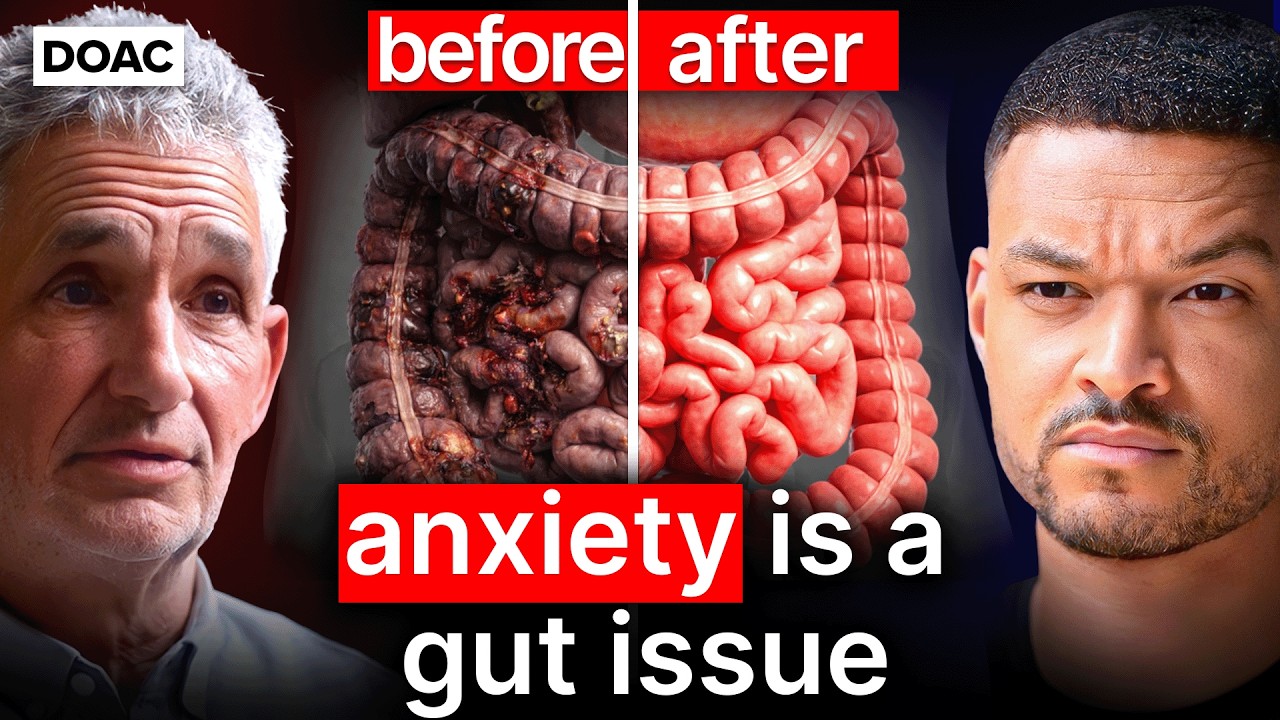
- Professor Tim Spector, one of the top 100 most cited scientists globally and co-founder of ZOE, explains how the gut microbiome is central not just to physical health but to brain health, mood, energy, and the prevention of dementia and other neurological diseases. His personal motivation comes from watching his 93-year-old mother live with advanced dementia, which drove him to re-examine the connections between gut, brain, and immune system.
- For 40 years, medicine has treated the brain as separate from the body, focusing on neurotransmitters like serotonin while missing the bigger picture: inflammation and metabolic dysfunction are at the root of most brain diseases, from depression to Alzheimer’s to Parkinson’s.
- The gut is not just a digestive organ — it contains the enteric nervous system (sometimes called the “second brain,” which actually evolved first), houses 70% of the body’s immune cells, and communicates with the brain via the vagus nerve, with 80% of signals traveling gut-to-brain, not the other way around.
The Gut-Brain Connection Changes Everything
- Mood, energy, and cognition are directly shaped by what you eat, often within hours or days. In every ZOE study, when people improved their diet, the first changes they noticed were improved mood and energy — before any measurable blood or gut changes occurred.
- Families on terrible diets (ultra-processed snacks, sodas, chocolate bars, chicken nuggets) were constantly fatigued, napping during the day, and had no idea their food was the cause. After six weeks on a gut-friendly diet, their mood and energy improved dramatically.
- Sleep disruption drives sugar cravings through an evolutionary stress response: when the brain detects poor sleep, it interprets it as a threat and demands quick energy, creating a vicious cycle of bad food → low energy → more bad food.
- Depression may be an immune system malfunction, not a chemical imbalance. Studies of vaccine responses show that immune activation triggers ~24 hours of depressed mood. In long-term depression, the immune system may be chronically activated, making the brain think it’s under constant attack.
Dementia Is Increasing — And the Gut May Hold the Key
- Dementia is rising even beyond what aging demographics explain. There are two main types:
- Alzheimer’s: protein tangles and localized brain inflammation.
- Vascular dementia (~of all cases): arteries supplying the brain become clogged, driven by high blood pressure, diabetes, and stiff arteries.
- Parkinson’s disease may start in the gut: 90% of people who develop Parkinson’s had gut problems (constipation, bloating) about 10 years earlier. The same misfolded proteins found in the brains of Parkinson’s patients are found in their gut, and the leading theory is that these proteins travel up the vagus nerve over a decade.
- Type 2 diabetes is the single biggest risk factor for brain diseases — people with diabetes are roughly four times more likely to develop conditions including depression, bipolar disorder, schizophrenia, and epilepsy.
- A massive Swedish study of millions of sibling pairs found that most brain diseases share a common genetic susceptibility (called “factor P”) rather than having distinct genetic causes — meaning the same underlying metabolic and inflammatory problems predispose people to many different brain conditions.
- Flossing reduces dementia risk by nearly half: poor oral hygiene allows inflammatory microbes to thrive in the gums, and these microbes appear to enter the brain and trigger inflammation.
The 8 Rules for Gut (and Brain) Health
-
Be mindful about what you eat — pause before eating and consider whether the food is actually good for you, rather than eating blindly in front of screens.
-
Eat 30 different plants per week — each plant feeds specific gut microbes. There are microbes that only eat coffee (Lawsonibacta), others that only eat seaweed, etc. Diversity of plants = diversity of microbes = better immune function and lower inflammation.
- ZOE’s Daily 30 supplement contains 34 freeze-dried whole plants, seaweed, algae, kombucha, and seven mushroom types. In a trial of 340 people over six weeks, it improved gut microbiome scores, digestion (70% of participants), fullness (+41.5%), energy (+43.3%), and happiness (45%) — far outperforming a standard probiotic, which only changed 4-5 microbes versus ~40 for the prebiotic approach.
-
Eat fermented foods — aim for 3 portions daily — fermented foods (yogurt, kefir, sauerkraut, kimchi, kombucha, miso, tempeh) reduce blood inflammation by about 25%. A Stanford study showed this clearly, and a ZOE study of 6,000 people found that half noticed improvements in mood, energy, and reduced hunger after two weeks of eating three fermented portions daily.
- Even dead fermented foods (pasteurized kombucha, sourdough bread, wine, beer) appear to have health benefits — the cell wall debris of dead microbes (“postbiotics” or “zombie biotics”) seems to calm the immune system as it passes through.
- Avoid zero-fat products like zero-fat Greek yogurt — they replace fat with starchy fillers and added sugar. The USDA recently reversed decades of guidance to confirm that fat is good.
-
Pivot your protein — most people get enough protein but focus on eggs and meat. Better sources include beans, legumes, mushrooms, and whole grains like quinoa and pearl barley, which also provide the fiber that 90% of people are deficient in. Fiber is what gut microbes actually feed on.
-
Think quality, not calories — calorie counting is a poor way to assess food. Calorie-restricted diets fail for most people because hunger signals increase, and hunger is the main driver of obesity. Focus on whole, unprocessed foods with their original structure intact.
-
Avoid high-risk ultra-processed foods — these contain additives (emulsifiers, preservatives, gums, colorants, artificial sweeteners) that gut microbes have never encountered in billions of years of evolution. They also cause overeating by about 25% because they dissolve in the mouth like baby food, require minimal chewing, and are hyper-palatable.
- White bread is a prime example: it gives a quick energy spike but leaves you hungrier an hour later. Better options are rye, spelt, and sourdough breads that retain whole grain structure.
- Many people who think they’re gluten intolerant (up to 30% believe this) are actually reacting to emulsifiers, colorants, or other additives in cheap bread — only about 1% truly need to avoid gluten.
- Nuts (almonds, walnuts) are excellent for brain health, cognition, and mood. They contain omega-3s and healthy fats. Walnuts have the strongest evidence for brain benefits, but diversity of nuts is best.
-
Eat as many colors as possible — natural bright colors (berries, purple cabbage, red lettuce) signal the presence of polyphenols, which act as fuel for gut microbes. Bitter plants (broccoli, extra virgin olive oil, coffee, dark chocolate) are also especially beneficial.
-
Give your gut a rest — practice time-restricted eating — a 12-14 hour overnight fast allows the gut to recover, reduces inflammation, and lets the “cleaning team” of microbes do their work. In a ZOE study of 100,000 people, a third found it too hard, a third loved it and still do it two years later, and a third did it intermittently. Even avoiding late-night unhealthy snacks makes a significant difference.
Keto, Metabolism, and the Brain
- Spector has become “keto-curious” because of the ketogenic diet’s remarkable success in treating drug-resistant childhood epilepsy — it works by switching the brain’s energy source from glucose to ketone bodies, essentially “rebooting” the brain.
- The broader implication is that how the brain gets its energy matters enormously for all mental health conditions, though good clinical evidence for keto beyond epilepsy is still lacking.
- Spector sees value in cycling in and out of keto (even for a week at a time) to reset cravings and “food noise” — the constant temptation to eat junk food. The challenge is that long-term keto is hard to maintain and may harm the gut microbiome, so finding a way to do intermittent keto while protecting gut health (e.g., with Daily 30) is an area he wants to explore.
Other Key Factors for Brain Health
- GLP-1 drugs (like Ozempic/Wegovy) will transform medicine and could save health systems hundreds of billions. They appear to be brain-protective and reduce dementia risk beyond just reversing diabetes. However, Spector worries that people take them without changing their diet, leading to yo-yoing, and that long-term effects on personality and drive (reducing risk-taking, addictions) need monitoring.
- Sauna use (ideally twice weekly, with optional cold plunge) acts as a workout for blood vessels in the body and brain, with compelling science behind it.
- Socializing is one of the most important things for brain health. The happiest, longest-lived populations all have strong social lives. Loneliness is one of the worst things for the brain.
- Early life trauma (emotional, physical, or sexual) permanently raises inflammation levels and increases risk for virtually all brain diseases later in life. Talk therapy has been shown to reduce inflammation markers, supporting the idea that psychological and physiological treatments work through the same pathways.
- Microplastics are found in everyone’s blood. Spector tested in the highest 20% for smaller microplastics (likely inhaled from London air over decades of cycling). He now uses water filters and avoids plastic containers, though the science on how harmful they are is still unresolved.
The Bigger Picture
- Spector is most excited about the idea that food choices alone can dramatically improve health and life outcomes. He’s driven by feedback from people whose lives have been transformed by changing their diet, and he believes treating food with the same seriousness as medicine is the most powerful tool we have.
- But he acknowledges the psychological challenge: we live in an environment engineered by a multi-billion-dollar food industry to make us eat badly. Supermarkets are paid more to stock the worst foods at eye level. Knowledge alone isn’t enough — you need tricks: don’t keep junk food at home, change your first meal of the day to break the cycle, and design your environment to make good choices the easy choices.
- The human body is not a single organism but a collaboration of trillions of microbes that co-evolved with us. Our mitochondria (the energy powerhouses in every cell) are descended from ancient microbes that merged with our ancestors. We are, in a very real sense, built from and dependent on microbes — a humbling reframing of what it means to be human.