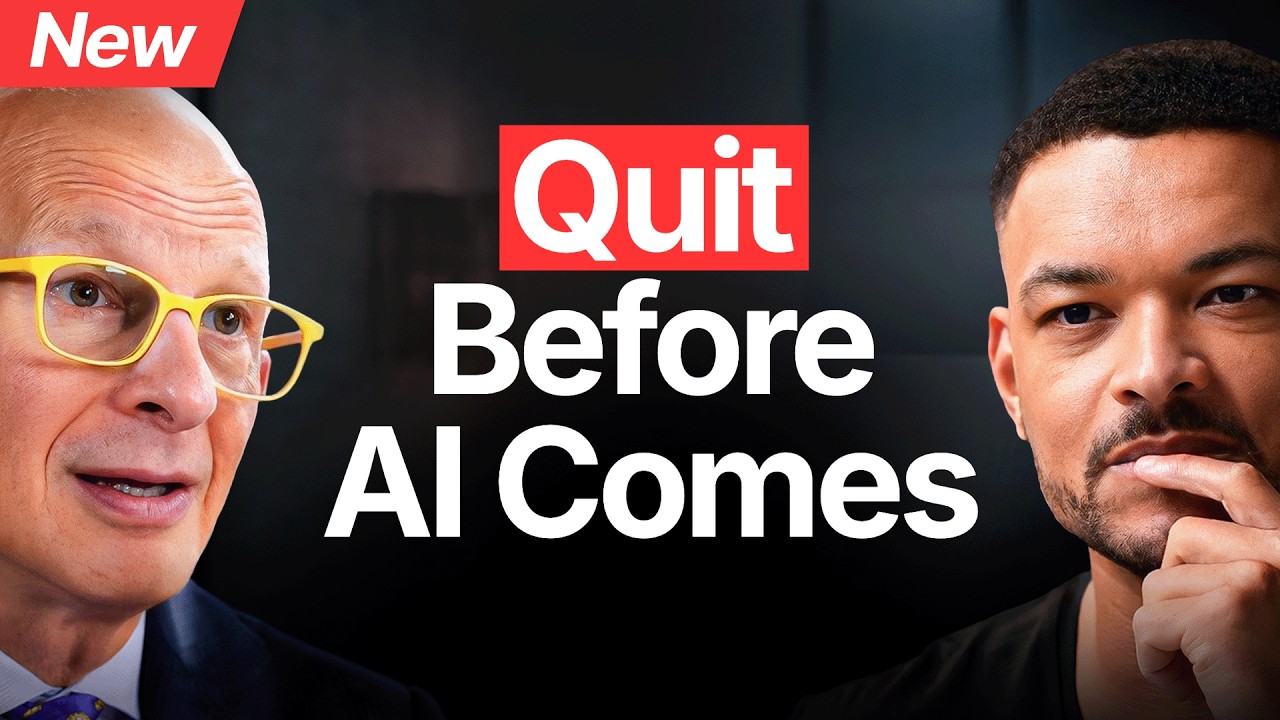
This episode features Seth Godin discussing how to get unstuck in life and work by identifying the hidden conflicts (“knots”) that paralyze us, distinguishing problems (which have solutions) from situations (which must be accepted), and choosing a purpose that lets you serve a specific audience rather than trying to please everyone.
The Core Problem: We’re Stuck Because We Want Two Incompatible Things
The “donkey” analogy (Buridan’s ass): a donkey halfway between water and carrots dies because it won’t move toward one without moving away from the other — we do this constantly with the word “but” (I want creative work but I don’t want rejection; I want to run a marathon but I don’t want to get tired).
The “knot” analogy (Alexander the Great): we’re stuck because we can’t see what’s holding us there — the pole in the center of the knot. Once you remove the pole (name the hidden “but”), the entanglement becomes visible and solvable.
Jackson Pollock’s tragedy: he wanted to be a frontier artist and a celebrated celebrity selling everything — when his second style failed, the conflict destroyed him because he forgot how long the first success took.
How to Get Unstuck: Name the Conflict, Choose One Path
Write down your “but” explicitly: “I want X but I also want Y.” Then decide which you’re willing to pay the price for.
You can’t maximize two things that use the same space (time, energy, identity). You can do many things sequentially over time.
Example: a father with three young kids who wants to launch an AI startup — he can’t do an OpenAI competitor (100-hour weeks), but he can build a business serving 15 regular clients in 40 hours, preserving dad-time.
The Uber driver analogy: instead of surrendering all agency to Uber’s algorithm, he could cultivate 15 private clients who value reliability and safety — same skill, different system, more autonomy.
Purpose Is a Choice, Not a Discovery
Purpose isn’t something you’re born with; it’s the intent you declare for this work: “The purpose of this work is to help [specific people] achieve [specific change].”
Two clarifying questions: “Who is this for?” and “What change am I here to make?”
If you can’t name the “who” (even 5–25 people), you’re trapped under an “amorphous horrible heavy blanket.” Naming the audience dissolves the paralysis.
The stand-up comic bombing for an Italian tour group: the jokes weren’t bad — the audience was wrong. “It’s not for you” is a valid, freeing conclusion.
Resistance, Embarrassment, and Shame
Resistance (Steven Pressfield): any feeling that keeps you from generous, generative, creative work — writer’s block, outfit-changing before a date, not starting the podcast.
Systems (school, corporate, social media) indoctrinate us to seek permission, avoid initiation, and be cogs — resistance serves the system.
Naming resistance doesn’t eliminate it; you “dance with it,” invite it for tea, say “this is resistance,” and move anyway.
Lisa’s potluck: moved to LA knowing three people, started weekly dinners requiring each guest to bring a new person — 50 weeks later, 400-person network. Anyone could do it; resistance stops almost everyone.
Embarrassment is the cost of entry. The “anonymous blog for 100 days” hack: publish under a pseudonym to prove nothing fatal happens when you show up publicly.
Shame requires your participation to land. A 4-year-old taunting you through a fence — you can refuse to receive it. “Sorry, it’s not for you. I forgive you.”
The Shake Shack French Fry Lesson: Know Who You’re Serving
Danny Meyer switched to fresh-cut fries to please NY critics; the fries became inconsistent, staff hated making them, customers revolted.
He asked: “What is the purpose of the fries? To make critics happy, or to further the Shake Shack story?” Reverted to crinkle-cuts — profits and morale recovered.
Amazon’s empty chair for the customer in every meeting: anchors decisions to the person served. (Though Godin notes Amazon later lost this by prioritizing ad revenue over search quality.)
Applied personally: every meeting, project, decision — ask “Who is this for? What is it for?” If it’s just to make the boss feel heard, send a memo instead.
The Three Drivers: Fear, Affiliation, Status
Fear (freedom from fear): avoiding things that make you nervous — keeps you small.
Affiliation: fitting in, doing what the group does — “you don’t wear a tuxedo to a funeral.”
Status: who eats lunch first at the oasis — not money, but relative standing. Drives car purchases, brand choices, career moves.
Example: buying a fast car not for speed but to prove something to a high-school bully. Once named, you can decide if that’s the problem you want to spend resources solving.
Sunk Costs Are Gifts You Don’t Have to Accept
Sunk cost fallacy: holding a losing stock because you paid more for it; staying in a bad lease because you signed a 4-year term.
The parking app example: you prepaid $35 for a garage, then see a free street spot. The $35 is gone — a gift from your past self. Take the free spot.
Law degree you hate: “a gift from your former self. Like all gifts, you don’t have to accept it.” Forgive it, untie the knot, choose differently now.
Relationships: healthy ending acknowledges “we were right for each other then; we’re different people now. Based on who we are today, do we recommit?”
Loss Aversion and the Evolutionary Trap
Losing £10 hurts twice as much as finding £10 feels good — we’re wired to protect what we have because in evolutionary history, risking a sure meal for a potential second one was fatal.
Modern culture changes faster than biology — AI frontier models launch weekly. We can either hide (seek stasis) or declare a purpose and use the change.
Picking Yourself: Gatekeepers Are Gone
Old system: do well in school → college picks you → company picks you → promotion → die. Billions indoctrinated to “wait to be picked.”
New reality: microphone, camera, typewriter, AI — all $20/month or free at the library. No one will call. You must pick yourself.
LBC radio audition: Godin never heard back, started podcast in kitchen instead. Now they’d call him — but he’s too busy.
Waiting to be picked is a shield against fear. “They picked me” lets you avoid responsibility for the outcome.
Publishing your own book / starting your own channel: you lose the excuse “they asked me to do this.” That’s why fewer people do it than you’d expect.
Delusion vs. Viable Path
You’re probably delusional if you’re skipping intermediate steps toward a famous happy ending (NBA player, bestselling novelist with big advance).
Test: make a PDF of your novel, email 20 people. If they share it, someone will call. If not, write a better novel. Don’t demand the world owe you for your effort.
Smallest viable audience: “What’s the smallest group where making a difference would be enough?” People hate this answer because it’s comfortable to stay stuck in “I’m a genius nobody understands.”
Customer traction (Steve Blank): “How many customers would miss you if you shut down tomorrow?” For a pizza place, 100 is enough.
Generous Tension: The Only Way Forward
Launching anything new requires creating tension, not relieving it: “You might be left behind. I have something that helps. You don’t know what it is yet.”
Taylor Swift concert: 15,000 seats, 40,000 want in. She creates tension by scarcity (tonight only). If she won’t create tension, she can’t tour.
Awkward to say “I’m doing this event, hope there’s room for you” — but it’s the only way to cause others to move.
Juggling Is About Throwing, Not Catching
Beginners lunge to catch (outcomes: weight loss, friends, revenue) and drop balls. Pros master throwing (the practice: showing up, writing, making promises).
If you get good at throwing — seeing problems, finding audiences, being generous — the catches take care of themselves.
Self-improvement podcasts obsess over catches. The practice (throwing) is under your control; outcomes aren’t.
Consistency Over Authenticity
“Authenticity is for amateurs. Professionals are consistent.” (Keanu Reeves isn’t “authentically Neo” — he plays Neo reliably.)
Friends/family want authenticity. The market wants a kept promise.
Perfectionism is a trap: “perfect” is unachievable, so announcing perfectionism = hiding (“I’ll never ship because it’s never perfect”).
Quality = meets spec. A 1998 Celica had higher quality than a 1998 Rolls-Royce because parts fit better. Raise the spec if you’re unhappy.
You shouldn’t sign up for work where you can’t happily be consistent. But consistency is a choice about the promise you make — it rhymes with your authentic self but isn’t identical to it.
Your authentic self changes over time based on the promises you keep (affiliation, status). Wall Street types become “Wall Street people” by hanging out there.
AI: Biggest Change Since Electricity — Work With It or For It
Two big ideas: (1) AI is the biggest shift since electricity. (2) Either you work for AI, or AI works for you.
1890 blacksmiths waiting for electricity to “go away” failed. This is faster.
If you work for AI: bosses push AI to do the good parts, you get the gig-work leftovers — insecure, unhappy.
If AI works for you: use it to connect humans, build trust networks. AI cannot replace human networks. Trusted connectors using AI tools will always make a living.
Jobs where you can write down the daily rules (bookkeeping) → AI will do faster/cheaper. Jobs where you can’t write the algorithm (curating podcast guests, leading retreats) → safe.
Godin’s fiancée’s breathwork retreats: “Most of what they get is each other.” Human connection is the scarce value.
Doctors with AI: spend more time per patient, not less. Patients pay for the human + AI combo over Dr. Google.
Dame Fina Cooper: One 80-Year-Old Changed a Country
Indigenous Māori woman in NZ, 78, organized 50 people to march to Parliament for land rights. Month-long walk grew to 4,000 people. Shifted national culture and laws.
She didn’t do it alone — she used her agency to connect others, build a culture, show up repeatedly with a practice.
“If one 80-year-old woman can change a country, what can we do?” We can’t fix everything, but we can find our people, tell a new story, establish a new normal.
Creating Urgency: The Meeting With Your Future Self
“When the person you’re dreaming of becoming meets the person you become, how’s that meeting going to go?”
Regret is powerful fuel: Godin regrets omissions (people not helped, doors not opened) far more than failed attempts.
The Carbon Almanac: 1,900 co-authors, 2 years volunteer work → bestseller in 5–6 countries, launched careers. Started with “I could post something and see who shows up” — easy to skip, but the practice of saying “this is next” creates a generative cycle.
Why He Keeps Going
Email marketing was for survival. Books are a lousy living but a good way to make a difference.
“Turning your business into a hobby” — doing what you love because you chose it.
Hearing “I learned from someone who learned from someone who learned from you” is the thrill. Turning on lights, offering dignity, creating the next cycle — if you sign up for that, you can’t stop.
Final Advice for the Stuck
“You’re not alone. We all are. Especially me.”
Forgive the stuckness. It’s real. The situation may not be fair. Feelings are real.
Only question: “What will we do next?” → “Who can I contribute to today? Who can I offer help to and maybe ask for help?”
In a noisy digital world (Instagram beaches shouting “your life sucks”), the critical skill is choosing which voice you serve. Knots form when you try to serve them all.
Would You Live Forever?
No. Selective immortality = heartbreaking curse. Everyone you love dies; you’re the only one not on the boat’s journey. Connection defines humanity — opting out of the shared journey loses the meaning.