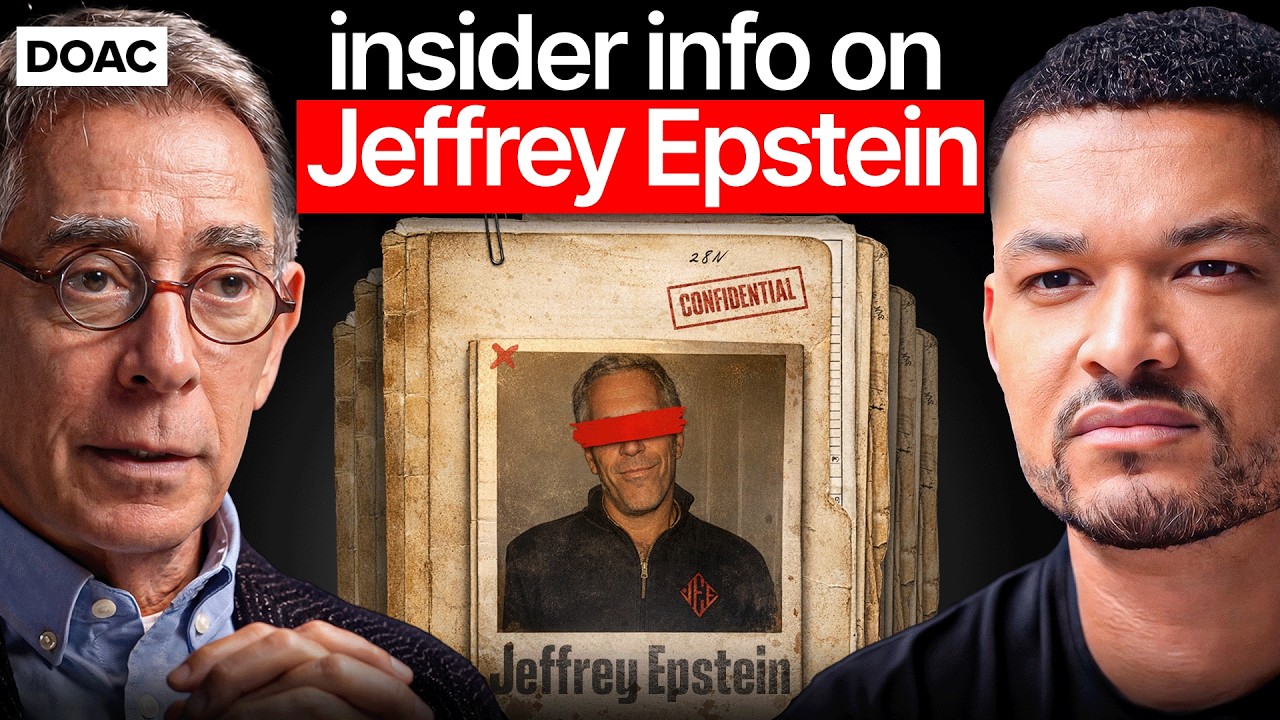
Gavin de Becker, one of the world’s foremost security experts, spent decades protecting the most powerful people on Earth — from heads of state and royalty to billionaires and celebrities — and in this conversation he pulls back the curtain on how governments actually operate, why privacy is effectively dead, what the Epstein affair really was, and how to navigate a world built on deception and fear.
He runs a firm focused on anti-assassination and threat management, with divisions for physical protection, threat assessment, and cybersecurity. He does not confirm or deny specific clients, but names that have entered the public record through other sources include Jeff Bezos, Elizabeth Taylor, Cher, Madonna, and Barbra Streisand.
His core message throughout: power centers — governments, corporations, institutions — lie as a default, and the most important survival skill is learning to trust your own intuition rather than official narratives.
There Is No Phone Privacy If a Government Wants In
The Saudi Arabian government used a system called Pegasus 3, developed by Israel’s NSO Group, to remotely hack Jeff Bezos’s phone. It required no click from the user — a “no-click exploit” — and could access everything on the device from 7,000 miles away, including turning on the camera and microphone even when the phone was off.
Pegasus 3 was obtained by Mohammed bin Salman (MBS) and used on dissidents worldwide, as confirmed by United Nations investigations.
Bezos was targeted because he owned the Washington Post, which had been critical of Saudi Arabia after the murder of journalist Jamal Khashoggi, and because of competitive and economic tensions around Amazon’s dealings in the region.
De Becker’s firm was brought in by Bezos to investigate how the hack occurred. At the time, de Becker himself did not know Pegasus 3 existed.
The broader lesson: there is no reliable protection for the confidentiality of your phone. Even when companies like Apple patch exploits, thousands of people immediately begin working on the next one. Any solution offered today will be temporary.
De Becker advises a radical behavioral shift: assume everything you text or email is visible to someone. He cites a friend who routes every message to his executive assistant — the awareness of being watched changes behavior and reduces risk.
The US government itself has hacked the phones of allied leaders, including the prime ministers of the UK and West Germany and the president of France. Surveillance is a permanent feature of international power.
The Epstein Operation Was a Blackmail Construct, Likely Run by Israeli Intelligence
De Becker’s assessment, based on inside information from government agency clients and from clients whom Epstein’s group approached, is that Jeffrey Epstein was not a self-made billionaire but a “construct” — an artificial persona created to serve as the front of a sophisticated intelligence blackmail operation.
His wealth — roughly $500 million — came from Les Wexner, the founder of Victoria’s Secret, a major donor to Israel. Wexner gave Epstein the money along with power of attorney to invest it as he saw fit. De Becker calls this an extraordinary and suspicious arrangement.
Epstein’s earning history is “highly suspect.” The private jet, the island, the homes, the access — all were part of the construct designed to attract powerful people into a controlled environment.
The mechanics of the trap: Epstein’s New York apartment and his island were equipped with hidden cameras, and later audio recording. Young women — some underage — were presented as massage therapists. Victims would be recorded in compromising situations.
The blackmail did not always take the form of direct threats. A more effective method: Epstein would call a target, express concern that a recording existed, position himself as the rescuer who could “handle it,” and thereby gain permanent leverage. The target would feel indebted and compliant for life.
De Becker notes that very few people would have the character to do what Bezos did — publicly expose an extortion attempt rather than submit to it.
The 2008 plea deal was one of the most unusual in American history. US Attorney Alexander Acosta (who later became Secretary of Labor) gave Epstein a deal that protected not just named co-conspirators but unnamed co-conspirators — potentially dozens of people. When asked why, Acosta said he was told Epstein “belonged to intelligence.” He later resigned over the controversy.
Epstein’s introduction to the world of high finance came through William Barr’s father. William Barr was the Attorney General when Epstein died in prison.
Ghislaine Maxwell’s father, Robert Maxwell, was an Israeli intelligence asset whose funeral in Israel was attended by the prime minister and every living head of Mossad director. Eulogies described deeds for Israel that “the world will never know about.”
De Becker believes the operation served Israeli intelligence specifically, and that the US government’s reluctance to release unredacted files stems from the involvement of an ally. He notes that senior US officials already know the full story.
When the FBI executed a search warrant on Epstein’s apartment, they found and photographed discs labeled with content but did not seize them, saying they would return with a warrant. Six days later, everything was gone.
Congress passed a law to release everything unredacted, but significant redactions remain.
Governments Lie as a Default — And Take Decades to Admit the Truth
De Becker’s view, shaped by working in the Reagan administration and decades in security, is that all power centers in human history lie. The relevant question is not whether an official narrative is false, but what the truth might be.
He draws a direct line from the Epstein cover-up to a pattern of institutional deception that repeats across decades:
Johnson & Johnson baby powder contained asbestos. The FDA was told in the 1970s and began “studying” acceptable levels. A ruling against asbestos in baby powder came only in 2024 — 52 years later.
Agent Orange was tested on lab mice; 38 of 40 died within 5 days. The results were classified. The government denied harm for decades before finally admitting it caused birth defects.
Opioids killed roughly 100,000 people through heart attacks. Companies were fined, but the fines were trivial relative to profits. No individuals went to jail.
Vioxx, silicone breast implants, and arsenic in baby food all followed the same pattern: deny, study, delay, admit decades later.
De Becker predicts the same trajectory for mass vaccination, where he believes myocarditis, pericarditis, and cancer in young people will eventually be acknowledged — but only after many years.
He argues that representative democracy is a tiny sliver in the pie chart of human governance. The norm is tyranny, and even democracies constantly drift toward totalitarianism through the accumulation of laws and the power of unelected regulators.
40,000 new laws are passed in the US each year. Almost none are rescinded.
The Empire Is in Decline, and Division Is the Method of Control
De Becker describes the United States as an empire in decline, noting it has 760 overseas military bases and a military budget larger than every other country in the world combined. China, by contrast, has one overseas base.
The method of control in any system of power is fear, and fear produces division. Rulers benefit when the population is fighting each other rather than questioning those at the top.
He uses the metaphor of a king and queen looking over the castle wall: when their subjects are fighting each other, they high-five. When the subjects unite, they are coming over the wall.
He believes the Western world is in a period of social decay that is visible in cities like Los Angeles, where every freeway on-ramp has tents underneath it. But he draws optimism from the resilience of human beings:
Even after nuclear war or civilizational collapse, small groups of people will reorganize, share skills, and begin again. Survival does not depend on electricity, plumbing, or institutions.
Historically, power consolidates: from thousands of small governance units to about 190 countries to roughly five power centers, and eventually to two. His prediction is that the final contest will be between the US and China.
We Are Already at War — And Technology Far Exceeds What the Public Knows
De Becker challenges the assumption that the US is at peace. He argues the US is already at war with Russia, providing satellite intelligence, electronic warfare, drone strategies, and targeting information to Ukraine. War is no longer just soldiers with rifles.
He visited a CIA museum and was shown a mechanical dragonfly the size of a real dragonfly, built in 1967 — before miniaturized electronics existed — that could fly into a room, record, and fly out. This illustrates that the technology available to intelligence agencies today is vastly beyond what the public has access to.
His belief: everything the public has access to now (like AI) is probably what intelligence agencies had 10 years ago.
The proliferation of AI-generated content is creating a “dead internet” problem where bots flood the web with synthetic content, making it increasingly difficult to determine what is real. De Becker sees this as ultimately beneficial because it forces people to redefine what they consider real — touch, nature, children, animals, genuine human connection — and to spend their time on irreplaceably human experiences.
Intuition Is Your Most Important Survival Tool
De Becker’s first book, The Gift of Fear, remains the best-selling book in the world on violence after 25 years. Its core argument: intuition is the nuclear defense system that all human beings have, and it is far more powerful than logic.
The root of “intuition” is the Latin intueri, meaning “to guard and to protect.”
Intuition is always right in at least two ways: it always has your best interests at heart, and it is always based on something — even if you cannot immediately identify what.
Logic is weak and plodding (A, B, C, D). Intuition goes from A to Z instantly. Every major success in life — including Bezos’s Amazon Prime, which was opposed internally — came from intuition, not from PowerPoint presentations.
The training needed is not to improve intuition but to stop ignoring it. He gives the example of a woman who feels fear when entering an elevator with a strange man but gets in anyway because she does not want to seem racist. He says: let the door close. Wait for the next elevator. It is a low-cost decision.
He references Magnus Carlsen, the world’s greatest chess player, who confirmed that his first thought is nearly always right and he spends the rest of his time confirming it. Studies on professional dodgeball players showed the same: when given less time to decide where to throw, they made better decisions.
Intuition must be trained through experience and pattern recognition. In areas where you have deep experience (like hiring, after thousands of iterations), your intuition is reliable. In new areas, it is less so — but it is still signaling something worth investigating.
What He Would Tell His Children About Living a Fulfilling Life
Contribution to others is essential to believing you belong here. This is especially important for people who had difficult childhoods and struggle with self-love.
What is right for you is always right for the other person. This was the hardest lesson for de Becker to accept. When he fired people, he used to believe he was destroying their lives. In reality, people he fired went on to thrive elsewhere. What is right for you frees both parties.
Everything you want is downstream. Stop swimming upstream. When the universe says no, accept it. De Becker shares a personal story: after a breakup, he flew to Bali to apologize to his ex-girlfriend with no agenda of getting her back. He told her he was leaving. In the 48 hours before his flight, they fell in love again. She is now his fiancée. The moment he stopped fighting, everything flowed.
He believes in predetermination — that life is consciousness trying to understand itself, and that every experience, including this conversation reaching millions of people, was always going to happen this way. He draws this from his teachers in India, particularly Nisargadatta and Ramesh Balsekar, who described human beings as “robots” acting out a script written by the universe.
His Childhood: Violence, Addiction, and the Path to Service
De Becker’s mother was a heroin addict who was violent and troubled. She shot his stepfather in front of him. He estimates there are nine bullets still in the walls and floor of his childhood home. She committed suicide when he was 16, which he experienced as a personal failure because he believed it was his job to keep the family alive.
He has reached a state of healing that he defines as no longer using any energy to manage the past. This frees all energy for the present.
In a dream, he asked his mother why she was so cruel to him. She seemed perplexed and said, “Cruel to you? I was preparing you for this extraordinary life.” He believes this is true.
His ambition for money and status is gone. His work now is about service — and he sees everyone in public life, whether they provide good examples or bad examples, as serving a purpose.
He applies this even to family: a friend who learned to speak more quietly because his aunt talked too loudly, to be more gentle because his uncle was rough, to listen because his father never listened. Every person is a teacher.
How to Think Clearly in a Distorted World
De Becker is deeply skeptical of centralized institutions — governments, large corporations, agencies like HHS with a $1.7 trillion budget and tens of thousands of employees. He believes they have nothing to do with humanity and everything to do with process and bureaucracy.
He advocates for subsidiarity — governance at the most local possible level. He points to Fijian villages of about 300 people, where the chief lives as everyone else does, and where people are born, grow up, marry, have children, and die all in the same house with the same people. There are no anonymous transactions.
In business, he kept his company at around 600 people because at 1,000, he lost the ability to know individuals. He developed a system called CARE (continuous asking, responding, and evaluation) — every employee answers a daily question when they log in, and he receives the statistical results. This allows him to detect problems like sexual harassment, discrimination, or unauthorized firearms in the workplace without relying on middle management.
His advice for navigating the modern world:
Trust your intuition over official narratives.
Assume no digital privacy and behave accordingly.
Cancel plans freely — you are not obligated to keep commitments made months ago.
Spend time on what is irreducibly real: touch, nature, animals, children, genuine human connection.
Let go of swimming upstream — when something feels impossibly difficult, it may be the universe telling you no.