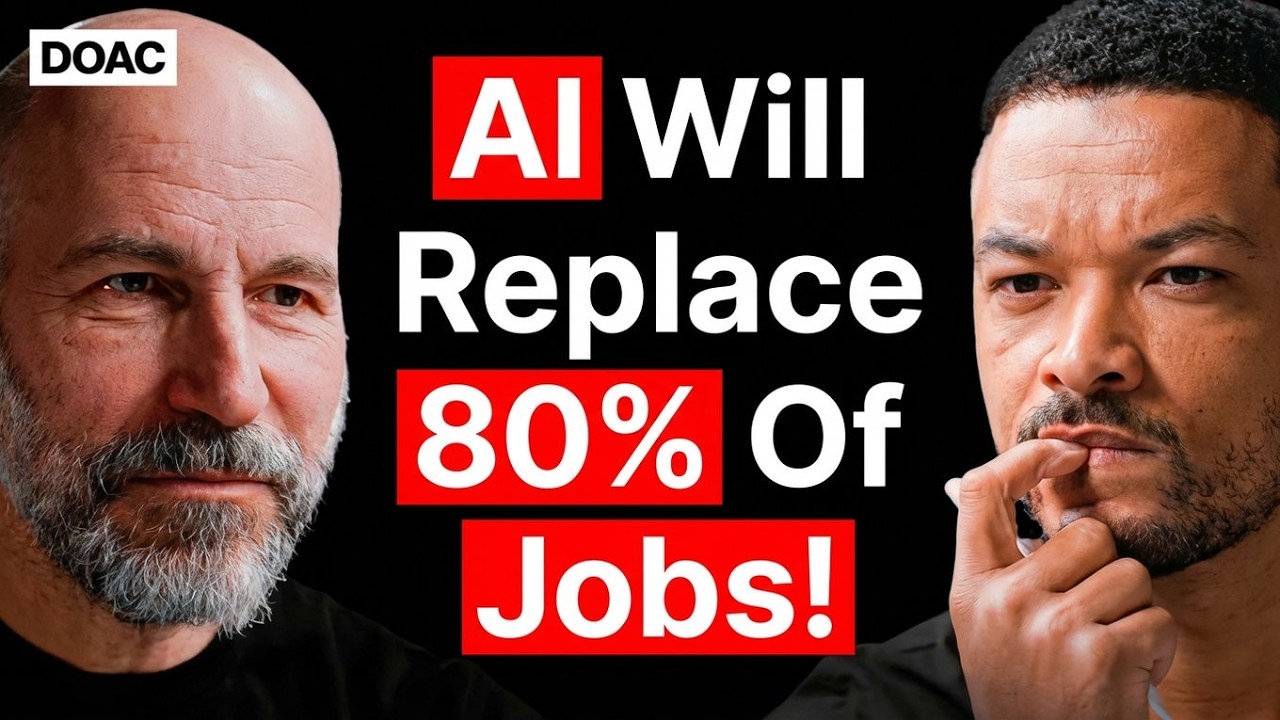
Dara Khosrowshahi, CEO of Uber, fled Iran as a child during the 1978 Islamic Revolution, an experience that forged his relentless work ethic and deep sense of insecurity that drives him to never take success for granted. He went on to lead Expedia for 12 years, growing sales from $2.1B to $8.8B, before taking over Uber — a company then losing $2.5–3B per year — and turning it into one generating $8.5B+ in annual free cash flow. The conversation covers how he builds culture, his philosophy on hard work as a learnable skill, his approach to radical transparency as a CEO, and his honest reckoning with AI’s potential to displace millions of workers, including Uber’s own 9.5 million drivers and couriers.
How fleeing Iran shaped his identity and drive
Born into a wealthy Iranian industrialist family that lost everything during the 1978 revolution; revolutionary guards fired bullets through his family’s living room, forcing them to flee to the US when he was 9.
His father was deeply diminished by the loss — his sense of purpose and identity were destroyed, and he was later trapped in Iran for six years without an exit visa.
This experience left Dara with a permanent feeling of insecurity: “I never feel safe” — a drive to rebuild and make his family proud, but also a refusal to ever take stability for granted.
His mother went from never having to work to becoming a salesperson to support the family, modeling resilience.
He describes himself as “over-stoic” — taught not to complain or express emotion — which he actively fights against in his personal life, though it serves him professionally.
The philosophy of hard work as the foundational skill
Dara’s core advice to young people: the most important skill in life is the ability to work hard — and it is a learned skill, not an innate one.
He points to elite athletes like Ronaldo and Michael Jordan: talent separates good from great, but relentless discipline and work ethic are what make the difference.
“I’m not going to let anyone outwork me” — this mentality compounds over time and becomes a massive competitive advantage.
He has never seen someone who isn’t a hard worker become one, suggesting the trait is largely formed early.
At Uber, this is codified culturally: “Don’t come here if you want to coast.” He is explicit that the company is demanding, but offers real agency and impact in return.
He distinguishes hard work from lack of flexibility — he protects family dinner time but works late at night and early morning; it’s about total commitment, not just hours logged.
Building culture and leading organizations
Radical transparency as self-defense: Dara believes most CEO failures come from bad data, not bad decisions. He tells his teams the hard truths so they feel safe telling him the hard truths back. If people can’t handle the truth, “then they leave.”
Going to the source: Learned from Barry Diller — skip the summaries, talk directly to junior engineers and analysts who haven’t learned to filter yet. He maintains random direct channels deep into the organization to bypass the information gatekeeping that naturally occurs in hierarchies.
Turning around Expedia: Arrived to find a technology engine that was broken — old codebase, coasting leadership. He turned over nearly the entire team quickly and replaced them with hungry, mission-oriented people. He ended up running both the parent company and the main business himself for 5–6 years, which is where he discovered his true love: operations.
Continuous improvement as organizational DNA: Every team at Uber is measured on optimizing their specific function every single day. The company operates like an organism where no part is static — if one team isn’t improving fast enough, another will replace them.
Values done right: His first attempt at company values failed because they were generic and crowd-sourced. He wrote one himself — “Do the right thing. Period.” — which placed responsibility on employees to use judgment. The surviving value set includes “Go Get It” (aggressive, move fast) and “Great Minds Don’t Think Alike” (intellectual diversity and constructive disagreement).
Toe-stepping: A value encouraging people to challenge each other even when uncomfortable — though he acknowledges it can be weaponized as an excuse to be a jerk.
Spotting transitions and betting on people
At Allen & Company and later at IAC/Expedia, Dara learned from Herbert Allen: “Always bet on people. Companies go up and down, but great people stay great.”
He defines great people as those with honor, loyalty, follow-through, and hard work — not just talent.
His investment thesis at Expedia was identifying the shift from phone/retail commerce to online commerce — buying Ticketmaster, Match.com, Hotels.com, and Expedia itself. The pattern: electronic transactions that didn’t require physical fulfillment.
Linear vs. exponential thinking: Humans naturally project linearly, but technology companies grow exponentially. The opportunity lies in the gap between the straight-line projection and the hockey-stick reality. He overpaid for every great company he bought by contemporary market standards, but was right about the exponential outcome.
Jevons paradox: When something becomes radically easier or cheaper, demand expands far beyond the original market. Uber proved this — the market for on-demand transportation vastly exceeded the black car and taxi market it replaced.
AI, autonomous vehicles, and the future of work
Uber is fundamentally an AI company at its core — pricing, routing, matching, batching are all driven by AI models trained on local conditions and stitched together across 40 million daily trips.
Coding transformation: ~90% of Uber’s engineers now use AI tools; ~30% are power users showing measurably higher productivity (code diffs per engineer). Dara expects the engineer’s role to shift from writing code to orchestrating AI agents that write code.
Autonomous vehicles: Waymo and Tesla FSD are already statistically safer than human drivers. Dara believes the majority of Uber’s trips will be fulfilled by autonomous vehicles within 15–20 years.
The honest reckoning: Uber has 9.5 million drivers and couriers — the largest organized flexible workforce in the world. Dara is unusually candid that these jobs will be displaced: “What do the 9 million people do? I don’t know.”
He is expanding the platform into delivery, shopping, and AI training work (“Uber AI Solutions”) to offer alternative income, but acknowledges he can’t say whether platform expansion will outpace automation.
Broader societal disruption: He estimates AI will replace 70–80% of human-capable intellectual work within 10 years, and physical work within 15–20 years. Unlike past technological transitions (farming, industrialization), the speed of change may not allow society time to adjust.
Retraining at scale is not a core capability of any country he’s aware of. Universal basic income experiments have consistently failed to improve outcomes, likely because work provides meaning and self-worth beyond income.
He refuses to be falsely reassuring: “I’m not going to do the BS.” He answers questions honestly even when the answers are uncomfortable, because audiences and interviewers can tell when a CEO is pivoting and dodging.
What he tells his own kids: Work hard, stay curious, don’t over-plan. People with rigid career plans lose curiosity and ignore signals that could change their lives. “Before you go out and try to change the world, let the world change you first.”
Personal reflections and what drives him
He is conflict-avoidant in his personal life (a product of being the youngest who “went with the flow”) but has learned to push through it with his wife Sid’s help — because avoiding conflict builds resentment.
He left Expedia — where he was the highest-paid CEO in US tech — largely because Daniel Ek told him: “Since when is life about being happy? It’s about making impact.” His father’s advice in Farsi: “When a company that’s a verb tells you to run it, you just say yes.”
The conversation he wishes he could have: a deep, honest talk with his father about his life, regrets, and experiences — something their stoic relationship never allowed. He now tries to have those genuine conversations with friends, family, and colleagues as a way of correcting for what he missed.