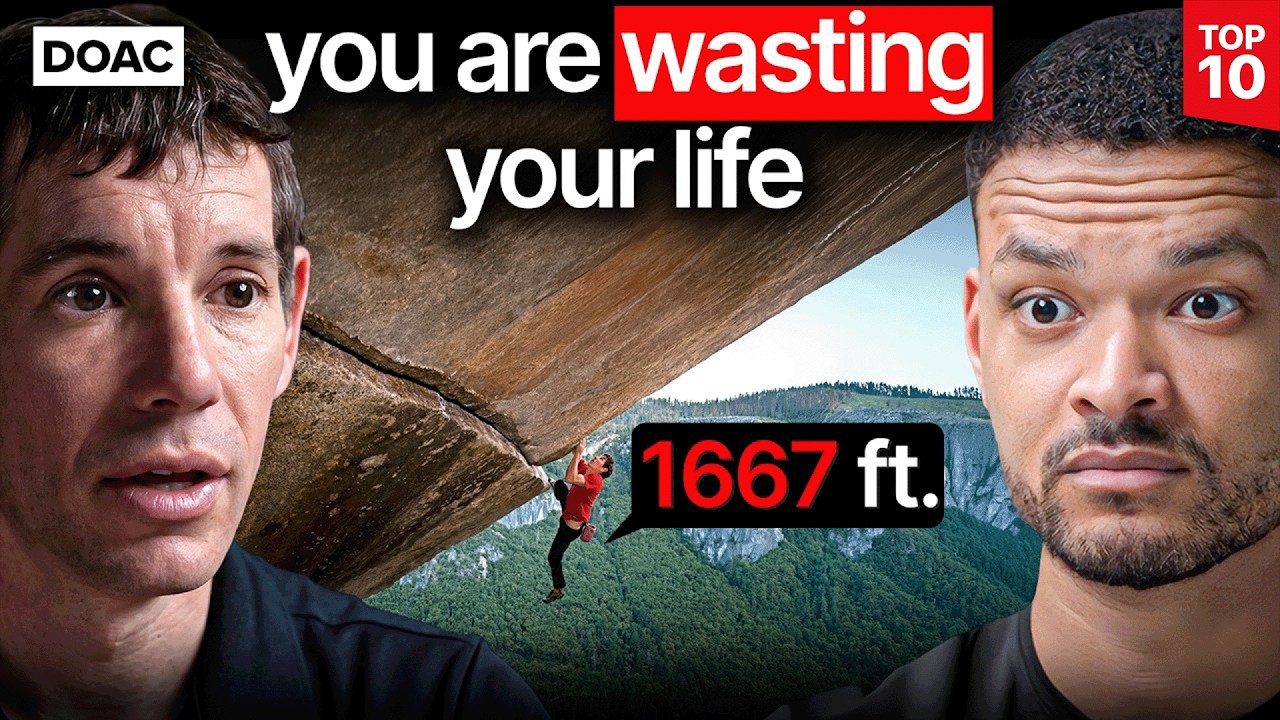
Alex Honnold is the world’s most famous rock climber, best known for free soloing El Capitan in Yosemite (climbing without a rope or protection), a feat captured in the 2018 documentary Free Solo. In January 2025, he climbed Taipei 101, one of the world’s tallest skyscrapers, live on Netflix. This conversation explores how his childhood, relationship with fear, philosophy of risk, and relentless preparation made him who he is, and why his life is less about being fearless than about being intentional.
His Childhood Shaped Everything
Alex grew up in a tense, emotionally reserved household. His parents stayed together “for the kids” despite a fraught relationship, and his father was deeply depressed for most of Alex’s childhood.
His mother was a high-perfectionist polyglot and artist who implicitly demanded excellence. She had a phrase that translated roughly to “not good enough” — anything less than perfect didn’t count.
Alex’s father died unexpectedly of a heart attack at 55, the season before Alex dropped out of university and began living in a van to climb full-time. The inheritance (put into bonds) gave him roughly $300 a month to live on.
The family was not athletic or outdoorsy. Both parents were professors. Alex describes himself as a “middle class suburban kid” with no natural aptitude for sports.
Living in a Van for 10 Years
From ages 20 to 30, Alex lived in vans, starting with his mother’s stolen minivan and then a Ford Econoline he bought for $10,000. He did three buildouts over the decade, the last one quite refined.
He describes this period as the best of his life, not something he “endured.” He was optimizing for challenge and growth, not money or fame.
His mother was supportive, partly because he was young enough that it looked like a gap year, and partly because external validation (sponsors, media) signaled he was good at something.
He earned roughly $10,000–$100,000 per year from climbing sponsorships during this period, which was more than enough given his lifestyle.
His Career Arc Follows a Power Law
Alex drew his career trajectory as a long flat line with two major inflection points: the Free Solo documentary (2018) and the Taipei 101 live climb (2025).
He argues this is common in winner-take-all fields (comedy, magic, sports): you struggle as one of many, then suddenly become “the dude who does the thing” and earnings jump dramatically.
His advice: focus on doing the thing as well as possible, and the money follows. He did years of climbing films for free, which led to a National Geographic cover, a 60 Minutes profile, and eventually corporate speaking.
Why He’s Not Actually Fearless
The famous fMRI brain scan from Free Solo showed his amygdala lighting up less than a control subject’s when shown scary images. Many people concluded he doesn’t experience fear.
Alex hates this interpretation. He points out he was lying safely in a metal tube looking at black and white photos — of course his fear response was muted. The scan showed the effect of 20 years of conditioning, not a missing amygdala.
He says he is scared all the time as a climber. Even with a rope, you’re constantly visualizing what happens if the gear fails. After years of low-level fear, you get better at managing it.
He draws a parallel to public speaking: 10 years ago he couldn’t get words out on camera. After years of interviews and film tours, it’s now easy. That’s exposure therapy, not a different brain.
How He Actually Manages Fear
There is no hack. You get scared over and over for years, and eventually it becomes manageable. This is slower in climbing than in “gravity-assisted sports” (skiing, kayaking) because climbing is slow — you make one move, then another, and fear creeps in at each step.
He uses rational assessment: “Am I actually in danger right now, or is my mind running away from me?” If the gear is solid and the rope is good, he takes a breath and carries on.
He visualizes falling constantly — not to scare himself, but to understand the consequences. With a rope, he needs to know: if I fall, will I hit a ledge or fall into free space? That’s the difference between a safe fall and a fatal one.
His scariest moments have actually been with ropes on, not free soloing, because with a rope you push into unknown territory. On a 2017 Antarctica expedition, he climbed crumbling spires where he couldn’t place good protection, meaning a fall could be 400+ feet — almost certainly fatal. He describes being “shell-shocked” and spooning Nutella in the tent between climbs.
Free Soloing Is About Preparation, Not Recklessness
People think free soloing is a 50/50 chance of living or dying. Alex says that’s absurd. He only free solos routes he has practiced extensively and knows he can climb.
He free soloed El Capitan in 2017 after roughly 10 years of climbing it (60+ times on different routes) and two years of specific preparation for the free solo. The documentary only captured the final two years.
He free soloed Half Dome in 2008 with minimal preparation and had a genuine crisis near the top — extreme panic on a slab. This illustrates the difference between adequate and inadequate preparation.
Statistically, climbing is safer than people think. It’s binary: you’re either safe or you die, but the odds of dying are very low. Most elite free soloists who have died did so in adjacent activities (wingsuit BASE jumping, rogue waves), not on routes at their limit.
The Taipei 101 Climb
In January 2025, Alex climbed Taipei 101 live on Netflix. The climb took roughly 1.5–2 hours and was broadcast with a 10-second delay.
He had scouted the building in September 2024, breaking the climb into segments (slab sections, overhanging “dragon” corners, “cloud” features, “ring” sections near the top) and taking detailed notes on each.
The hardest part was the eight overhanging “bamboo box” sections — relentlessly physical and tiring. One section had a security camera bolted to the wall that he used as a handle, avoiding what would otherwise have been an extreme jump.
He chose the southeast corner for the good morning light and filming conditions, even though the northwest arête would have been better for climbing (full shade, cooler). This illustrates the tradeoff between doing the hardest possible climb and doing one that works for broadcast.
He says the climb was in his “sweet spot” — hard enough to be genuinely challenging and require months of training, but not at his absolute limit, because you can’t do your absolute limit on live TV.
Over half of Netflix subscribers in Taiwan watched the climb. It became a cultural moment, with kids across Taipei trying to climb buildings.
Risk, Mortality, and Living Intentionally
Alex’s philosophy: everyone is going to die regardless. The average person takes enormous unchosen risks (drunk driving, sedentary lifestyle leading to heart disease) while telling themselves they’re playing it safe.
He argues for choosing your risks intentionally, preparing thoroughly, and doing the things you care about. “You might as well take smart, calculated risks and at least die happy.”
His father’s death at 55 was a formative reminder of mortality. He’d rather die at 55 having done things he’s proud of than die at 78 wishing he’d lived more.
He’s high in perseverance, sensation-seeking, and conscientiousness, and low in neuroticism (general anxiety). He attributes much of this to 30 years of climbing five days a week and being scared repeatedly — neuroplasticity, not innate difference.
Neuroplasticity and the “Anterior Mid-Cingulate Cortex”
Alex is skeptical of people who put him in a box (“your brain is different”). He emphasizes that he was bad at sports as a kid, comes from a non-athletic family, and only became exceptional through decades of loving climbing and putting in the time.
He references the anterior mid-cingulate cortex — a brain region associated with doing things you don’t want to do (pain, fear, effort). It grows with use. Athletes have larger versions; sedentary people have smaller ones.
He cites his friend Tom Bilyeu as an example: at 30, Tom was so lazy he’d jump out of bed when his girlfriend came home to pretend he’d been active. After learning about neuroplasticity, he built a billion-dollar company. Today he looks like a disciplined athlete-genius.
The lesson: start with appropriately sized challenges. If you’re depressed and can’t leave your room, day one is bringing the vacuum cleaner in. Day two is plugging it in. Day thirty you’re outside. “Don’t let perfect be the enemy of good.”
Love, Family, and Emotional Growth
Alex is not naturally emotionally expressive. He grew up in an unemotional household and has struggled with verbal affection in his marriage.
His wife Sonnie wrote him a letter (read in the podcast) describing how she sees his love expressed through acts of service: rushing back from climbing for dinner, flying red-eyes to come home early, cramming in workouts so she has time for hers, adjusting his schedule to fundraise for their foundation.
She wrote: “Paying attention is love. Your ability to see the world so clearly allows you to also appreciate it more clearly. And that is a special form of your love.”
Alex acknowledges he needs to say the words more, not just do the things. He’s making slow progress and frames it as a lifelong project: “I’ve started at such a low point and I’m making progress so slowly that I basically have a good project for the rest of my life.”
He married someone far more emotionally intelligent than anyone in his family, and sees this as “hiring for your blind spots” — building a team (a life partnership) where the other person fills what you lack.
The Honnold Foundation
Since 2012, Alex has donated roughly one-third of his annual income to the Honnold Foundation, which funds community solar projects around the world.
The foundation has given over $13 million to 130+ projects in 30 countries, impacting 650,000 people and creating 1,200+ jobs. It has also indirectly protected 15 million acres of biodiverse forest by empowering indigenous communities to resist illegal logging and mining.
Projects range from lighting to food refrigeration to water pumping — basic energy access for people who’ve never had it.
Alex covers the foundation’s overhead himself, so every external dollar goes directly to projects. The website is honnoldfoundation.org.
He sees this as the materially impactful counterpart to his climbing: “I hope the climbing inspires people, but at some point you just do a direct thing that actually helps people’s lives.”
What Comes Next
Alex doesn’t make rigid long-term plans. He keeps running to-do lists of climbing goals and adjusts opportunistically. He has goals going back 20 years.
If he had one last climb, he’d attempt the “Free Triple” in Yosemite — free soloing El Capitan, Half Dome, and Mount Watkins all in one day (roughly 18–24 hours of climbing). It’s never been done and would be a “next generation achievement.”
He’s also scouted the Burj Khalifa twice but considers it too extreme — the holds are too far apart, too slippery, and you’d have to do the same hard sequence 112 times.
His broader life goals: be a good father to his two daughters (June and Alice) and grow the Honnold Foundation.
His closing philosophy: “You can’t connect the dots looking forward. You can only connect them looking backwards.” Clarity isn’t a prerequisite for action — it’s the reward you get after you move.