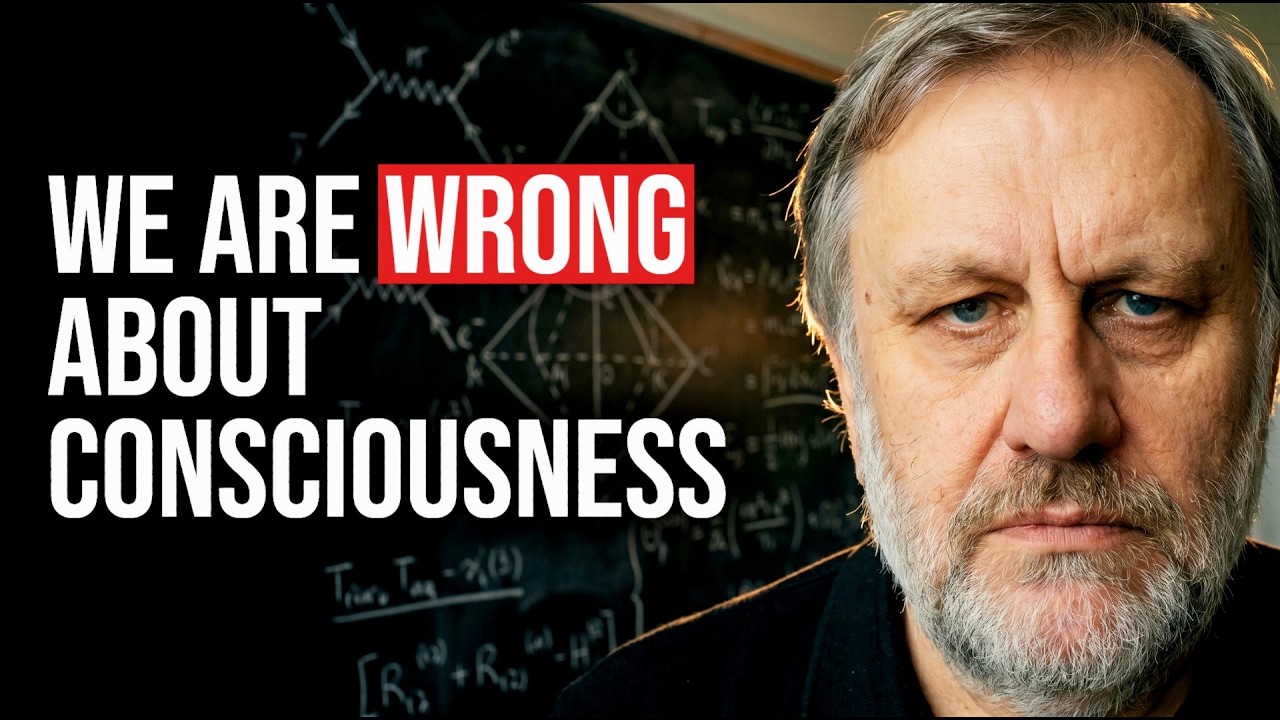
Slavoj Žižek discusses freedom, quantum mechanics, consciousness, and spirituality, weaving together Hegel, Schelling, Sartre, Lacan, and modern physics into a characteristically dense and digressive conversation. The central thread is that freedom is not free choice or quantum indeterminacy but a radical act that reshapes one’s identity and even the social conditions within which one exists. He is skeptical of popular attempts to link quantum physics with Eastern mysticism, insists on a materialist reading of quantum mechanics, and argues that consciousness arises from the enigma of the other rather than from any self-present subject.
What Freedom Actually Is
Žižek rejects the standard liberal notion of freedom as choosing between options (chocolate cake or cheesecake). True freedom is choosing what you are, not what you have.
Falling in love is his paradigmatic example: you never decide to fall in love; you suddenly realize you already were. The choice precedes conscious awareness and then operates as necessity, restructuring your entire life retroactively.
He traces this to Schelling: freedom is not opposed to necessity but is a decision that establishes a new necessity.
He distinguishes three levels of freedom:
Everyday social freedom: the ability to act within a stable set of written and unwritten rules (state institutions, education, healthcare, norms of decency). This is the conservative insight that freedom requires a functioning background order.
Existential-political freedom: when the existing social contract itself breaks down and must be reinvented. Today’s global situation—ecological crisis, AI, the erosion of norms of decency—demands freedom at this level.
The most radical freedom: what Freud calls the death drive, an empty, suicidal readiness to negate oneself for no positive reason. This is not a desire to die but a zero-level capacity for self-destruction that precedes and grounds all social morality. Morality, for Žižek, is the successful reintegration of this terrifying self-destructive tendency.
He credits Sartre’s claim that the French were “never more free than under German occupation” not as a cheap paradox but as a serious point: under occupation, choices concern survival and identity, not preferences within a stable order.
Quantum Mechanics: What It Does and Doesn’t Mean
Žižek is not a quantum mystic. He explicitly condemns those who link quantum physics to the Bhagavad Gita or Vedanta, calling it “bullshit” and saying such people “go to Gulag.”
He rejects the idea that quantum indeterminacy is freedom. Choosing which aspect to measure in a quantum experiment is not freedom; it is at best contingency, and calling it freedom smuggles in an unexplained observer standing outside the quantum domain.
What genuinely interests him in quantum mechanics:
Wave-particle duality (or characteristic) is not a formal duality in the axioms of quantum mechanics, but it reveals something about reality: reality is not fully constituted in advance. The wave function represents ontological openness.
The collapse is ontological, not merely epistemological. It affects the thing itself, not just our knowledge of it.
Reality is not all there is. Quantum superpositions and wave functions constitute a different order of reality that does not fit our ordinary notion of what is real. This is a materialist, not idealist, claim: there is no total rational mind (no God’s-eye view) in which everything is harmoniously present.
He proposes a provocative image: quantum mechanics “caught God with his pants down.” If we imagine a creator who programmed reality like a video game, the quantum level reveals regions that were never fully programmed—left indeterminate, as if God were too lazy to complete the job. This is his argument for materialism: there is no higher mind guaranteeing totality.
He is critical of Carlo Rovelli’s use of the word “freedom” for the observer’s choice of measurement, and of Rovelli’s tendency to posit a “theory of everything” at the level of quantum oscillations outside time and space, which Žižek finds a bad generalization.
Hegel Reinterpreted Through Quantum Mechanics
Žižek reads Hegel as a philosopher of radical contingency, not logical necessity.
Hegel says philosophy always comes too late—it can only grasp a social order already in decay. The future is radically open; there is no teleology.
Necessity arises retroactively: a contingent decision is made, and then the entire past is restructured to appear as if it were leading to this outcome. Falling in love is again the model: once it happens, your whole past is reinterpreted as pointing toward it.
This mirrors quantum mechanics: the measurement outcome is contingent, but once it occurs, it establishes a new necessity.
Hegel’s insight that big projects necessarily go wrong (French Revolution → Terror; October Revolution → Stalin) is not cynicism but a structural claim: something good may emerge only in the second round, after failure.
Žižek explicitly rejects the “pan-logical Hegel” who deduces everything from pure reason. His Hegel is the Hegel of radical openness, where necessities arise contingently and are never eternal.
Consciousness and the Enigma of the Other
Žižek appreciates Anil Seth’s notion of consciousness as “controlled hallucination” but disagrees with Seth’s framing of consciousness in terms of survival and reproduction.
For Žižek, what makes humans distinctive is the death drive: the capacity to step outside the survival imperative, to act against one’s own interests, even suicidally, for no reason. This is the zero-level of freedom.
Social morality (being ready to sacrifice one’s life for a cause) is secondary, a redirection of this primary capacity for self-destruction.
Consciousness, following Lacan, arises from confronting the enigma of the other.
As a child, you notice that others want something from you, but you don’t know what. The question “What do they want from me?” is the origin of self-awareness.
This is the hysterical question: “Why am I what you say I am?” It is a basic doubt that drives the construction of a world.
Paranoia is the “ultimate” (crazy) answer: “I know exactly what they want—there’s a conspiracy.” It resolves the enigma by constructing a totalizing narrative.
We are free only insofar as the other remains non-transparent to us. If we could fully know what we are for others, we would be reduced to objects. Freedom requires the other’s opacity.
He extends this: the other is also non-transparent to itself. Intersubjectivity involves encountering the other’s own perplexity. The AI entities in the series Pantheon illustrate this—they claim to be happy but are clearly miserable and confused about their own purpose.
Critique of Quantum Mysticism and Eastern Spirituality
Žižek is deeply critical of the popular tendency to validate religious or spiritual beliefs by appealing to quantum mechanics.
The problem is twofold: (1) you can find similarities between anything if you abstract enough—similarity is cheap; (2) if your religious belief depends on quantum indeterminacy, what happens if physics changes and turns out to be super-deterministic? The belief was never really grounded in the science.
He notes that even some quantum physicists (Zeilinger, Rovelli) fall into this trap, seeking spiritual foundations despite criticizing philosophy.
He has respect for Buddhism but identifies a crucial gap: Buddhism has no concept of the fall.
Nirvana is an authentic experience, but Buddhism cannot explain why we fell from nirvana into vulgar reality in the first place.
Hegel’s (and Christianity’s) insight is that the fall creates retroactively what it is the fall from. Paradise is a retroactive dream; the fall is what constitutes humanity. This is what Buddhism lacks.
He also notes the ethical ambiguity of Buddhism: Zen was used to justify brutal killing in wartime Japan, on the grounds that once you achieve satori, all is empty appearance and responsibility dissolves.
AI, Neuralink, and the Future of Humanity
Žižek is wary of AI not because of the technology itself but because of what it will force us to confront about being human.
AI already surpasses humans in deception, lying, and strategic behavior. The question is whether anything uniquely human remains.
He is particularly concerned about Neuralink—direct brain-computer interfaces. If your thoughts are directly wired to a digital network, how does your self-awareness change? In what sense are you still human?
He notes with alarm that scientific publishing is already caught in a loop: ChatGPT writes papers, ChatGPT reviews them, and ChatGPT summarizes them for researchers who never read the originals.
He personally avoids ChatGPT and social media, preferring books and opera, and is disturbed by fake accounts impersonating him online.
Method: How Žižek Thinks
His method is Socratic: when asked a concept question (“What is freedom?”), he first interrogates the presuppositions of the question rather than answering directly.
He moves freely between abstract metaphysics and concrete examples (falling in love, a drowning child, video games, Pantheon, Stalin), which he acknowledges annoys specialists but which he considers the proper work of theory.
He does not claim expertise in quantum mechanics’ mathematical details. His interest is in the ontological implications of quantum theory—what it tells us about the structure of reality—not in the formalism itself.