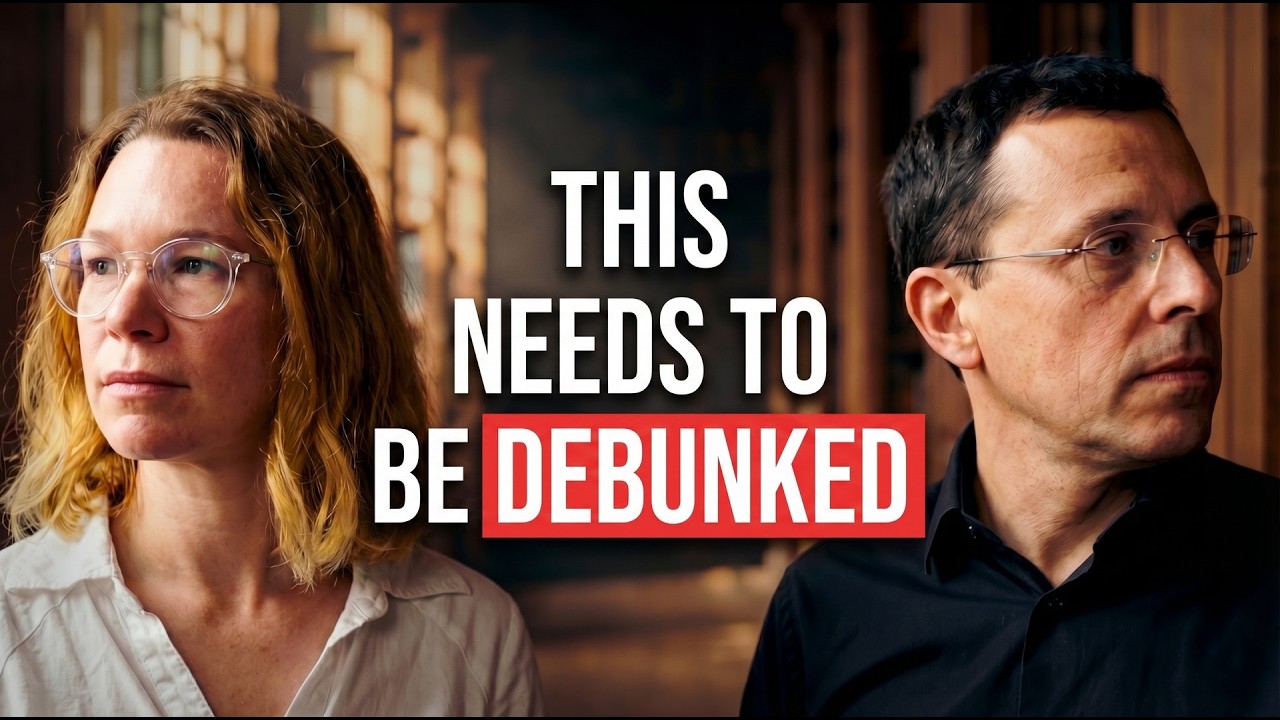
- This is a wide-ranging philosophy-of-physics conversation between Emily Adlam and Jacob Barandes (Harvard), hosted by Curt Jaimungal, in which two physicists-turned-philosophers probe the foundations of quantum mechanics and the mind. Their central target is the Everett (“many-worlds”) interpretation, which claims to derive everyday reality from quantum mechanics’ bare mathematical axioms alone. They argue that the interpretation’s celebrated elegance breaks down when you examine how it justifies probability: without a process that selects which branch you become, the math gives no rational guidance about what to expect. From there they extend the same skeptical logic to personal identity, consciousness, and free will, and close with a passionate case that physics and philosophy need each other.
The case against many-worlds
-
What the Everett approach is trying to do
- Standard textbook quantum theory has two kinds of axioms: mathematical (Hilbert space) axioms describing a quantum state evolving in time, and measurement axioms connecting that math to experimental outcomes.
- The measurement axioms carry the “measurement problem”: there’s no clean definition of what counts as a measurement, so it’s ambiguous when to apply them.
- The Everett approach tries to discard the measurement axioms entirely and recover all of observed reality from the mathematical axioms alone. As the universal wave function evolves, it develops independent, non-interfering macroscopic “branches” treated as the different ways the world can be.
-
Barandes’s “zero amplitude” objection
- Everettians assume that a branch whose amplitude (the number in front of it) is zero simply doesn’t exist anymore. This “throwing away” of zero-amplitude branches is essential to making the world picture coherent.
- But the Hilbert space axioms can be rewritten in a mathematically equivalent (isomorphic) form—worked out independently by Franco Strocchi (1960s) and André Heslot (1980s)—that looks like a collection of classical springs/harmonic oscillators.
- In that equivalent picture, zero amplitude corresponds to a spring that isn’t oscillating—and a non-oscillating spring is still a spring. Nothing about the math privileges one representation over the other, so it is no longer obvious that zero amplitude means “does not exist.”
- This is a new argument; he hadn’t yet presented it to Everettians, and they didn’t reach it at a recent “Why I am not an Everettian” conference.
Self-location and the probability problem
-
Two kinds of self-locating uncertainty (Adlam’s distinction)
- Superficial self-locating uncertainty: the candidate locations belong to different possible worlds. Example: “What time did I wake up?”—in each possible world there’s one fact, and you can use a scientific theory to assign probabilities. This is ordinary science.
- Pure self-locating uncertainty: the candidates all exist in the same possible world. Example: 10 clones, 9 behind blue doors, 1 behind a red door—“What’s the probability I’m behind a blue door?” There is no process selecting which clone you are; you simply are whoever you are.
- Adlam argues there’s a bright (sharp) line between these two cases, even though it’s easy to miss—unlike most philosophical demarcation problems (heaps, science vs. pseudoscience), which have fuzzy boundaries.
-
Why pure self-location has no rational answer
- To know which betting strategy is “best,” you first must define success—e.g., maximize total winnings across all clones, or make one specific clone win. But once you’ve chosen your goal, the credences are immediately fixed: equal weighting if you want to maximize the total, probability 1 on one clone if you favor that one.
- There’s no empirical or theoretical step in between (unlike a coin flip, where you can test the coin). So these “credences” aren’t really beliefs or probabilities—they’re just expressions of what you care about. Since rationality doesn’t dictate values, no assignment is rationally compelled.
- This matters because self-locating credences are relied on in cosmological multiverses, Everettian branching, Boltzmann brains, and the simulation argument—all of which assume there’s a uniquely correct way to assign them.
-
Indexicals and the “Cartesian ego” (Barandes)
- Probability statements often use indexicals (I, you, us). Normally these can be replaced by third-person descriptions (e.g., “Jacob Barandes, born in New York City”). But in a universe with infinitely many identical copies, “which Jacob Barandes am I?” can’t be de-indexed without collapsing into a tautology. Such irreducible indexicals are qualitatively different from ordinary probabilistic statements.
- The hidden intuition driving Everettian probability is a “Cartesian ego”—an essence (like a karaoke ball hopping word to word) that randomly jumps to one post-branching copy. If such a hopping ego existed, you’d have a real selection process to attach probabilities to.
- But most Everettians reject any such ego, so they can’t borrow that intuition—and they’re left with Adlam’s problem.
- The many-minds interpretation (David Albert and Barry Loewer) adds multiple hopping minds, which does help recover probability—but it undercuts Everett’s main selling point (no added structure), and once you’ve singled out well-defined trajectories, it becomes unclear why you need many worlds at all rather than a single (perhaps “indivisibly stochastic”) trajectory.
Personal identity and the teleporter
- Adlam denies there is any fact of personal identity over time beyond the physical, causal facts. “Emily tomorrow” being the same as “Emily today” is just two bodies causally and psychologically connected—nothing more.
- Therefore she would step into a teleporter (dissolve and reconstitute elsewhere), since the relationship to the reconstituted copy is essentially the same as her relationship to her ordinary future self.
- Even in the harsh version—make a verified copy, let it greet you on video, then kill the original—she’d accept it, though she admits she’d feel real fear. That fear is an intuition she distrusts; it comes from the emotional associations of “death,” not from a genuine metaphysical difference.
- Barandes would not step in, grounding his reluctance in not understanding consciousness well enough to trust the process. Adlam counters that once you’ve fully specified what the teleporter does, there’s nothing further to trust or distrust.
Consciousness, time, and agency
-
The hard problem
- Both take it seriously. The “easy” problem is modeling the brain well enough to predict its behavior; the hard problem is crossing the explanatory gap to subjective first-person experience.
- Adlam finds it uniquely baffling: for other hard problems she can imagine what a satisfying answer would look like, but for consciousness she can’t even conceive of the form an answer would take—which tempts her toward the view that it may not be a well-posed question, though the alternative is that it’s simply beyond current cognitive reach.
- Barandes refuses to dismiss it just because it’s intractable, urging humility about questions we may be unable to answer.
-
Childhood encounters with consciousness
- Adlam recalls being shocked and upset as a child by the spatio-temporal confinement of her mind—being locked into one tiny region while a whole world exists out there, knowable only inferentially.
- Barandes, by contrast, experienced his consciousness through fascination with other minds and frustration at never fully knowing what it’s like to be someone else. He likens consciousness to a giant “recording needle” that landed on his particular body—the single most important thing that ever happened to him, and one he doesn’t understand at all.
-
Why we experience one time at a time
- Adlam’s tentative view ties this to agency. If consciousness were merely passive “looking in” at brain states, there’d be no reason it couldn’t span several times at once. But because we act, being conscious-and-acting across multiple times would create causal paradoxes—so the agential, decision-making nature of mind explains the sharp temporal localization of experience.
- Barandes offers the four-dimensional “space-time worm” / world-line picture: from outside time, a person is a line of brain-states, each encoding only past-directed memories; he sometimes feels life is “a ride” along a fixed track, with the sense of choice as one of its illusions.
- They note fictional treatments (Dr. Manhattan in Watchmen, Arrival/Ted Chiang, Vonnegut’s Slaughterhouse-Five Tralfamadorians) where beings perceive all of time at once—and observe that such beings can’t really be free-willed agents, reinforcing the agency-time link.
Free will
- Adlam rejects strong, libertarian free will as incoherent: people want choices both unconstrained by the physical world and made for reasons tied to their personality and memories. These two demands fundamentally conflict—adding non-physical indeterminacy just makes choices more random, not more free. She accepts a compatibilist sense (decisions mediated through the right causal pathways in the brain).
- Barandes is more drawn to the mystery and uses van Inwagen’s consequence argument against compatibilism as a tool: if laws are deterministic, then the deep past plus the laws fix the future, and we control neither—so we don’t control the future.
- His key move: every premise hinges on an undefined notion of control (which itself smuggles in free will), and the argument ignores initial conditions.
- With time-reversible deterministic laws (as in classical and most pre-20th-century physics), saying “the past determines us” is no more privileged than saying “we determine the past.” David Albert’s example: nothing in Newtonian mechanics forbids scattered rocks from spontaneously assembling into statuettes of the royal family—its unlikeliness is a fact about initial conditions, not laws. So one could equally say our present choices “fix” the initial conditions, reopening room for compatibilism.
Emergence and the layers of physical theory
-
Adlam’s worry about emergence
- Physicists hope to write a microphysical theory and watch the macroscopic world emerge from it. But our microphysical theories were arrived at using macroscopic instruments and perspectives, so they may smuggle macroscopic features back in—e.g., a directed “time evolution” that reflects our experience, not the micro-world.
- This threatens circularity: we may be presupposing the macroscopic world inside the very theory meant to derive it. (She cites Jaynes: in quantum mechanics the inferential and the real are scrambled into an omelette no one can unscramble.) She thinks the obstacles are surmountable but harder than usually assumed.
-
Causation at the micro level
- Adlam is largely eliminativist about microphysical causation: causation is macroscopic, though the micro-world clearly has some modal, law-like (not merely correlational) structure.
- Barandes was once eliminativist too, but his “indivisible stochastic” program gives microphysical conditional probabilities that carry a directedness from causes to effects—crucially without selecting an arrow of time. The apparent arrow of time emerges contingently from the universe’s initial conditions, as in standard physics.
- Their remaining disagreement: whether microphysical causation is genuinely directed/asymmetric (Barandes more open) or not (Adlam more skeptical)—a small-looking but substantive difference, since for many “causation just is asymmetry.”
-
“Microphysical” defined relationally
- Barandes uses “microphysical on a theory” to mean a theory’s stipulated basic moving parts (ontology/degrees of freedom) plus its dynamical laws (deterministic or probabilistic). What counts as microphysical on one theory may be emergent (supervenient) on a deeper theory.
- On whether there’s a bottom level or infinite regress of theories: Barandes simply sees a mystery and wants to explore it without presuppositions; Adlam leans toward a fundamental bottom level on grounds of parsimony, calling it an aesthetic preference rather than a real argument.
Speculation versus rigor, and the case for philosophy in physics
-
Both prefer rigorous, careful reasoning over wild speculation, and find that analytic philosophy of physics often involves less unconstrained speculation than parts of high-energy theoretical physics. They stress the importance of clearly signaling—especially to the public—when one is doing rigorous, data-grounded work versus creative idea-generation. Adlam adds that speculation has a real place in seeding new ideas, provided you know which mode you’re in.
-
Why philosophy has driven major physics
- Barandes argues philosophically-driven thinking about quantum foundations produced an enormous payoff relative to its tiny funding and the career penalties paid by its pioneers:
- The EPR/entanglement debates; Bell’s theorem (developed by John Bell semi-secretly while officially a CERN particle physicist), now used in certified quantum randomness and cryptography.
- Decoherence, first rigorously described by David Bohm in chapter 22 (§22.8) of his 1951 textbook (also developed by Dieter Zeh in the 1970s), now ubiquitous across physics and central to quantum computing.
- The no-cloning theorem (independently found, including by philosopher Dennis Dieks), the no-signaling theorem, the Elitzur–Vaidman bomb tester.
- David Deutsch’s 1985 paper launching quantum algorithms, explicitly motivated by seeking evidence for the Everett picture.
- He argues the great early-20th-century ferment (statistical mechanics, relativity, quantum mechanics) coincided with physicists and philosophers being trained in and engaged with each other’s fields—and that we’re at a ripe moment for renewed cross-pollination. He half-jokingly proposes every physics department have a resident philosopher of physics, Statler-and-Waldorf style, flagging overreach.
- Adlam adds that the supposed split is illusory: physicists already do philosophical work (e.g., early holography papers reasoning about information and surfaces) and philosophers of physics do technical calculations.
- Barandes argues philosophically-driven thinking about quantum foundations produced an enormous payoff relative to its tiny funding and the career penalties paid by its pioneers:
-
Why the fields drifted apart (Sturgeon’s Law)
- “90% of everything is crap”; you must know a field well to spot its valuable 10%. As physics and philosophy diverged, each lost the ability to recognize the other’s good work, seeing only the noise—producing a vicious cycle of mutual dismissal.
- Barandes notes a common attitude among some physicists that they can do philosophy better and don’t need philosophers. The remedy is agency: individuals deliberately choosing now to bridge the fields. Both credit Jaimungal’s podcast as exactly this kind of bridging work, and note growing openness among students and young faculty to these cross-disciplinary questions.