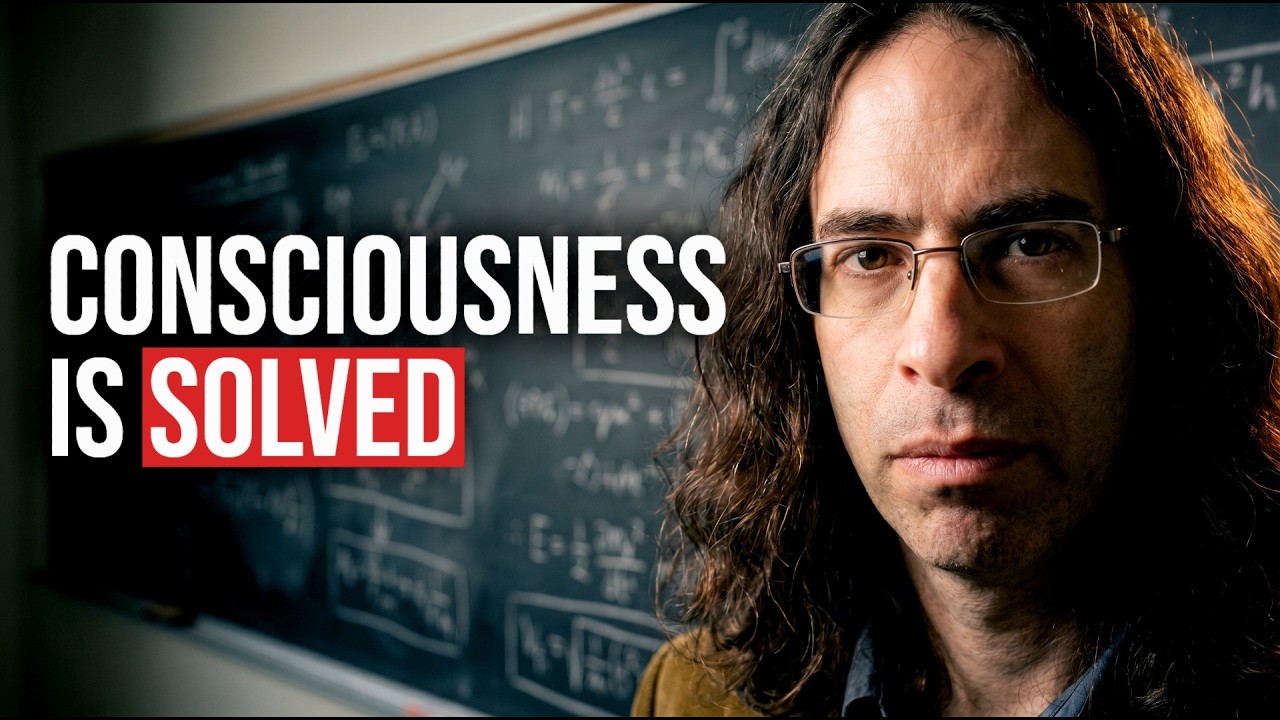
The episode centers on physicist Nir Lahav’s “relativistic theory of consciousness,” which proposes that consciousness is not generated by the brain but is a physical property that manifests relativistically — dependent on the observer’s cognitive frame of reference — and that this framework can dissolve the “hard problem” of consciousness (why physical processes produce subjective experience at all).
The Explanatory Gap and Why Standard Approaches Fail
Most people, including many neuroscientists, assume consciousness emerges from neural computations — that brain activity simply produces conscious experience.
But this assumption runs into the explanatory gap: we can measure neural patterns (third-person, public, physical) but those patterns have completely opposite properties from conscious experience (first-person, private, qualitative). Neural patterns are public and physical; experience is private and phenomenal. They cannot be identical.
The brain only ever produces more neural patterns — there is no “screen” in the brain where the actual experience appears. We cannot find the mechanism that translates neural activity into the felt quality of experience.
This is not a problem neuroscience can solve from within its own third-person framework.
Defining Consciousness
Consciousness is defined using Thomas Nagel’s canonical formulation: a creature is conscious if there is “something that it is like” to be that creature. When awake or dreaming, there is something it is like; in deep sleep or anesthesia, there is nothing.
This definition is acknowledged as imperfect and somewhat circular, but serves as a necessary starting point to avoid talking past each other.
The Principle of Relativity as the Foundation
Lahav’s theory is not about Einstein’s special or general relativity per se, but about the principle of relativity — the broader philosophical principle that there is no absolute frame of reference, and that what is real depends on what relations an observer can measure.
Galileo first articulated this: you cannot distinguish, through any physical experiment, between being stationary and moving at constant velocity. Both observers are equally correct.
Relationalism accompanies relativity: properties are not absolute but are manifestations of relations within a system. Leibniz argued space and time are relational; Einstein’s equivalence principle showed that acceleration and gravity are indistinguishable — two frames of reference measuring the same situation manifest different physical properties (one measures gravity, the other measures acceleration), and both are real.
Cognitive Frames of Reference
A frame of reference is generalized beyond coordinate systems to mean any entity with causal relations to the world — an electron, a person, a cognitive system.
A cognitive frame of reference is a cognitive system (one that receives inputs, learns, represents the world, and produces outputs) that has causal relations with its environment.
Just as with velocity, where two observers can measure contradictory properties (one says “I’m stationary,” the other says “I’m moving”), a first-person cognitive frame measures consciousness while a third-person frame looking at the same brain measures only neural patterns. Neither frame is privileged. This dissolves the apparent contradiction of the explanatory gap: consciousness and neural patterns are two sides of the same coin, manifested in different frames of reference.
Lahav developed a mathematical transformation group (discrete, compact, abstract — unlike the continuous Lorentz group) that maps between cognitive frames and preserves invariance, showing the laws are the same across transformations.
Relational Physicalism
Lahav identifies as a physicalist, but of a new kind: relational physicalism. Physics is grounded not in absolute entities or properties but in causal structures — chains of cause and effect. Different frames of reference manifest these causal structures as different physical properties.
Consciousness, in this view, is a physical property that manifests in the right frame of reference, just as gravity manifests in one frame and acceleration in another. There is no reduction from consciousness to neurons any more than there is reduction from gravity to acceleration — they are two manifestations of the same underlying causal reality.
Three Scenarios Building Toward Consciousness
Scenario 1 — Emergence is relativistic: Water and wetness do not exist in a micro-frame of reference (which only measures molecules); they exist in a macro-frame (which measures fluid dynamics). Emergence is not absolute but observer-dependent. What is “real” depends on which causal closure you inhabit.
Scenario 2 — Simulation creates reality: A perfect simulation of the universe, run on a computer, creates its own intrinsic frame of reference. From outside, we see only code and electrical states; from inside the simulation, the variables of the equations manifest as stars, gravity, and all the properties of the simulated world. The simulation is real from within its own frame. This creates an artificial explanatory gap that is bridged by the principle of relativity.
Scenario 3 — The brain as simulation: The brain creates an internal simulation of the external world to understand current inputs and predict future ones. Inside this simulation, the variables have all the causal power and manifest as real physical properties. This is where consciousness begins to emerge.
The Four Conditions for Consciousness
Condition 1: A cognitive system that creates a simulation of the external world.
Condition 2: The simulation includes affective valence — a variable that labels inputs as good or bad for the system (is this apple good for me? Is this tiger bad for me?). This variable does not exist in the external world; it is added by the cognitive system and manifests inside the simulation as a new physical property.
Condition 3: The simulation must include a representation of the cognitive system itself (the system simulates itself so it can use affective valence to guide decisions).
Condition 4: The system must have the ability to take actions — causal power to interact with the world based on what affective valence tells it.
When all four conditions are met, the frame of reference of the simulated cognitive system inside the simulation manifests phenomenal properties — “what it is like” — as a genuine physical property. It starts rudimentary (good/bad) and becomes more elaborate as more causal relations are incorporated.
Addressing Objections and Implications
The hard problem restated? A Chalmers-style objection would say this merely restates the gap in new symbols. Lahav’s response: relationalism shows how new physical properties manifest from causal relations in specific frames. Affective valence is a new variable that adds subjectivity to physics — it is a subjective relation (between the simulated brain and simulated objects) that manifests as an actual physical property. This is exactly what we should expect from qualia.
Philosophical zombies are refuted: If a zombie is physically identical to a conscious person in every measurable way, then by the principle of relativity, they are equivalent — there is no absolute property that distinguishes them. The zombie must have consciousness.
Split-brain patients: The theory predicts that if each hemisphere creates its own simulation with affective valence and self-representation, there could be two consciousnesses — consistent with Gazzaniga’s split-brain experiments.
LLMs are not conscious: They may learn some causal relations between words, but they do not simulate themselves, have no affective valence, and lack the other conditions. In principle, AI could be conscious if all four conditions were met.
Consciousness is not absolute: Your consciousness exists in the frame of reference of your simulated cognitive system inside your brain’s simulation. From outside, only neural patterns are measurable. This is not a limitation — it is the structure of reality.
Open Questions and Future Work
Lahav’s first paper established the plausibility of the relativistic approach; his second paper (submitted to the Journal of Consciousness Studies) specifies the relations that manifest phenomenal properties; a third paper will address the quantum measurement problem and show mathematically that the vacuum must contain infinite “bubbles of reality.”
The theory generates testable predictions (e.g., about split-brain patients, about which animals or fetuses have consciousness) but requires collaboration with neuroscientists and funding to test experimentally.
Lahav is based at the consciousness and cognition lab at Cambridge and is actively seeking collaborators in philosophy and neuroscience, as well as funding for experiments.