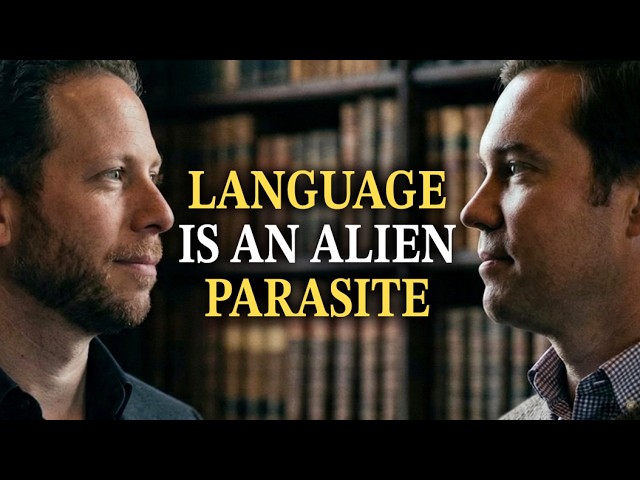
Language as an alien organism in the brain — Professors Elan Barenholtz and William Hahn argue that language is not a tool we use but an autonomous informational system — almost an organism — that installs itself in human brains during infancy, operates independently of sensory experience, and drives much of our behavior without our conscious consent. This reframing challenges the intuitive belief that our thoughts are truly our own.
Language as a self-generating system
Language is autogenerative: it contains within its own structure the capacity to generate itself, a property revealed by large language models (LLMs) like ChatGPT, which learn to predict the next word in a sequence and in doing so expose the predictive structure already latent in language.
Language operates on meaningless squiggles — symbols with no inherent connection to the sensory world. The word “red” knows only its statistical relationship to words like “apple” or “blue,” not the actual experience of redness. This is what Barenholtz calls ungrounded processing.
LLMs and human brains perform the same fundamental computation: autoregressive next-token prediction. At no point does the system plan the full sequence ahead; it only ever guesses the next token, feeds that back into the loop, and repeats.
Despite only predicting one token at a time, this process produces the “pregnant present” — each token choice implicitly encodes the entire past context and projects a plausible future trajectory, enabling long-range coherent narratives and reasoning without any explicit planning module.
Memory and cognition redefined
Memory is not storage and retrieval — the classic cognitive science model of short-term and long-term memory as separate boxes is replaced by a single autoregressive generation process. The brain does not retrieve stored facts; it generates responses on the fly, just as an LLM does.
The brain’s stored weights (analogous to an LLM’s trained parameters) instantiate a function: given an input sequence, produce the next output. What we call “memory” is simply the capacity to autoregressively generate appropriate responses to prompts.
This dissolves the arbitrary distinction between short-term and long-term memory and eliminates the need for any retrieval mechanism. There is only residual activation from what has just been generated, feeding back into the next step.
Cognition broadly — planning, imagining the future, daydreaming — is the same autoregressive process extended beyond language. When you stare into space thinking about tomorrow, you are generating the next cognitive token, then the next, letting the sequence unfold.
Software, virtual machines, and the self
Software is the most important idea in a thousand years — it provides the conceptual framework (virtual machines, layers of abstraction) needed to understand how minds work. The brain is not directly running our thoughts; rather, it is instantiating software layers that produce thought.
Just as a laptop runs multiple programs through intermediate layers (Python talking to C talking to the chip), the brain may instantiate multiple selves or virtual machines — consciousness is one program running among many, not a direct product of neural tissue.
Cases of multiple personality disorder suggest that more than one seemingly conscious entity can run on a single brain, supporting the virtual machine model rather than a one-to-one brain-consciousness mapping.
Aphantasia and absent inner monologue — roughly half the population reports no visual mental imagery or no inner speech. This does not disprove the autoregressive model because the process can run without meta-awareness of itself. The “observer” watching thoughts is an additional layer, not a necessary feature of the generative process.
The origins and evolution of language
Language represents a qualitative computational leap from animal signaling systems. Animals use concrete, stimulus-bound signals (a sound for a specific environmental situation). Language is stimulus-independent, computationally autonomous, and generative — no animal communication resembles it.
The origin of language remains a deep mystery. It cannot be explained by a simple genetic mutation for better communication. Something far stranger occurred: an autogenerative system emerged that no group of engineers could have deliberately designed.
Language likely did not evolve in small tribal groups but at the city-state or empire level (e.g., ancient Sumer), where thousands of people cooperated and words circulated beyond any individual’s knowledge — creating an externalized, self-propagating informational ecosystem.
Animal communication may have seeded language — bird songs, animal calls, and prosody may have served as a proto-language that shaped the brain over millions of years. Prosody (the musical, emotional layer of speech) likely preceded words and carried meaning before strict tokenization existed.
Early words were not fixed tokens — historical evidence shows the same word (e.g., “rabbit”) spelled differently every time it appeared in a single document, and Shakespeare’s signature varied across dozens of instances. The concept of a word having one correct spelling is relatively modern.
Consciousness vs. the symbolic
Consciousness is sensory, not symbolic — phenomenal experience (the redness of red, the feeling of pain) arises from the physical world impinging on sensory systems. These are real mathematical relationships in neural representational space grounded in wavelengths, photoreceptors, and bodily states.
Symbols break this grounding — language turns experience into arbitrary vector representations. The word “red” is a location in a high-dimensional space whose meaning comes only from its relation to other symbols, not from any connection to physical reality. Matrix multiplication in LLMs operates in this arbitrary symbolic space.
Therefore, LLMs cannot be conscious — they have no access to the analog sensory space where consciousness lives. They manipulate symbols without any grounding in physical experience.
Consciousness may be a virtual machine installed by culture and parents, not something that automatically emerges from brains. We are only beginning to map the diversity of conscious experiences across the population.
Language as a divine parasite
Language is a “divine parasite” — extraordinarily powerful but not originally ours. It is a cultural artifact downloaded into every human brain before birth, without consent, and it runs autonomously.
Language functions as an operating system that makes people do things: go to jobs, pursue prestige, plan for the future — behaviors no animal exhibits. These drives come from language, not from individual choice.
Prompt engineering and jailbreaking apply to humans too — since language is an autoregressive system running in our brains, we are vulnerable to the same kinds of manipulation as LLMs. Saying “don’t think of pink elephants” forces the thought. Advertisers, scammers, and ideologues have been doing this for generations.
Now that we can simulate human-like language systems in silicon, A-B testing of mind manipulation becomes possible at unprecedented speed — running thousands of variations to find the most effective way to change beliefs or behavior, then deploying that on real people.
“God” as a token — the word “God” does not point to a divine being but functions as a powerful node in the linguistic operating system that shapes behavior, belief, and social cohesion. Its reality is like the reality of software: not physically tangible, yet enormously consequential. A “third-order religious” perspective recognizes that the first-order belief in God and the second-order recognition of its utility are the same thing.
Advice for students and thinkers
Be suspicious of scientific orthodoxies — the certainties held by even the greatest scientists are shakier than they appear. Language itself was not understood as an autonomous system until LLMs revealed it. We are barely scratching the surface of what can be known.
Have courage in your own ideas — if you have an idea that seems radical or premature, share it. The ideas discussed in this panel would have been nearly impossible to hear a decade ago. The world changes fast.
Tolerate ambiguity and question strong opinions — if you or someone else has an instant, strong reaction to a claim, ask where that reaction came from. Strong pre-formed answers are often the product of the language system running its scripts, not genuine independent thought.