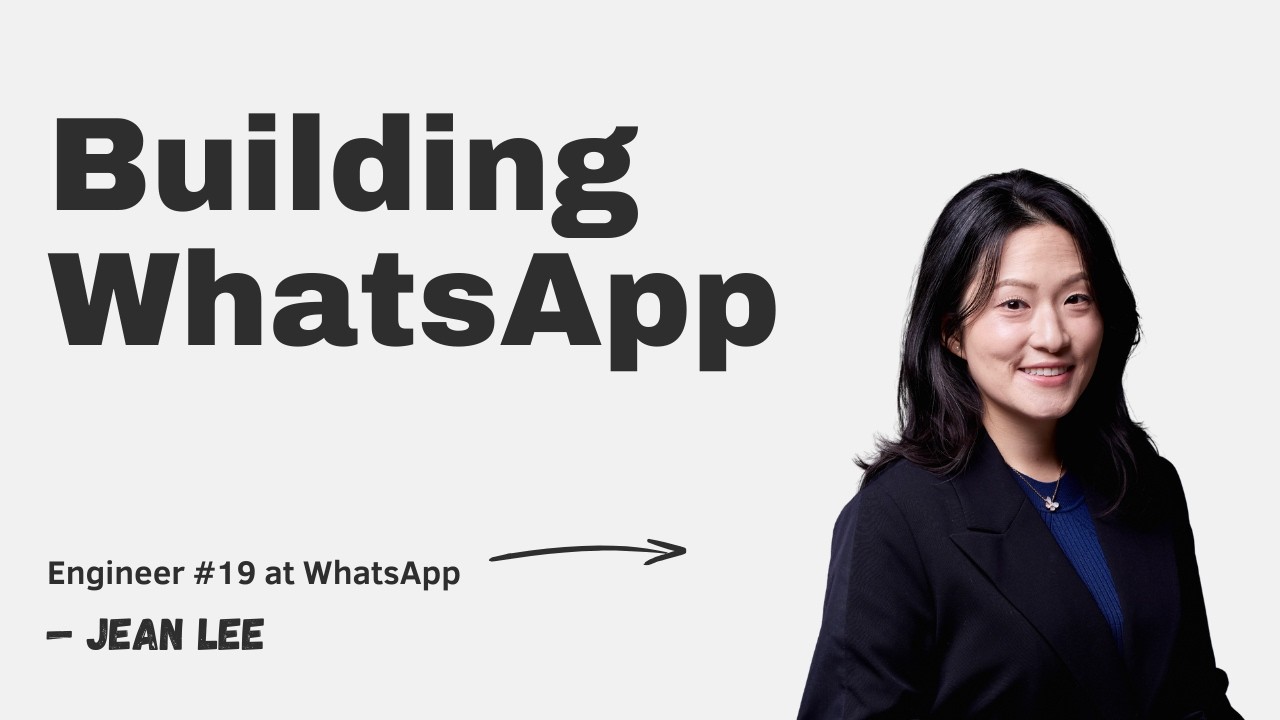
Jean Lee was engineer number 19 at WhatsApp, joining in 2012 when the company was still relatively unknown in the US but growing rapidly in Europe and India. She witnessed it scale to 450 million users with a team of under 30 engineers, and was at her desk when the $19 billion Facebook acquisition was announced. The episode explores how WhatsApp operated with almost no formal process, why that worked, and what today’s AI-native startups can still learn from their approach.
Jean’s path to WhatsApp
Grew up as a “small-town girl” in the San Francisco area; her father pursued a PhD in brewing, which she describes as making him an “OG hipster.”
Moved to San Francisco in 1999 and was first exposed to tech careers there; studied computer science at USC.
Her first internship was at a three-person video-sharing startup where she loved the ownership and speed but lacked mentorship, which led her to seek a more structured first job.
Joined IBM in 2007 for the mentorship and training it offered from experienced engineers, but missed the small-team environment and direct impact; left in 2009 during the economic downturn at age 22 or 23.
Took time off to explore different classes and gig work, then decided to return to a startup that was more experienced than a three-person team but still small enough for autonomy and impact.
Found WhatsApp on LinkedIn in 2012; the interview was a system design conversation about messaging apps, including her knowledge of KakaoTalk. Jan closed the deal in person the next day, asking her on the spot what it would take to join. She signed the offer the following day.
A competing company that was slow to send a written offer called on her first day at WhatsApp to extend their offer; she declined.
She was engineer number 19 and one of only four people under 30 at WhatsApp; most of the team were in their 30s or older, many recruited from Yahoo, Europe, Stanford, and Sequoia’s network.
WhatsApp’s unusual tech stack
WhatsApp maintained eight separate native platforms: iPhone (Objective-C), Android (Java), BlackBerry, Windows Phone, Nokia S40, Nokia S60 (Symbian C++), KaiOS (briefly), and a web client.
The backend was built in Erlang, a language originally developed by Ericsson for telecommunications, chosen for its robustness in handling concurrency and its ability to maintain uptime 24/7 across global time zones.
The core engineering challenge was handling massive spikes in message volume, such as on New Year’s or Christmas, when millions of users send messages simultaneously.
WhatsApp deliberately rejected cross-platform frameworks because Jan’s stated goal was that “a grandma in a remote countryside” should be able to use the app on any device, including low-memory phones, which required each platform to be lightweight and optimized natively.
How WhatsApp operated with almost no process
No formal code reviews after an engineer’s first commit (Brian reviewed Jean’s first commit with rigorous questions, but never reviewed her code again).
No stand-ups, no sprint planning, no Scrum, no Agile with a capital A, no TDD.
Engineers pushed directly to production and were trusted to ask if unsure; with only 30 engineers, everyone could read each other’s Git commits and discuss them in group chats.
Heavy emphasis on dogfooding: Jan’s title was effectively “chief QA officer” and he would try to break things before every release.
Jan said no to almost every feature request, an estimated 99% of the time. WhatsApp launched without groups, voice calls, or video calls for years, and worked on video calling internally for a long time before shipping it, prioritizing quality over speed of feature delivery.
The only metric prominently tracked in the office was a countdown display showing the number of days since the last outage.
Outages were discussed in server group chats; there were no formal blameless postmortems or documentation, just direct conversation and fixing the problem.
Jean contrasts this with her time at Skype, which had 1,000 engineers, Scrum Masters, consultants, and two-week sprints, yet WhatsApp with 30 people and no formal methodology was shipping faster and growing faster on every metric that mattered.
Why WhatsApp won against competitors
Network effects helped, but WhatsApp was not the only messaging app on the market.
While competitors like WeChat chased features, WhatsApp was intentionally minimalist, holding back features until they had full conviction about quality.
Features like voice and video calling were used internally with engineers’ families as a beta group for a long time before public launch.
This contrasts with the conventional startup advice to launch early and iterate; WhatsApp polished first, then shipped.
The Facebook acquisition
In 2014, two years after Jean joined, Facebook announced the acquisition of WhatsApp for $19 billion.
Jean was coding with noise-canceling headphones on when the head of business waved everyone into the meeting room; they were asked to turn off their phones before the announcement.
Jan had previously said selling a company was “like selling your baby,” so the acquisition was a genuine surprise.
Jean journaled about the moment: she zoned out trying to calculate how much her equity was worth, couldn’t do the math in her head, but concluded “I’m going to be rich.”
Mark Zuckerberg walked in and held a Q&A; engineers were nervous about whether everything would change, citing examples like Yahoo acquisitions where acquired companies lost their essence. Zuckerberg was charismatic and reassuring, promising nothing would change.
The financial windfall was significant; the company organized meetings with accountants, financial advisors, and a Wealthfront founder who gave an hour of finance advice. Jean read “Random Walk Down Wall Street” and other books to learn to manage her new wealth at age 29.
Life inside Meta after acquisition
Changes were very gradual; WhatsApp didn’t move into Facebook’s Menlo Park headquarters for at least a couple of years and continued operating with the same culture, hiring at a slow, steady pace.
Only after moving into the Facebook office did cultural integration begin, such as using Facebook’s HR and recruiting services.
WhatsApp remained its own organization within Meta, with its own physical area, chairs, and decorations, though mixing increased over time.
Jean was leveled as an L3 (junior engineer) at Facebook despite her experience, because she was one of the youngest; she was unhappy about it but stayed to continue vesting her shares and was promoted relatively quickly within WhatsApp.
She eventually became an engineering manager, a transition that happened because someone on her team begged their manager to report to Jean, who was already acting as tech lead.
WhatsApp’s business model and growth suppression
WhatsApp was free for the first year, then charged $1 per year in certain countries.
The $1 fee was not primarily a revenue strategy; it was a growth suppression tactic. Server costs, salaries, and SMS registration codes (about $0.10 per international code) added up to roughly $1 per user per year, meaning WhatsApp was roughly break even.
Jan and Brian were transparent about finances in annual all-hands meetings, walking through earnings and expenses. They had raised $8 million from Sequoia but never touched it, treating it as a backup.
Brian explained this conservatism by referencing his father, a business owner who would wake up at night worried about making payroll.
After the acquisition, Facebook removed the $1 fee and growth accelerated because they had the funding to support it.
Building the London office
Facebook asked Jean and two other relatively new engineering managers to start a WhatsApp office in London because Menlo Park was running out of space and WhatsApp was hugely popular in Europe.
They moved into an existing Facebook office in London, converted two European contractors (one in England, one in Scotland) to full-time, and began hiring.
Hiring was significantly easier in Europe than in the US; at Stanford recruiting events before the acquisition, students had never heard of WhatsApp and wouldn’t leave resumes, whereas in Europe people were excited to talk to them.
The 8-hour time zone difference with California was a challenge, but was mitigated by quarterly travel in both directions and strong relationships between the London and Menlo Park teams.
After about a year and a half, Jean realized she didn’t know someone’s name, which was a turning point where the office stopped feeling like a startup and started feeling like big tech.
Transitioning to management and performance reviews
Jean became a manager not by asking for it but because a team member requested it; she was already acting as tech lead managing projects.
She taught herself management by reading books on leadership, communication, and psychology, including “Surrounded by Idiots” (about the DISC personality framework), since resources on engineering management were limited at the time.
She focused on understanding each individual’s strengths and motivations: one engineer loved debugging and improving systems, another loved building new features, and she tried to assign work accordingly while still providing growth challenges.
As a manager in calibration meetings, Jean describes her role as “a lawyer representing her clients”: she has no authority to give promotions or set compensation; she makes the case to other managers who must reach consensus.
The engineers who got the easiest consensus for high performance reviews were those who made their work visible by posting frequently on Facebook Workplace (the internal Facebook feed), engaging in comments, and documenting their impact publicly. Managers in calibration rooms are making decisions about people they may never have worked with directly, so visibility is not vanity; it is how the system actually works.
Jean notes that AI may eventually eliminate the advantage that diligent managers had in gathering their engineers’ work for calibration, leveling the playing field.
Leaving Facebook and what came next
Jean left after 8 years, burned out from her personality of wanting to get A+ on everything she did. She was on a 2-year contract in London and had the option to stay or return to Menlo Park but chose to leave.
She challenged herself to do nothing for 6 months, which she achieved by reading (she read 100 books during this period), exercising, walking, and doing meditation retreats.
After 6 months, she talked to 100 founders from a spreadsheet to evaluate joining or starting a company, but realized she wasn’t passionate about any of the opportunities.
She identified that what she loved most about WhatsApp was creating a supportive culture where people could learn and thrive, so she pivoted to mentoring, coaching, writing, and making YouTube videos.
She recently hit 100,000 YouTube subscribers; she almost gave up early on because a video went viral and she felt uncomfortable being public, rooted in a family history where her grandmother escaped North Korea and the cultural instinct was to not be seen or heard. A mentor encouraged her to continue.
AI’s impact on engineering and advice for the future
Jean observes that AI is enabling smaller teams, but notes that WhatsApp achieved extraordinary efficiency without AI simply by staying small; she questions whether the current wave of small, efficient teams is truly caused by AI or is a return to basics.
She believes AI will eliminate much of the tedious work that engineering managers and engineers had to do manually, such as writing comments, gathering impact data for performance reviews, and maintaining OKRs and documentation.
Engineering management itself is less affected by AI because it requires human-to-human interaction, asking questions, and understanding engineers personally.
For new grads building durable careers in an AI-native world, her advice is to focus on foundations: tools and languages come and go, but foundations don’t.
For AI-native startups, she recommends learning from WhatsApp’s clarity of goal: Jan said no to distractions and was ruthless about prioritization, while competitors got distracted building shiny features. She advises founders and engineers to be clear about what they’re building and why, to avoid decision paralysis in a landscape with too many options.
She also highlights the value of lean teams in removing process overhead, which creates ownership and freedom to build. Founders should push early hires toward excellence through rigorous initial engagement (like Brian’s detailed code review of her first commit) and then trust them with responsibility, rather than over-babying capable adults with excessive onboarding structures.
Book recommendations
“What Color Is Your Parachute?” for understanding strengths, goals, and priorities in career and life.
“Surrounded by Idiots” for learning how to communicate and work with different personality types (DISC framework).
“Random Walk Down Wall Street” for understanding how to manage money and investments.
“The Hunger Games” series as a favorite fiction recommendation, which she admires for the story of a woman overcoming challenges and winning.