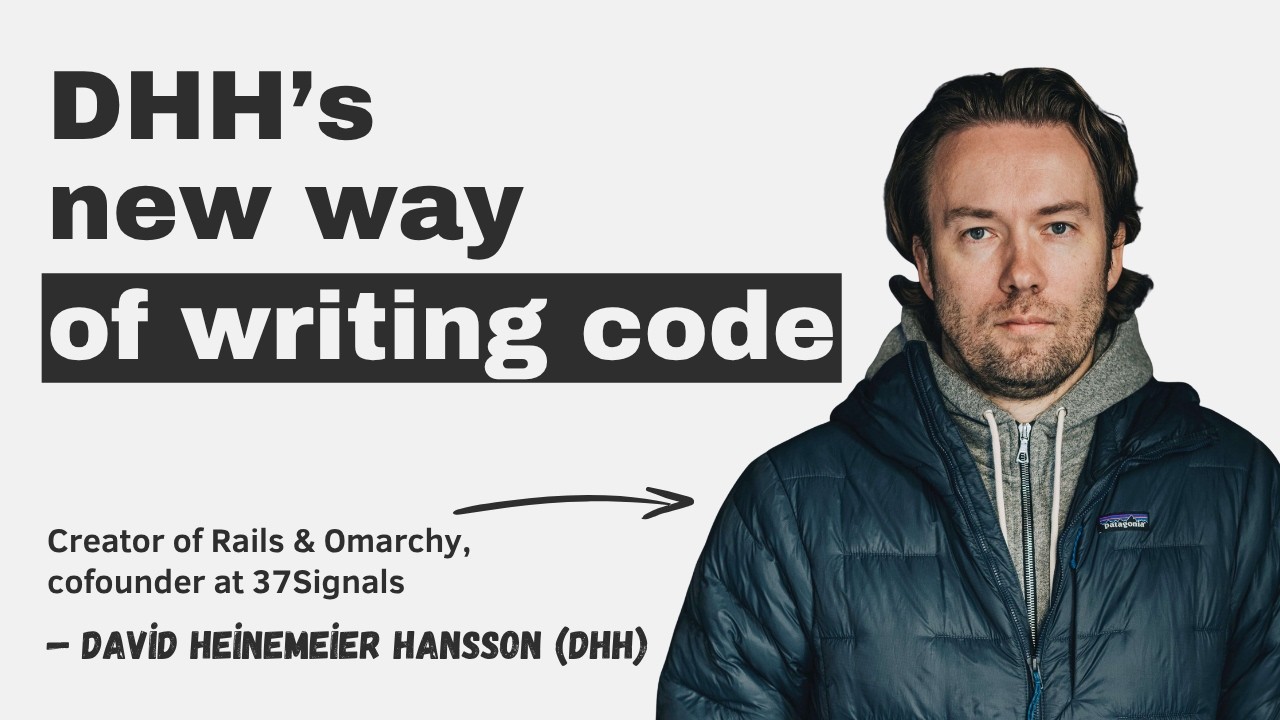
David Heinemeier Hansson (DHH), creator of Ruby on Rails and co-founder of 37signals, went from publicly bashing AI coding tools on Lex Fridman’s podcast six months ago to going “agent-first” on everything after a 180-degree turn during the winter break of 2025. The shift was triggered by two developments: the emergence of agent harnesses (tools that let AI use bash, the terminal, and the internet rather than just autocomplete) and the release of Claude Opus 4.5, the first model that consistently produced code DHH was willing to merge with little or no alteration. Today, DHH and his team at 37signals use AI agents as a core part of their workflow, enabling them to tackle projects they never would have started before, while placing even greater emphasis on taste, aesthetics, and craft.
37signals: the company and its products
37signals was founded in 1999, started as a web design consultancy, and pivoted to a software company in 2004 after launching Basecamp.
Basecamp remains their biggest and most important product after 20+ years, which DHH considers their best business idea.
They launched HEY.com in 2020, an email service competing directly with Gmail, which holds roughly 80–85% of US email traffic.
HEY’s key differentiator is “the screener,” which gives users full control over who can reach their inbox, solving the problem of unwanted sales outreach and spam.
Apple initially refused to approve the HEY app unless they paid the 30% App Store fee, creating a two-week public battle that ended at WWDC. The controversy gave HEY wall-to-wall media coverage and tens of thousands of signups in the first weeks.
The company has about 60 employees total: roughly 20 programmers, 10 designers, 14 in customer support, 10 in operations/DevOps, plus HR and finance.
They have maintained a 40-hour work week rolling average over 25 years.
How 37signals builds products
Major products start with a tiny team—often just one programmer and one or two designers—until the shape and architecture are figured out, then ramp up near the end.
Designers at 37signals are not just visual designers. They function as product managers (figuring out what to build and why) and also implement their work in CSS, HTML, and sometimes Ruby and JavaScript.
DHH believes this multi-hat approach produces better work because the designer understands the medium they’re working in—similar to how an architect should understand load-bearing structures.
With agent acceleration, designers can now produce complete functional implementations, not just mockups.
DHH values aesthetics deeply: “aesthetics is truth.” He believes beautiful code and beautiful interfaces are more likely to be correct, and that being surrounded by well-functioning, beautiful systems is a key part of human happiness.
He sees Ruby as uniquely beautiful among programming languages—broad in scope yet focused on developer happiness, without rigid ideology.
The AI inflection point
DHH’s skepticism about AI was never about the potential of the technology—he recognized ChatGPT’s launch as a historic moment from day one. His objection was to the ergonomics: autocomplete-style tools like Copilot were infuriating because they interrupted his flow and were wrong too often.
The unlock came from two changes:
Agent harnesses (Claude Code, OpenCode) that give AI tools to use bash, the terminal, and the internet—moving from “autocomplete” to “agent.”
Claude Opus 4.5 (released late November 2025), the first model that consistently produced high-quality code from vague instructions and could incorporate feedback without repeating mistakes.
DHH describes the period around late November/early December 2025 as a collective shock across the industry, especially during the winter break when hands-on technical leaders experimented with side projects and discovered they could complete them in hours instead of weeks.
He credits Toby Lütke at Shopify as someone who saw the shift coming much earlier and helped pull him in.
DHH’s agent-first workflow today
DHH now starts every project with an agent. His setup uses Amachi (his custom Linux distribution) with a split-screen layout: Neovim on the left, OpenCode running Kimi K2.5 on top right, Claude Code running Opus on bottom right, and a terminal strip at the bottom.
He prompts the agent, reviews the diff, and either commits or makes alterations. The ratio of agent-written to human-written code has shifted dramatically.
He experimented with OpenClaw (an autonomous agent) by asking it to sign up for HEY and Fizzy and join a Basecamp project—all through the browser, with no MCP, CLI, or special tools. It succeeded, which convinced him that agents will eventually need no accommodations from developers.
For now, his team is building CLIs for all their products (Basecamp, HEY, Fizzy) to give agents structured access, validating the Unix philosophy of small interoperable tools.
Example workflow: an agent checks Sentry for errors, posts an analysis to Basecamp, creates a pull request on GitHub, and posts a comment back to Basecamp—all autonomously.
AI’s impact on ambition and the “explosion of the pie”
The most significant change isn’t just speed—it’s that the team now tackles projects they never would have considered.
Jeremy’s P1 project: Instead of optimizing P50/P95/P99 response times, Jeremy optimized P1 (the fastest 1% of requests), taking them from 4 milliseconds to under 0.5 milliseconds—a 10x improvement across 2,500 lines of code in a few days. DHH calls this a “vanity metric” that would never have been justified before.
DHH now kicks off agents with vague, half-formed ideas just to see what comes back, treating code as having near-zero residual value—easy to generate, easy to discard.
Example: dual-boot support for Amachi was something DHH didn’t want to spend 4 hours on, so he had Opus and Codex ping-pong a plan back and forth, then executed it.
DHH compares this to the Terminator 2 scene where a recovered chip gives humans “ideas we would never have investigated before.”
What this means for developers
Senior developers benefit most right now. They can validate agent output, redirect when needed, and work in parallel with multiple agents—5x to 10x their previous productivity.
Amazon’s internal analysis reportedly found they could no longer let junior programmers ship agent-generated code to production without review, after major outages.
Junior developers face a more tenuous position. The traditional path of learning by doing implementation work is disrupted when agents can do that implementation and only seniors can verify it.
DHH believes we may have hit “peak programmer” in terms of the number of developers needed and the compensation premium for implementation skills alone.
Jevons paradox (lower cost → more demand) will produce more software than ever, but that doesn’t guarantee all programmers benefit equally.
Companies where software development is a cost center (the majority of the world’s software work) will face pressure to reduce costs when agents can do the work at a fraction of the price.
The constraint is shifting from implementation to product judgment: figuring out what to build, how it should work, which customers to serve, and what the aesthetic quality should be.
DHH historically had low esteem for product management as a function because product managers were underutilized—the bottleneck was always implementation. Now that bottleneck is loosening.
The stereotype of “I just want to sit and code” is ending. Only someone at the level of John Carmack could retain that privilege, and even Carmack needed business sense. Most developers will need to combine coding/AI skills with empathy, communication, and product thinking.
Hiring and what it takes to be “the best”
Over 37signals’ history, roughly 100–150 programmers have worked there out of tens of thousands of applicants. Their batting average for long-term success is slightly better than 50/50.
Google’s research on hiring found no reliable predictors (Ivy League, GPA, Leetcode scores) for employee outcomes.
DHH’s hiring process: discard half to two-thirds of applications immediately for not following instructions, narrow to ~20 for an at-home test, then proceed with interviews.
The at-home test is the biggest filter. Some candidates resent it, but DHH sees no alternative to evaluating actual work.
Warm referrals have a much higher hit rate than open calls, but this isn’t actionable advice for most people.
His practical advice: show up and do your best wherever you are, even if the job is “shitty.” People who goof off at a bad job cheat themselves of the practice and visibility that leads to better opportunities. Warm referrals come from colleagues who noticed you tried hard despite the environment.
The best programmers today are more valuable than ever because they get the most out of AI acceleration. DHH says he’s enjoying programming more now than at any time since discovering Ruby in the early 2000s.
Work-life balance and sustainability
A tension exists: people who are “all in” on AI are working harder than ever because the dopamine hit of shipping is hyperactive when agents make you this effective.
DHH warns against treating this like a limited-time sale—AI isn’t going away, and burning out in the next two weeks makes no sense.
He prioritizes eight hours of sleep as the single best investment in cognitive capacity and refuses to trade health or exercise for more agent work.
He’s had a few sleepless nights from AI excitement (very rare for him) but recognizes this is unsustainable.
His message: “Slow down, buddy. The next 10 years are going to see more and more of this. Don’t squander your health.”
What keeps DHH building
DHH could have retired long ago but continues because he genuinely loves computers—since age 5. He compares instrumenting agents to playing StarCraft.
He rejects the idea that wealth is a checkpoint that leads to leisure. Psychological studies show that unlimited time without purpose leads to misery, not happiness. Every entrepreneur who sells their business and sits on the beach for three weeks comes back because the mission itself is the satisfaction.
He’s currently leaning hard into agent accessibility (building CLIs for all products) and is more curious and excited about computers now than he was five years ago.
Omachi and the itch-scratching pattern
Omachi is DHH’s custom Linux distribution, built on Arch and Hyprland, started as a summer project during downtime at the 24 Hours of Le Mans race.
It has ~400 code contributors and tens of thousands of daily driver users in just over six months.
DHH’s pattern across Ruby on Rails, Kamal (deployment tool), and Omachi is the same: build something that perfectly suits his own needs, then share it. When it resonates personally, thousands of others with similar tastes find it valuable.
37signals has switched most developer machines to Linux (via Omachi) to be closer to their production environment and to contribute to the distribution’s development.