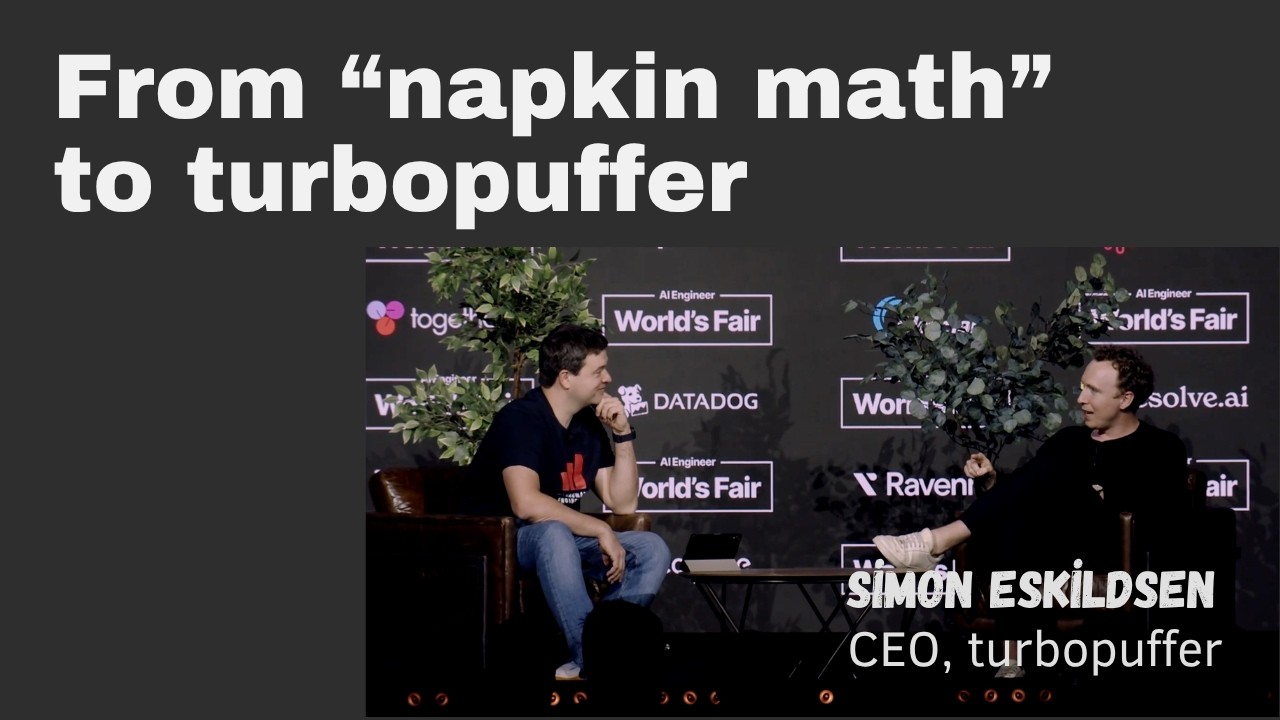
Simon Ericson, founder and CEO of Turbopuffer, traces his path from building games in PowerPoint and FrontPage as a child in Denmark to competitive programming (IOI), dropping out of a university track to join Shopify at 18, spending eight years scaling its infrastructure, then founding Turbopuffer — a vector search engine built on object storage that dramatically lowers cost by keeping hot data in memory and cold data in S3.
Early path to programming
Got hooked on computers through PowerPoint’s clickable diagrams (Turing-complete), then FrontPage, Dreamweaver, PHP, and eventually hit the limit of Danish-language programming resources at age 11–12.
Learned English through four years of World of Warcraft, which unlocked the global internet of technical knowledge.
Discovered the International Olympiad in Informatics (IOI) via an Australian internet friend; competed for Denmark in high school, solving algorithmic optimization problems (e.g., truck/package packing).
A Hacker News / New York Times feature on his 2013 blog post about switching from iPhone to a Nokia brick phone caught a Shopify recruiter’s attention; interviewed in Ottawa while still in high school and joined Shopify in 2013.
Eight years at Shopify (2013–2021)
Treated the first year as a “gap year” but stayed after realizing he’d found what he wanted to do; systematically self-studied every unknown concept (TCP, TLS, reverse proxies) each evening to close the gap with CS-educated peers.
Gravitated to the infrastructure layer — containerizing with Docker, preparing for Black Friday traffic spikes (120–140% YoY growth), buying physical hardware, and sharding MySQL because “you can’t cache writes.”
Worked on multi-data-center rollout, splitting a mysterious 128 GB Redis server that had become a single point of failure, and building a failure-mode matrix so session-store outages wouldn’t take down the whole storefront.
Created Toxiproxy, a Layer 4/7 proxy that sits between app and database and can inject latency, errors, corruption, or connection drops on command; enabled realistic failure testing in CI and uncovered dozens of bugs in Rails and the MySQL driver (still running in Shopify CI today).
Rewrote the storefront (with Justine, later co-founder) to handle ~100% of traffic 18 months in; worked on caching, database scaling, and Kardashian-driven traffic surges.
Left in 2021 to “inject novelty” and learn faster; did “angel engineering” (vesting equity by working at friends’ startups) while exploring what to build next.
The Napkin Math project
Maintained a GitHub table of ~50 hardware cost/performance numbers (DRAM bandwidth, S3 round-trip latency, NVMe vs EBS throughput, $/GB for memory/S3/spot/committed) and made flash cards for every cell.
Used it to challenge infrastructure decisions based on poor benchmarks: e.g., a search query benchmarked at 10 s should take ~10 ms given DRAM bandwidth and posting-list intersection math — the gap reveals either a misunderstanding or a bad benchmark.
Discovered MySQL could do 10k writes/sec on a small box despite fsync taking 1 ms (theoretical 1k/sec) because fsync batches many 4 KB pages; traced via BPF and obscure German blog posts.
Starting Turbopuffer (summer 2023)
Three catalysts: (1) painful experience with a traditional search engine at Shopify that couldn’t hit napkin-math performance; (2) the Napkin Math project gave intuition for what hardware could do; (3) while angel-engineering at Readwise (read-later app), built a recommendation engine that worked but would cost $30k/mo on existing vector DBs vs. $5k total infra budget — so it wasn’t shipped.
Obsessed over “why is storing vectors so expensive?”; did napkin math on clustering vectors, writing clusters to S3 objects, and searching by downloading centroids + nearest clusters.
S3 latency: P99 ~200 ms for 256–512 KB objects; tree traversals multiply round-trips, so system must minimize requests and design for P99/P999.
First version (July–Oct 2023): simplest possible clustering → files named cluster1, cluster2… + centroids file; search = download centroids → pick N closest clusters → download those files; JSON merging for cost/performance control; no custom cache layer — just Nginx reverse proxy caching S3 objects, with cache invalidation via xargs rm on Nginx’s cache directory.
Ran on a single 8-core T-Mox instance in GCP; launched on Twitter (“1M vectors for $1” vs. ~$100/M elsewhere) with full durability invariants (writes committed directly to S3, shut down VMs → no data loss).
Cursor becomes first customer
Cursor (then ~8 people) reached out after the Twitter launch; they had hit unit-economics wall with in-memory vectors (Aurora/Postgres) and had already discussed “why hasn’t anyone put cold vectors in S3?”
Simon flew to SF, helped them debug an Aurora autovacuum issue (sequential scans instead of index scans) — built trust.
Justine (co-founder) replaced Nginx cache with a direct file-based cache; Cursor migrated over 1–2 weeks; bill dropped 95% (from previous vendor’s last bill to Turbopuffer’s first bill).
Cursor’s Swallow later said: “Never bet your business on a tiny startup where you’re their only/biggest customer — except Turbopuffer.”
CPU scarcity in the cloud
GPUs stay scarce, but CPUs are now also scarce because: (1) RL workloads need massive CPU for environment simulation (teaching models to search, use tools, run Bash); (2) agents run general-purpose code on CPUs; (3) applied AI reveals gaps (CAD, shipbuilding) → more RL environments → more CPU demand.
Big labs and cloud customers fight for allocations; even Turbopuffer competes with its own customers for CPU.
Turbopuffer mitigates by being SKU-agnostic: runs on many instance types (GCP C4D, Z4D, C4A ARM) — only needs CPUs + NVMe + S3.
Works with cloud providers on regional power/CPU availability; power constraints drive where new silicon lands.
Meeting Jensen Huang
At an Nvidia partner event, Simon opened with: “If everything goes south we can pivot into vapes.” Jensen replied: “Judging by your slide, maybe you should.”
Simon, nervous, asked: “Jensen, do you vape?” (No answer.) Nvidia team Slacked: “Simon just asked Jensen if he vapes.”
Despite pre-event coaching to avoid the “C-word” (CPUs), Simon couldn’t stop praising AVX-512, SIMD, and CPU abundance — Jensen took interest.
VC philosophy: six reasons to raise
Fund R&D — first raise (Jan 2024, ~$700k) to hire Boyan (IOI “God” from North Macedonian team) and Morgan; Simon/Justine had gone 6 months no salary, paid GCP bills personally.
Fund growth — spend to tell the world.
Founder ego — status, press, big numbers; dangerous, dilutes employees, sets high strike price; not a valid reason.
Reward employees — second raise (Dec 2024) for employee liquidity (tender) so early team doesn’t wait for IPO.
Strategic partnership — rare but can make companies.
M&A — acquisitions.
Simon only raised for reasons 1 and 4; wants to keep “playing with open cards” and only continue if venture-scale conviction solidifies.
Remote culture: campfires & TurboCredits
Fully remote since 2023 (Shopify was remote-first); whole company meets twice/year (Berlin, Mexico City, etc.).
Campfires: ad-hoc co-location — when a few people land in a city, call it a campfire, invite anyone to join (customer dinners, hacking sessions). No obligation; some attend only offsites, others fly every two weeks.
TurboCredits: earn by giving conference talks, writing blog posts, staffing expo floors → upgrade next flight to business class. Evolving into internal economy (central bank, interest rates, betting markets).
Goal: encourage in-person connection if people want it, without mandating travel.