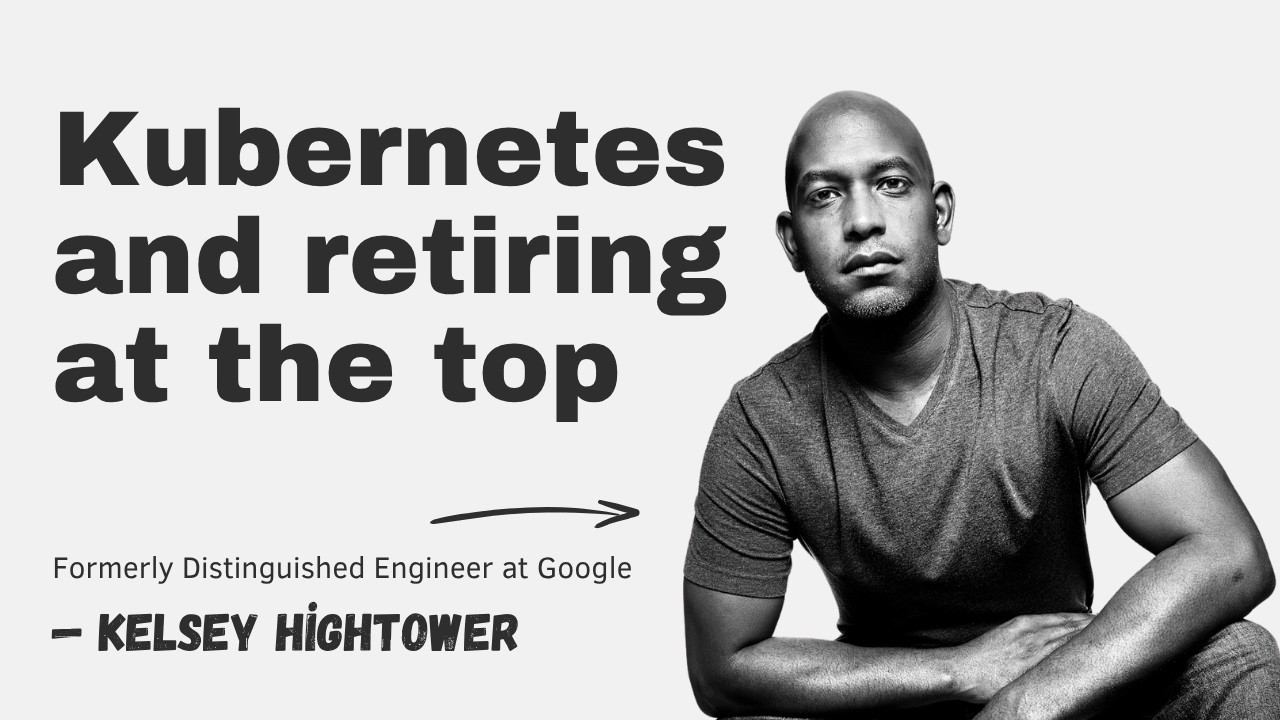
Kelsey Hightower’s career is a case study in how non-traditional paths, relentless skill-building, and public work can lead to the top of the tech industry without a college degree. He dropped out of college at 19, got an A+ certification, installed DSL lines door-to-door, ran a small computer store, worked in financial services, joined Puppet Labs, co-founded CoreOS, became one of the most visible faces of Kubernetes, rose to distinguished engineer at Google Cloud, and retired at 43. The episode traces every major inflection point and extracts practical lessons about career growth, open source, the container wars, executive-level impact, retirement planning, and how to think about AI as a tool rather than a threat.
From McDonald’s to A+ certification: the most efficient path into tech
Kelsey’s first job was at McDonald’s at age 14, where he became an assistant manager by 15 and learned responsibility, efficiency, and how to deal with real customers under pressure.
After high school in 1999, he briefly attended college but dropped out after two weeks because the pace felt too slow compared to the internet boom happening around him.
He didn’t know any programmers or system administrators personally, so college didn’t feel like a visible path. Instead, he bought a $35 A+ certification guide, studied it cover to cover, passed the exam in 10 minutes, and used it to land a contract role installing DSL internet for Bell South.
This was his core insight at the time: certifications offered a fast, self-directed feedback loop and a controllable path into the economy, unlike college which felt slow, expensive, and disconnected from the jobs he saw advertised.
Entrepreneurship at 19: from DSL installs to a computer store
While doing DSL installations, Kelsey noticed businesses wanted multiple computers connected to one internet link. He taught himself networking, bought a Linksys router, and started doing side installations.
A client wrote him a check made out to a company name, which forced him to quickly register a business (Digital Gateways), get a business license, and open a business account at age 19.
He eventually opened a small computer store outside Atlanta, assembling machines, selling parts, and doing service calls. He also added Pro Tools studio installations as a service and managed a comedian on the side.
After 3-4 years, he did the math and realized that service-based entrepreneurship has limited upside compared to software. He wanted stability, a family, and a predictable paycheck, which led him to apply to Google.
Google data center technician: where metrics taught him about feedback loops
Kelsey joined Google around 2004-2005 as a data center technician. The facility held roughly 200,000 servers and was immaculate, systematic, and unlike any data center he’d seen before.
His job involved walking a crash cart through racks, diagnosing failed machines (burned SATA cards, bad RAM), replacing parts, and logging predictions in a system. His score was measured by accuracy: if the machine didn’t come back for repair within 30-60 days, he’d diagnosed correctly.
He learned to use a diagnostic device with flashing lights (built by Tim Hawk, who later became Kubernetes networking lead) to quickly identify bad RAM slots without running lengthy software tests.
When his scores dipped below 90%, he wrote shell scripts to diagnose multiple components at once, regaining both speed and accuracy. This was his first experience with a healthy feedback loop: granular, frequent, and something he could control.
He job-hopped internally every 3-6 months to learn every role in the data center, roughly doubling his salary through successive moves.
Learning automation at a Rackspace spinoff (ServerBeach/Pier 1)
After Google, Kelsey joined a Rackspace spinoff focused on fully automated web hosting. Their tagline was “latency kills.”
The entire provisioning pipeline was automated via PXE boot and PHP scripts: ordering a server triggered RAID configuration, VLAN assignment, OS installation, and credential delivery, all within about an hour.
He learned that you could do anything to a machine before it committed to an OS: updating RAID controller firmware, configuring hardware, screen-scraping Windows machines via mouse movements to patch software.
The key lesson: when customers pay $99/month and you have minutes to fix their problems, you learn to move fast and automate everything. There’s no budget for manual work.
The ticket queue inflection point: activities vs. impact
While working tech support, Kelsey noticed the phone queue was round-robin and the ticket backlog kept growing, leading to 3-day response times and angry customers.
He stopped answering phones and instead focused exclusively on clearing the ticket queue to zero, writing small scripts to batch-resolve common issues (MySQL vacuuming, PHP upgrades, etc.).
When his manager questioned why he wasn’t on the phone, Kelsey explained the distinction: being an all-star on calls (activity) was less valuable than keeping the team’s ticket queue at zero (impact).
The manager agreed to restructure the process so some people stayed off the phone with the commitment that the queue stayed at zero. This was Kelsey’s first explicit lesson in the difference between activities and impact.
Financial services: maturity, change windows, and EngineX
Kelsey’s next move was to a financial services company (TSYS/Total Systems) processing credit card transactions. His salary doubled from $45K to $90K, and he had to wear a shirt and tie for the first time.
The interview was shockingly easy for him, which made him wonder whether he was genuinely skilled or the bar was low. He later realized the cost of mistakes was enormous: a 7-second response window for Visa transactions, with chargebacks and penalties for failures.
He spent 3 years there, learning patience, how to deal with executives, and how to get buy-in from stakeholders before making changes. This was the first time he stayed long enough to change a culture.
The big win: the team’s Apache-based load balancer kept crashing under memory pressure. Kelsey had tested EngineX in a dev environment and knew it could replace the Java-heavy stack with a fraction of the memory. After convincing leadership, he got one chance during a midnight-to-6am change window. He deployed EngineX, memory usage dropped from ~32GB to ~2GB, and the system held through the next day’s peak load.
He negotiated the bet from a steak dinner (he was vegetarian) to buying pizza for the entire floor for a week, turning his individual win into a team celebration. This taught him that success at maturity means getting consensus and sharing credit.
Bringing Puppet into the enterprise and building a reputation through open source
At the financial services company, Kelsey introduced Puppet (version 0.24.8) to replace manual shell scripts and ticket-driven operations. He wrote Puppet manifests in the DSL, contributed Ruby extensions, and contributed upstream to Puppet’s open source project on nights and weekends (since the company didn’t understand or allow open source contributions at work).
He built a Jira-based interface on top of Puppet: users selected RPMs and environments from dropdowns, tickets got approved, and a system he called “Mr. Roboto” extracted custom fields and ran the appropriate Puppet manifests. Most users never knew Puppet existed; they just got what they wanted on demand.
His manager attended a conference and met James Turnbull, author of the first Puppet book and a Puppet Labs employee. When James visited the office, he recognized Kelsey’s name from open source contributions, which surprised Kelsey’s manager who didn’t know about the side work.
James invited Kelsey to speak at PuppetConf, where he gave his first real conference talk. Afterward, Luke Kanies (Puppet’s founder) offered him a job at Puppet Labs, which Kelsey accepted with a salary increase and remote work flexibility.
The container wars: Puppet, Chef, Docker, Terraform, and the shift in thinking
At Puppet Labs (2011-2012), Kelsey believed configuration management (Puppet vs. Chef vs. Ansible) was the endgame. The competition was only between those tools.
He first encountered Golang by rewriting Puppet’s “Facter” (a tool that gathers system facts) in Go. Cross-compiling on Mac, SCPing to Linux, and running facts in parallel was dramatically faster than the Ruby version. He pushed for Go adoption but was blocked because Puppet needed to support Solaris and AIX.
Terraform emerged as a challenger: instead of managing nodes with agents, it managed cloud infrastructure through APIs. This was a fundamentally different model from Puppet’s node-centric approach.
Docker initially seemed like a fad to most at Puppet Labs. They dismissed it as a toy without config management or enterprise features. Kelsey didn’t fully get it either until after he left.
After Puppet, Kelsey joined a company as VP of engineering, rewrote Java microservices in Go, and open-sourced “confd,” a tool that pulled variables from etcd and generated config files. This was his bridge between the Puppet world and the container world.
CoreOS: where containers met distributed systems
Kelsey met the CoreOS team at GopherCon (a Go language conference). He had given a talk titled “Golang for System Administrators” where he live-demoed building a PXE server in Go from his slide deck and booting CoreOS VMs from it. The CoreOS team was in the audience and recruited him.
CoreOS’s vision was an operating system designed only to run Docker containers: minimal OS, everything in Go, a key-value store (etcd) for config synchronization, and systemd for process management.
Kelsey saw CoreOS as the natural evolution of what sysadmins always wanted: a minimal, secure, repeatable OS where changing parts are isolated in containers.
At CoreOS, they built “Fleet,” their own distributed init system using etcd and systemd unit files. This was their vision for container orchestration before Kubernetes existed.
Kubernetes: the overnight integration that changed everything
When Google announced Kubernetes, the CoreOS team got one day’s notice under embargo. Kelsey stayed up all night reading the Go source code (there were no docs), figured out how to run it on CoreOS on bare metal, patched a few things, and wrote a guide.
When Google announced Kubernetes at DockerCon, CoreOS published their guide the same day and hit #1 on Hacker News. People downloaded CoreOS just to try Kubernetes.
Kelsey started giving Kubernetes talks immediately, often live-demos on stage. The CoreOS founders initially had their own roadmap (Fleet), but after a few months of Kelsey contributing nights and weekends, they got in a room and decided to go all-in on Kubernetes, deprecating Fleet.
Kelsey became product manager at CoreOS, contributed to CNI (the Kubernetes networking layer), and helped develop the concept of “Operators” (coined by Alex Polvi), which became a core Kubernetes extensibility pattern.
Why Kubernetes won: Docker, data model, and extensibility
Kelsey identifies three reasons Kubernetes broke through where Mesos/Swarm/Nomad didn’t:
Docker as the runtime: By the time Kubernetes launched, Docker had already achieved global consensus. Kubernetes reused existing Docker containers and workflows instead of requiring a new image format or runtime. This gave them a running start.
Infrastructure as data, not code: Tools like Puppet and Terraform used imperative code (if-this-do-that, modules, loops). Kubernetes introduced a declarative data model: you specify the desired state in YAML, submit it to an API, and control loops reconcile actual state with desired state. This made automation safer because infrastructure finally had a type system, like typed programming languages. You could do static analysis, validation, and composition without being a compiler expert.
First-class extensibility: Brendan Burns designed a way to extend Kubernetes by simply describing a new object type. You could say “I want a firewall” or “I want a certificate from Let’s Encrypt,” give that description to Kubernetes, and all the existing tooling (kubectl apply, dashboards, etc.) worked with it. This opened the ecosystem to Cisco, Red Hat (OpenShift), and hundreds of other vendors without requiring them to build entirely new systems on top.
Joining Google: defining DevRel on his own terms
After CoreOS, Kelsey considered joining NASA’s Jet Propulsion Lab (JPL) to work on Mars rover infrastructure. He was inspired by scientists using technology for actual human purpose, not just making apps. He even signed an employment agreement.
Google called and offered him a role in Developer Relations (DevRel). Kelsey was skeptical: he’d been an IC his whole career and didn’t want to become a cog. Google gave him freedom to define the role.
He refused to do traditional DevRel (conferences, tutorials, evangelism) because he saw those as activities, not impact. Instead, he:
Joined sales calls as a Kubernetes expert, flying to customers like Disney and Walmart to whiteboard solutions for 6 hours, directly impacting revenue.
Worked across product areas beyond Kubernetes: serverless (Cloud Functions), databases (Spanner/Postgres), and Go support.
Introduced “empathetic engineering” sessions where Google engineers (including distinguished engineers and Borg veterans) had to install Kubernetes from scratch without scripts, discovering the pain points firsthand. This led to tools like kubeadm and “Kubernetes the Hard Way” (Kelsey’s famous guide).
He read other teams’ OKRs and helped them find the two things that would most impact revenue and adoption. He’d orchestrate sessions to help teams discover these themselves rather than prescribing solutions.
Promotions at Google: from L5 to L9 (Distinguished Engineer) in 7 years
Kelsey was focused on promotions because each level required different skills and expanded his impact. Early promotions (L3-L5) were somewhat formulaic and decided locally. Higher levels required cross-org consensus on impact.
His promotion strategy: focus on “landings” (people actually paying for and using what he built) rather than “launches” (shipping features and celebrating). Launches don’t matter as much as landings.
He diversified beyond Kubernetes into serverless, databases, and Go support. He launched Go support for Cloud Functions at GopherCon in a live keynote, creating a trifecta: vision, execution, launch, and landing.
For one promotion packet, he rejected the standard template and wrote in first person: “Here’s what I did, here’s the people I brought along, here’s the teams I impacted, here’s the results.” He wrote it for the promotion committee members themselves, knowing they’d be reading dozens of dry packets. He got promoted.
The key to becoming distinguished engineer wasn’t writing the most complex code. It was impact on Google Cloud’s culture: empathetic engineering became an official program, he helped multiple teams succeed, and he brought an enterprise customer perspective that Google had been missing.
The Microsoft offer: how to leave without an ultimatum
While at Google, Microsoft recruited Kelsey. He wasn’t interested initially (he didn’t like Windows, Azure, or .NET), but his wife encouraged him to at least interview.
The recruitment process was unusual: no resume needed, no technical quizzes. They brought out senior leaders (including Scott Guthrie) to sell Microsoft to him. He realized they were courting him, not interviewing him.
Satya Nadella sent a personal email. The offer PDF had an extra zero compared to what Kelsey expected, even after years of strong compensation at Google.
Kelsey countered higher, and Microsoft countered back higher. He then told his long-time manager (Greg, who he’d had for 6 years) that he was leaving. He explicitly did not use it as an ultimatum.
Greg responded supportively: “You’re worth every penny of this.” He presented the offer to leadership, and Google matched it within hours. Kelsey stayed, got promoted to distinguished engineer, and later met Satya in person, who reflected that Microsoft had offered him money to run away from something rather than something to run towards.
Retirement: treating money as freedom tokens
Kelsey practiced minimalism throughout his career: living well below his means, avoiding lifestyle inflation, not caring about jewelry or cars. Money became “freedom tokens” for him.
He calculated his retirement number based on vanilla US Treasury bond yields (not stock market gains) and kept negotiating salary to stay on track. When he blew past the number and was still young enough, he adjusted the target.
He started “zooming out” on his career around age 37, asking why he was working. The birth of his daughter gave him a clear answer: he was working for his family’s safety and freedom.
He noticed he’d neglected the non-work parts of life: relationships, experiences, being present. He started slowing down: staying an extra day after conferences (visiting bath houses in Budapest with colleagues), reading lyrics while listening to music, cleaning his own house as a meditative practice, attending his daughter’s school events.
He retired at 43 as a distinguished engineer, 3 years before this conversation. He describes himself as a “junior retired person” who still does advisory work, investing, and public speaking, but with more philosophy and less ego.
Advising and investing: how to do it right
Kelsey’s advice on advisory work:
Don’t work for free. Advisory shares alone are worth nothing 99.99% of the time (dilution, taxes, no exit). Negotiate a retainer ($1,500-$5,000/month) plus equity (0.25%-1% depending on stage and risk).
Use 1-year vesting with no cliff and a 10-year exercise window, not the standard 4-year vest. Advisory should have impact within a year.
Be a domain expert, not a generalist. If you’ve built engineering teams, advise on hiring, vesting schedules, junior/senior spread, and when to bring in leadership. If you’re good at this, VCs will recommend you to other portfolio companies.
Have low ego: if a company no longer needs your expertise, let them find new advisors. You’ve done your part.
On investing: he started angel investing after getting advisory shares. He learned to do deep due diligence: meeting founders, reviewing code, looking at AWS bills, GitHub issue management, and team dynamics.
Example: Pixie Labs (observability using eBPF). Kelsey advised them to pivot their messaging from “eBPF-based observability” to “agentless observability” and “Pixie Scripts” for system administrators. They got acquisition offers from VMware and New Relic the day after their launch keynote. Kelsey’s shares were accelerated, and he saw a real return for the first time.
A people-first view of GenAI
Kelsey’s philosophy is people-first. When crypto emerged, he engaged with it but kept asking how it impacts real people (currency resets, retirement savings, forced labor cycles). He found the community hostile to these questions and eventually stepped back.
On GenAI, he pushes back on the narrative that it will replace humans. His core arguments:
We trained these models. Every book he published, every Stack Overflow answer, every comment is in the training data. The machine’s worldview comes from human contributions.
Software development was never just about writing code. It’s about decision-making: what database to use, whether to collect someone’s social security number, how to structure data for downstream reporting. Writing code is the last step.
The job is to solve human problems using whatever technology is required. Software isn’t required for every human endeavor, and GenAI doesn’t solve all human problems.
He’s concerned about new engineers who are told they’ll just use GenAI to do everything. They’re missing the fundamentals that lead to invention and creativity.
His practical framework for evaluating AI startups: “Don’t say AI.” Force founders to explain the specific problem they’re solving, how the industry currently solves it, and what’s wrong with the current approach. If they can’t explain it without saying “AI” or “agentic,” they don’t have a clear value proposition.
Example: Mass Driver (visual infrastructure as code). Instead of naively pivoting to “AI for cloud management,” Kelsey helped them reposition their existing features as “guardrails” and “context engines” for AI agents. This way, when Claude or Cursor interacts with AWS, it does so through structured, bounded interfaces rather than having unrestricted console access.
Using AI with guardrails: practical advice for engineers
Kelsey’s advice on using AI tools effectively:
If you’re generating the same blocks of code repeatedly, stop. Extract it into a function, library, or framework. Don’t use AI to do what abstraction should do.
Most APIs were designed incorrectly even for humans. AI tools are exposing this. The lesson: design intent-based APIs (“create a VM”) not imperative ones (“call these 7 APIs in sequence”). Kubernetes did this years ago; MCP is doing it now.
Documentation has been written as hints for too long. AI tools are forcing developers to write better documentation (full examples, context, error cases) to give agents context. This should have been the standard all along.
AI is good at closing the documentation loop: giving you working examples immediately instead of making you search Stack Overflow. But we should have been writing better docs all along.
On the fear of AI commoditizing software engineers:
Engineers have been automating other industries for decades (iPhone replacing dozens of devices, internet replacing newspapers). Don’t be surprised when your own field faces disruption.
If your only skill was writing code, you’re vulnerable. If you understand architecture, design, security, product, and customer needs, AI is a tool that lets you focus on higher-value work.
There’s value in going slow before writing code. Decision-making benefits from reflection. “Writing is thinking” applies to code too. AI can generate code fast, but it can’t replace the thinking that should happen before coding.
For the new generation: you don’t have to learn fundamentals to get a job, but your career will be limited if you don’t. Depth leads to invention. If you only know the surface, you can’t imagine what doesn’t exist yet.
His analogy: great artists know how to mix primary colors. You don’t need to buy 16 million colors if you know how to mix. Learning fundamentals is a superpower, not a burden.