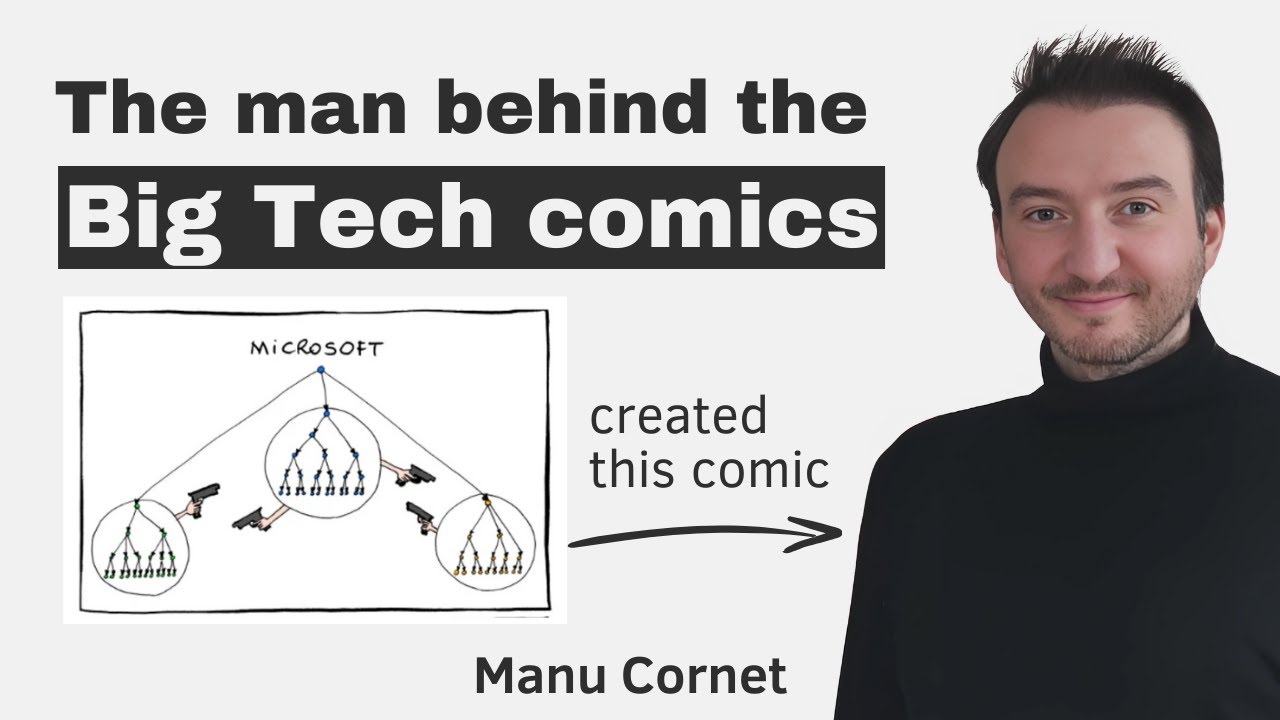
Manu Cornet is a senior software engineer and cartoonist who spent 14 years at Google working on Gmail, Android, Chrome, and Google Search, and later worked at Twitter before Elon Musk’s acquisition. He is best known for his tech industry comics, especially the “org structure” comic from 2011 that depicted the organizational charts of Amazon, Google, Facebook, Apple, Oracle, and Microsoft — a comic so accurate it is still widely referenced over a decade later. In this episode, he walks through the stories behind his most famous cartoons and what they reveal about the culture, tradeoffs, and inner workings of big tech companies.
The org structure comic and why it resonated
Published in 2011, the comic shows six panels of org charts for major tech companies, each capturing a distinct cultural stereotype:
Amazon is a standard hierarchical tree structure.
Apple is extremely centralized with all decisions flowing from the top.
Google is bottom-up and engineering-driven.
Facebook is flat and chaotic.
Oracle has a large legal department and a tiny engineering department — a reference to the Oracle-Google Java lawsuit happening at the time.
Microsoft (added as a sixth panel to make the layout work) shows warring departments, which ended up being the panel that got the most attention.
Manu almost didn’t publish it because he didn’t find it funny after finishing it — a common problem for cartoonists who spend too long staring at their own work.
The comic was later described on the first page of a CEO’s book (without attribution), which Manu considered a nice hat tip.
The “Who Sues Who” comic
Another 2011 cartoon showing a tangled web of lawsuits between Apple, Google, Amazon, Samsung, HTC, and Microsoft, with Nokia sitting alone in the corner, not suing anyone and not being sued — just “burning.”
Manu added a Starbucks as a joke about Oracle potentially suing over Java beans.
The Nokia reference connects to the famous “burning platform” speech by Nokia’s then-CEO, which was happening around the same time.
Google vs. Amazon: Guns and Roses
A later comic depicts Google holding guns toward customers and roses toward employees, while Amazon does the opposite — roses to customers, guns to employees.
This oversimplification captures a real cultural difference:
Google historically treated employees exceptionally well (dedicated SRE on-call teams, generous perks) while offering almost no customer support to free product users.
Amazon bends over backward for customers, including B2B customers on AWS, even mid-size ones — as illustrated by a story from Steve Yi, who was surprised that Amazon PMs flew out to meet his mid-size team at Grab just to hear their feedback.
Google’s on-call culture is described as “as chill as it gets” because dedicated SRE teams absorb most of the load, whereas at Amazon “everyone’s on call” regardless of team size.
Why Google is so bad at naming products
Manu traces this to Google’s bottom-up culture: engineers are empowered to start projects, which leads to competing efforts and a proliferation of overlapping products with confusing names.
The example of Google’s payment products illustrates the problem: Google Wallet → Android Pay → Google Pay → GPay → Google Wallet again, with multiple apps coexisting on the same phone at one point.
This is the “bad consequence of a good company culture” — being nice to employees and giving them freedom means shipping the org chart to consumers, who end up confused.
Manu contrasts this with Apple, where secrecy is so extreme that teams don’t even share what they’re working on with each other over lunch, and where naming is tightly controlled from the top.
Google has been moving toward Apple-style siloing, which Manu finds ironic given Google’s mission to “organize the world’s information.”
The “two ways of doing things at Google” comic
Based on a quote attributed to Eric Schmidt or John Rosenberg: “There are two ways to do things at Google — the deprecated way and the way that doesn’t work yet.”
The comic shows a fork in the road: the old road is marked “deprecated” and looks dirty, while the new road is “under construction” with danger signs.
This tendency to build a new improved version before it’s ready to replace the old one is not unique to Google — Manu says people at Twitter asked him to rebrand it as “Welcome to Twitter” because the same thing happened there.
Code reviews comic
A cartoon showing multiple people standing on a table trying to screw in a light bulb, each representing a different role:
The engineer doing the work, the code reviewer who won’t stop suggesting alternatives, the PM holding the light bulb like Hamlet’s skull, the TPM/manager checking their watch to ship faster, the SRE adding stability, and the UX designer bringing a decorative light bulb.
Another related comic shows the author assuming the reviewer will catch problems, while the reviewer assumes the author knows what they’re doing — a mutual diffusion of responsibility.
The comic printed on every Google door
After Google noticed people were being let into offices by employees holding doors open for strangers (called “tailgating”), Manu created a comic showing an alligator slithering through a half-closed door with the caption “Beware the Tail-Gator.”
Google liked it so much they printed it on every office door worldwide and asked Manu for new versions every year to keep the security message fresh.
20% time and Google’s innovation tradeoff
Google’s famous 20% time policy allowed engineers to spend one day a week on self-directed projects. Gmail and Google News both started as 20% projects.
Manu’s comic shows a woman labeled “Innovation” sitting on a large branch of a tree, while a man in a suit saws it off — representing the gradual discouragement of 20% projects as Google became more traditional.
The tension between 20% time and Google’s reputation for killing products: Manu suggests Google could have used an internal “Gmail Labs” approach (which Gmail actually used — experimental features clearly labeled as unsupported) to let projects prove themselves before public launch.
Gmail Labs was a section in settings where experimental features were clearly marked as potentially going away, which Manu thought was a fair and transparent approach.
The Google Graveyard and Stadia
On the day Google launched Stadia (its cloud gaming console), Manu published a comic showing a Google employee waving developers toward a beautiful road with rainbows and unicorns, while ignoring a massive graveyard of dead Google products on the side.
Stadia was eventually discontinued, and Manu’s interpretation of why: it lacked network effects. Even if the product was superior, developers had to build specifically for Stadia while everyone was already on Steam — the same dynamic that killed Google Wave and Google+.
Google did provide full refunds to Stadia customers, which Manu acknowledges was at least one thing they did right.
Manu’s time at Twitter
Manu joined Twitter hoping to recapture the early Google culture — smaller, less bureaucratic, friendly, with fast iteration.
He worked on the web client and was known as one of the most productive front-end developers, actively monitoring social media for user complaints and fixing bugs directly — something almost unheard of at Google, where engineers rarely interacted with users.
He describes the Google Search codebase as looking like a “moving castle” — old, complex, and hard to navigate — while Twitter’s developer experience was much smoother.
Elon Musk’s acquisition of Twitter
Six months after Manu joined, rumors began that Elon Musk might buy Twitter. Management told employees to “tune out the noise,” which Manu captured in a comic showing workers sitting in a sports arena surrounded by tens of thousands of cheering spectators, banners, helicopters, and fireworks — with the boss saying “just tune out the noise.”
After Musk completed the acquisition, roughly 80% of employees were let go within weeks.
Manu’s dartboard comic shows the Twitter org chart with dozens of red “fired” darts hitting it randomly, with executives saying “shall we stop now?” “No, this is fun,” and “Your turn, Elon.”
The randomness of the firings was striking: one of the most productive engineers Manu had ever worked with was fired, seemingly at random, though he was later rehired due to visa issues.
Manu’s “sink” comic shows Musk emptying a can of blue birds (employees) into a sink, but there’s a hole in the pipe and all the birds escape and fly away happy — a hopeful take suggesting employees might be better off leaving anyway.
Disillusionment with big tech
Manu’s most personal comic shows two drunk characters on a park bench at night — a person in a Google t-shirt and the Twitter blue bird. The Google character says, “It only took me 10 years before capitalism killed my ideals.” Twitter replies, “Good for you — it took me three months.”
Manu joined Google believing it was a company trying to make the world better, not just maximize profits. Over 14 years, he watched it become more and more of a traditional company.
He documented the Twitter acquisition story in a book called “Twit Tunes,” summarizing the entire saga through comics.
Rapid fire
Favorite programming language: None — Manu believes in using the right tool for the job. He has used Java, JavaScript, Python, C++, Objective C, C, and is learning Rust.
Book/comic recommendation: “Gomer Goof” — a famous European comic series about a well-meaning anti-hero who goofs everything up, now being translated into English.
Favorite comic he’s created: The two-panel cartoon about a software engineer who starts with “clean slate, solid foundations — this time I’ll build things the right way,” only to end up with an even bigger mess of disconnected buildings six months later. Manu says every engineer can relate to the cycle of rewriting from scratch and ending up in a worse place.