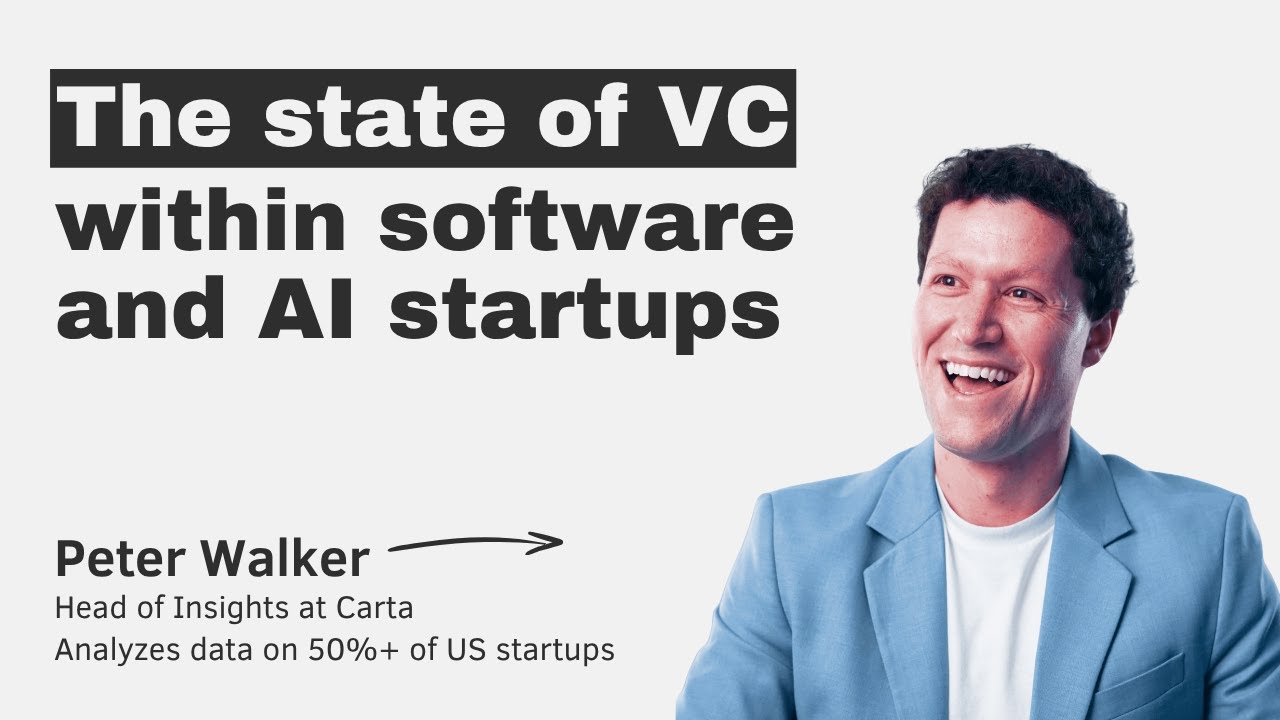
Peter Walker, head of insights at Carta — a platform used by over 50% of US startups to manage equity and funding data — walks through what the data reveals about the current state of venture capital and how AI is reshaping startups. The big picture: VC dollars invested have stayed relatively flat, but the number of companies raising rounds has dropped sharply since 2021, meaning capital is concentrating in fewer (often AI) companies. Startups are hiring far fewer people, teams at funding milestones are smaller, the time between rounds is lengthening, and solo founders are becoming more common — though VCs still prefer founding teams. For software engineers, this means joining a startup is riskier than it was in the 2021 boom, but the upside in learning and ownership remains high.
Venture-backed vs. non-venture-backed companies
The defining difference is that VC-backed companies are pushed to prioritize explosive growth over profitability, which affects culture, pace, compensation, and expectations from founders and boards.
Non-VC-backed companies can grow at a sustainable pace and stay profitable, giving founders more autonomy and employees more stability.
The VC model works when growth is dramatic enough (e.g., Uber eventually became profitable at scale), but many companies take VC money and never achieve the growth rates investors need, leaving founders and employees in a difficult position.
The health of venture capital in 2025
By total capital deployed, VC looks healthy — but that’s driven by a small number of mega-rounds at companies like OpenAI and xAI.
The number of early-stage rounds (seed and Series A) has been declining every year since 2021: Carta recorded about 7.4 rounds per day in 2025, roughly half the 2021 pace.
Two reasons for the decline:
VCs are demanding much higher growth rates (200–300% YoY vs. the old 100% benchmark) because of examples like Cursor.
More founders are choosing to bootstrap or pursue profitability instead of taking VC money, a shift from the Silicon Valley norm.
Hiring is down dramatically
Startups on Carta hired 73,000 people in January 2022, 40,000 in January 2023, 32,000 in January 2024, and roughly 20,000 in January 2025 — a drop of about 70% in three years.
The 2022–2023 decline was driven by less available capital; the 2024–2025 decline increasingly reflects AI tools making existing engineers more productive, so companies aren’t adding headcount.
Peter is direct: “I am not one of those people that says AI is not going to take jobs. I think it kind of already is.”
Smaller teams at every funding stage
The median Series A startup on Carta had about 20–22 full-time employees in 2022; by 2025 that’s down to about 15, and likely heading toward 12–13.
ARR per FTE (annual recurring revenue per full-time employee) has become the key metric VCs use to evaluate capital efficiency.
In 2021, the median Series A startup had ~$1.3M ARR; by 2024 it was nearly $3M, with the 75th percentile at ~$7M.
A Series A company with 15 people and $7M ARR generates roughly $400K+ in revenue per employee — a number that can approach profitability for some businesses.
The old 2021 mindset was “hire as many people as possible to grow fast”; now the emphasis is on doing more with fewer people.
Valuations, priced rounds, and SAFEs
A priced round means shares have a set price based on an agreed valuation; a SAFE (Simple Agreement for Future Equity) gives investors the right to equity at a future priced round, deferring the valuation question.
SAFEs were popularized by Y Combinator and are now standard for seed-stage deals because valuing a very early startup is inherently speculative.
Median seed-stage valuation on Carta in 2025 is about $16M pre-money — higher than 2021 even without adjusting for inflation, driven largely by AI hype.
Founders are often emotionally incentivized to raise at high valuations (“I’m the founder of a $200M company”), but high valuations create risk of a down round (raising at a lower valuation than before), which can spook employees and signal trouble.
Down rounds are culturally damaging in startups even though they’re normal in public markets — employees may interpret them as a reason to leave.
Bridge rounds and what they signal
A bridge round is additional capital from existing investors when a company can’t yet reach the next priced round.
Bridge rounds are generally a negative signal: the percentage of companies that make it from seed to Series A after a bridge has dropped from ~33% in 2020 to ~8% in 2022.
Some bridges are priced rounds; others are done on SAFEs or convertible notes, which “kick the can down the road” without forcing hard decisions.
For engineers: if your company raises a bridge round, it’s worth quietly networking and preparing alternatives.
Solo founders are rising — but VCs still don’t love them
Over a third of new startups on Carta in 2024 were solo-founded, the highest share in at least 10 years, driven by AI lowering the cost of building a company alone.
However, only about 17% of VC-funded companies in 2024 had a solo founder — the gap between solo-founded startups and funded ones remains large.
VCs cite key person risk and the belief that if a founder can’t attract a co-founder, they won’t attract talent later.
Counterexamples exist: Cursor has three co-founders and is the fastest-growing dev tools startup, suggesting founding teams still have advantages.
Employee option pools (ESOPs) are shrinking
The employee option pool is the percentage of equity reserved for employees; it used to be 15–20% but now starts at 5–10%.
The pool expands with each fundraise through dilution — new shares are created, so everyone’s percentage gets smaller even though their share count stays the same.
Deep tech startups (robotics, biotech, energy) have similar option pool sizes to software startups, contrary to the assumption that deep tech needs larger pools to attract specialized talent.
Employees are often disappointed by acquisition payouts because of dilution and the preference stack: investors get their money back first (typically 1x liquidation preference) before employees see any proceeds. A $1.2B acquisition with $1B raised means only $200M is shared among employees and founders.
Time between rounds is increasing
The median time from seed to Series A has grown from the traditional 18–24 months to about 2.5 years; Series A to Series B is approaching 3 years.
This reflects both companies that want to raise but can’t, and companies that choose not to raise because they’ve reached profitability.
For VCs, this is a “tricky moment” — their best portfolio companies may not need more capital.
The Series A graduation rate has dropped
In the 2021 boom, up to 50% of seed-stage startups raised a Series A; now it’s around 25–30%.
The 2021 era felt low-risk for startup employees because even struggling startups were often acqui-hired; that safety net is gone.
Engineers should ask in interviews: when did you last raise, how much runway do you have, what are your revenue growth rates?
The case for sometimes quitting
Many startups that raised seed rounds in 2021 or earlier are still operating but not growing fast enough to raise another round — they’re in limbo.
Silicon Valley culture celebrates both “never quit” and “failure is good,” which creates conflicting signals.
Peter argues that talented founders of stuck startups should consider shutting down and starting something new — investors will often back them again if they acted in good faith.
Carta’s CEO Henry raised his first company, it failed, and the lessons and investor relationships from that failure helped him build Carta.
How to evaluate a startup before joining
Think like a VC: assess growth rate, unique technological edge or moat, and defensibility against competitors (including AI-powered ones).
At seed or Series A, you’re primarily betting on the founder — research their track record and talk to people who’ve worked with them.
Ask concrete questions in interviews: revenue, growth rates, how much capital was raised and on what terms, and how long since the last fundraise.
A company that raised its seed round 4–5 years ago with no subsequent round has a very low probability of making it.
Skills that help engineers thrive at startups
Technical skill is necessary but not sufficient; startups require a player-coach mentality — you’ll write code directly, often with one or zero direct reports.
Engineers need to engage beyond pure code: talking to customers, evaluating market maps, and thinking about adjacent products or acquisitions.
The hidden value of working at a startup is the business knowledge you accumulate — understanding how businesses grow, compete, and make tradeoffs — which is why many former startup engineers go on to found their own companies.
Joining a well-hyped startup is valuable even if it fails, because the network of talented colleagues will scatter and create opportunities elsewhere (the “PayPal mafia” / “Airbnb mafia” effect).
Summer fundraising: the data
The stereotype that VCs disappear in July and August is false — deals do get signed in summer, though January is actually the slowest month.
April and December see spikes in signed deals, likely reflecting spring deal cycles and year-end closing rushes.
Due diligence is taking longer than it used to: VCs are asking more questions, interviewing customers, and scrutinizing financials more closely as the number of rounds has decreased.
Signals engineers should watch
Bridge round: roughly 8% chance of making it to Series A afterward (based on 2022 data).
Down round: culturally damaging, may trigger employee departures.
Long gap since last fundraise: if it’s been 4–5 years with no growth, the founder may shut down with little warning.
Fast’s collapse is a cautionary example: employees were caught off guard when the company ran out of money, highlighting the importance of understanding your company’s burn rate and runway.