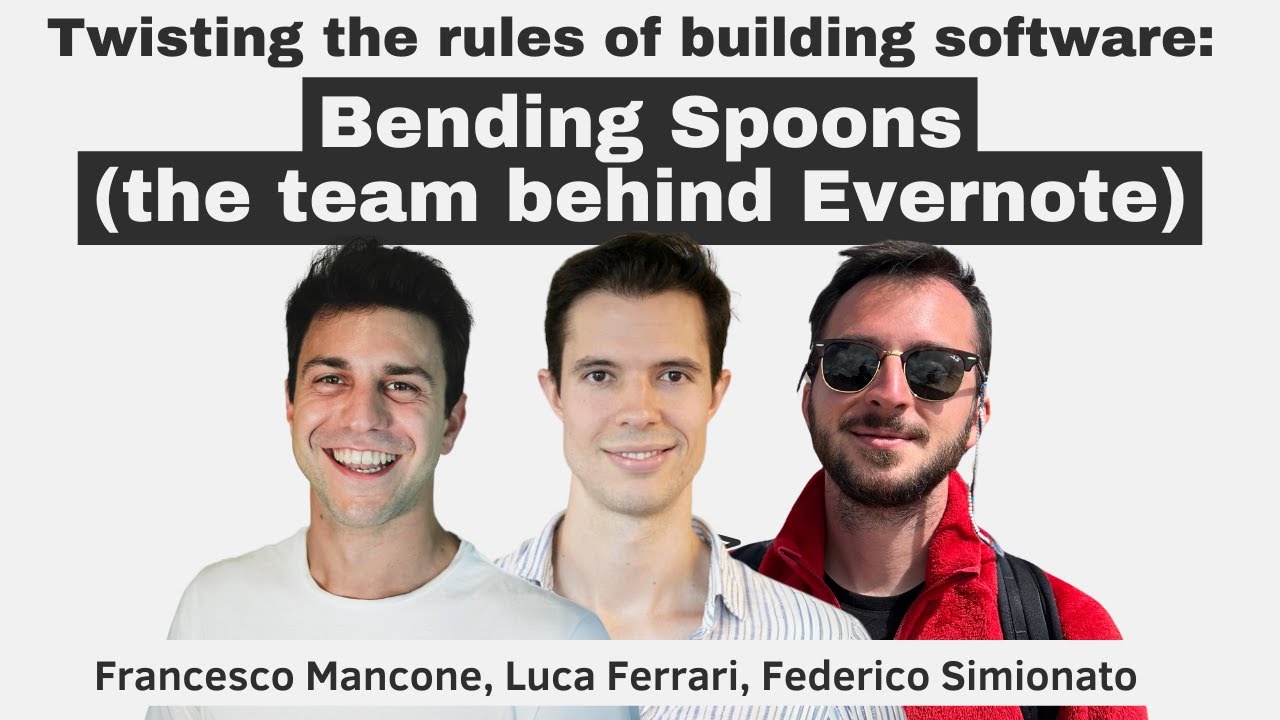
Bending Spoons is an 11-year-old Milan-based tech company that has grown from five developers building small mobile apps into a 450+ person organization generating over $700 million in annual revenue, profitable every year since founding, and having spent more than $1 billion on acquisitions. The company owns and operates well-known products including Evernote, Meetup, Streamyard, WeTransfer, and Remini (an AI photo enhancer with over 100 million monthly active users). What makes the company unusual is its model: it acquires struggling or available companies using its own money (not VC funding), restructures them aggressively, and operates them for the long term. This approach has drawn criticism in the press due to layoffs following acquisitions, but the company argues it is rescuing businesses that were already failing and positioning them for long-term success. The episode covers the Evernote acquisition in detail, the company’s engineering philosophy, organizational structure, and the unconventional principles that underpin how it operates.
The acquisition model and the layoff controversy
Bending Spoons acquires companies that are typically struggling or actively seeking buyers, using its own cash rather than investor capital, and plans to own and operate them indefinitely.
After acquisition, the company goes through a learning phase of several weeks to a few months, during which experienced team members embed across the organization to deeply understand the product, technology, and business before forming a long-term vision.
Restructuring often involves significant layoffs, which the company acknowledges are painful but argues are necessary to build leaner, more focused organizations positioned to thrive for five to ten years.
The company sees a fundamental divide in worldview: some believe a business should not be made more successful if it requires painful decisions like layoffs; others believe you should run a business as efficiently as possible while treating departing employees well. Bending Spoons falls firmly in the latter camp.
Despite the external criticism, the company reports extremely low unwanted employee churn of about 1% per year (roughly 3–5 people out of 450), which they see as evidence that the model works for those who align with it.
The company is transparent about its values, sending new hires a document called “Controversial Principles” that outlines its uncompromising stance on excellence, including the willingness to demote or let go of people who are not top performers in their roles.
Company history and growth
Luca co-founded a previous startup called Evertale in Copenhagen around 2010–2011, which aimed to create a self-writing diary of a user’s life using AI. It was a commercial failure, but the team was able to buy back shares from their VC for $1 and repurpose the remaining ~$40,000 as seed capital.
Bending Spoons was founded in Copenhagen in 2013 with that $40,000 by the same three Evertale co-founders plus two capable former Evertale employees. The company soon moved back to Italy.
The first acquisition was a $10,000 iOS keyboard personalization app bought from a solo developer. The team improved it and sold it for $20,000, then reinvested into progressively larger acquisitions, compounding over a decade into hundred-million-dollar deals.
A notable milestone was acquiring Splice, a mobile video editor from GoPro, which was the first time they acquired an asset from a large structured seller rather than individual developers or small teams.
Raising venture capital in Italy in 2013–2014 was “borderline impossible,” and the founders felt their unusual model would not attract VC interest anyway. This forced the company to be profitable from day one, relying on cash flow and traditional bank loans rather than equity financing.
The founders believe this early scarcity bred resourcefulness, ingenuity, and efficiency that now gives them an edge over competitors who were flooded with funding.
The Evernote acquisition and technical transformation
Bending Spoons learned Evernote was available for acquisition in late 2022, moved quickly, and closed the deal in early January 2023 after antitrust clearance.
When they acquired Evernote, the technology stack was a Java 11 monolith running on 750 manually provisioned virtual machines on Google Cloud. The data was sharded across these machines unevenly, causing heavy maintenance burden and frequent on-call incidents.
The original cloud migration had been a lift-and-shift (one-to-one) move from bare metal to cloud VMs, meaning the architecture was not cloud-native at all.
The first major technical step was migrating all user data from local databases on the VMs to a managed database, which freed the team to restructure the application logic.
The team then moved from the monolith to a microservices architecture, extracting core note-handling logic piece by piece without disrupting user flows.
A critical change was replacing the client-server communication mechanism: clients had previously used heavy polling (continuous requests to the backend), which required clients to embed complex logic for combining mutations and handling synchronization. The team moved to an event-driven system called N Sync, where the backend propagates state changes to clients in real time. This eliminated many data synchronization bugs and moved the responsibility for maintaining a single source of truth to the backend.
The team also overhauled the CI/CD pipeline, moving from self-hosted Jenkins with many manual steps to CircleCI with custom orbs, significantly speeding up releases.
As of the conversation, the team is close to completely sunsetting the monolith by the end of 2024, after which they plan to consolidate the microservices (many of which are overly granular) into a more efficient architecture.
On the product side, the team committed to shipping 100 updates in 2024, mixing quick UX wins (like collapsible sections in the note editor and slash commands) with deeper infrastructure improvements. They recently released what they consider the best AI transcription feature in any note-taking product, allowing one-click transcription of video, audio, and image files, and plan to offer it as a standalone tool outside Evernote.
Engineering philosophy: radical simplicity and no on-call
A core cultural principle at Bending Spoons is “radical simplicity”: the team actively seeks the simplest solution, and the burden of proof is always on anyone proposing to add complexity. People are encouraged not just to avoid adding complexity but to look for ways to remove it.
This principle applies beyond technology to policies and processes. For example, the company eliminated bonuses years ago, finding weak evidence that they drive performance and significant overhead in managing them. Everyone receives 100% fixed pay, with the option to take a portion in equity.
The company tries to avoid having on-call programs entirely. The reasoning is that knowing there is no safety net forces engineers to think carefully about corner cases and build truly robust, sharply engineered systems. On-call is reserved only for situations where the damage from an issue would be truly staggering or where the codebase is not yet mature enough.
Engineering processes are not prescribed top-down. Teams choose their own approaches to testing, releasing, and QA based on what is most effective for their product’s maturity and needs. More mature products tend to have more automated tests (unit, integration, end-to-end); newer products invest less in this.
Software engineers share responsibility for quality through white-box testing, while dedicated QA testers handle black-box testing. The company invests in developer experience to make testing by engineers practical rather than cumbersome.
The company is careful about observability and monitoring, tailoring metrics to maximize coverage while minimizing false positives, which they found can severely degrade engineers’ quality of life.
Organizational structure
Bending Spoons is organized into business units (e.g., Evernote, Meetup), each with its own dedicated management team, engineers, data analysts, product designers, and other resources. These units operate largely autonomously.
A shared platform layer, called Foundations Technology, provides services used across business units: analytics tools, monetization, user acquisition, A/B testing, infrastructure management, data pipelines, and machine learning models for forecasting user behavior.
The platform model is viable because of the large portfolio of products (100+ digital products), which justifies the investment in shared tooling. When a tool is built for one product, it is immediately available for all others.
Improvements flow in both directions: business units can improve shared platform tools and pass those improvements back for the benefit of all units. Examples include making authentication more resilient against abuse and improving payment processing for extreme loads.
Teams are kept small with high talent density and given broad mandates. The company does not impose specific tech stacks, processes, or directions on teams. There are guidelines and coaching available from platform experts, but teams are trusted to take full responsibility for their objectives.
Technology stack
The most popular backend language is Python (with Fast API for APIs). TypeScript is heavily used to enable engineers to work across frontend and backend. Node.js powers backend services.
Native iOS and Android apps are built with Swift and Kotlin, though React is used where it makes sense. Electron is used for desktop applications.
The company is not prescriptive about technology choices. Teams generally prefer tools already widely used in the organization to avoid knowledge silos, but they will adopt a different technology if it is clearly the best fit for a specific goal.
A notable example is the internal marketing attribution tool (called XA), which was built in Rust for performance reasons after the team determined Python was not suitable for handling the required load efficiently.
Hiring and career development
Bending Spoons strongly favors hiring junior engineers, new graduates, and inexperienced people over experienced hires. The reasoning is twofold:
Talent cannot be taught, but experience can be gained over time by working alongside great colleagues on challenging projects. The company optimizes for talent with a 5–20 year view.
The company’s culture and approach are so unusual that highly experienced individuals often struggle to adjust, whereas junior hires come without preconceptions about how things “should” be done.
The company invests heavily in training and coaching for junior hires during their ramp-up period.
There are no titles internally. Everyone doing software engineering is called a “software engineer.” Managers are called “leads.” People can choose whatever title they like for external purposes (LinkedIn, CV) as long as it is not misleading.
There are very few career levels, and the differences between them are substantial. The company does not try to make fine-grained distinctions in contribution or have frequent review cycles. People who want very regular, specific feedback and adjustments are not a good fit.
The traits the company hires for are: strong problem-solving ability, fast learning, a strong sense of ownership (self-directed, no micromanaging needed), and team spirit (collaboration over individual ego). They avoid hiring brilliant people whose high opinion of themselves disrupts teamwork.
Engineers who thrive at Bending Spoons tend to be well-rounded and interested in the business impact of their work, not just deep technical expertise in a single area.
Why this model is rare
Bending Spoons is not aware of any other company attempting this specific model at this scale. The barriers to entry are enormous: 11 years of building the platform, culture, employer brand, and 50+ internal technologies. Even with infinite capital, the founders estimate it would take at least six years to replicate.
The company’s unique position stems from its unconventional path: a failed startup before founding Bending Spoons, inability to raise VC in Italy, forced profitability from day one, and operating at the fringes of the tech ecosystem with few advisors. This led to a culture of figuring things out independently rather than copying established playbooks.
The founders suggest that seven years ago they were building the kind of efficient, capital-disciplined company that many are now trying to build, giving them a significant head start as the industry shifts toward efficiency.