-
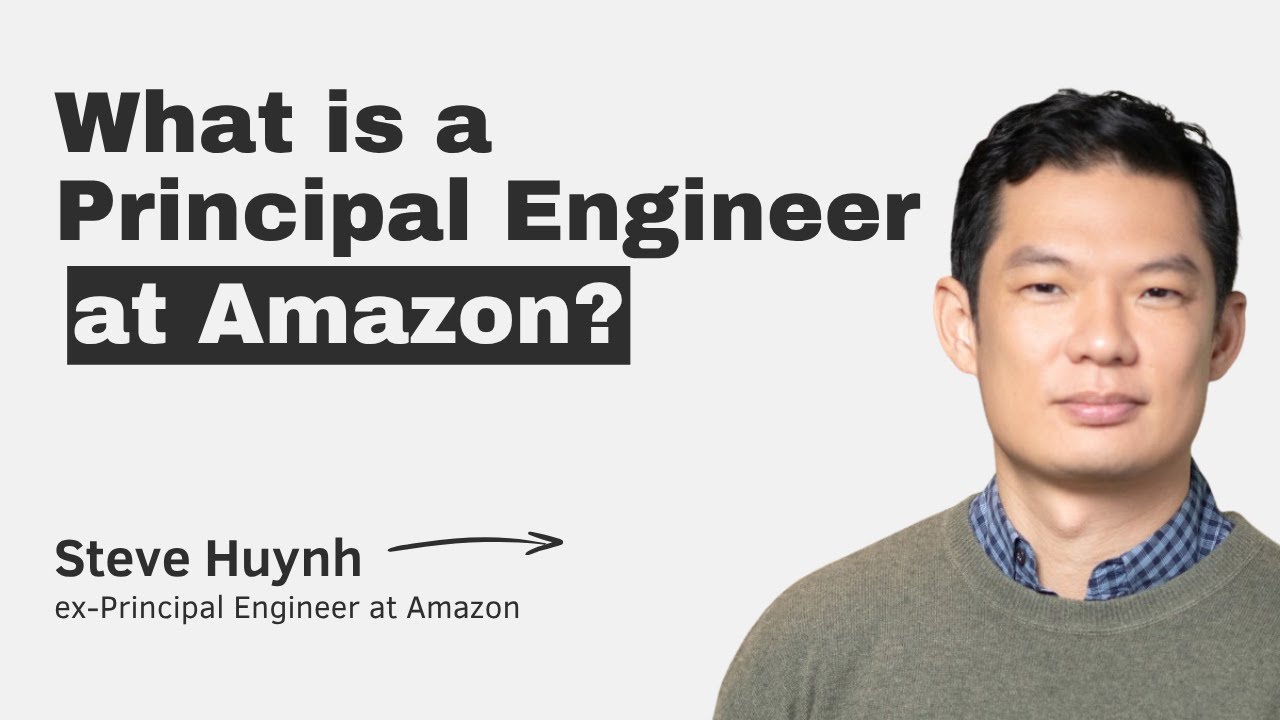
Steve Huynh spent 17.5 years at Amazon, working across many teams including Kindle, Prime Video, Amazon Local, Amazon Restaurants, Amazon Tickets, and live sports streaming. He spent his final four years as a Principal Engineer (L7), one of the hardest engineering levels to reach in big tech.
- Amazon’s Principal level is unusually difficult to achieve because the company skipped a “staff” level, making the jump from Senior (L6) to Principal (L7) effectively a 2.5-level jump compared to other companies. This has caused a brain drain, with talented engineers leaving for companies like Meta where leveling progression is more linear.
- Despite hundreds of open Principal roles and thousands of Senior engineers trying to get promoted, the bar is extremely high. Steve took 8 years to go from Senior to Principal (compared to 4 years from support engineer to Senior).
- Once promoted, Principal Engineers gain access to a tight-knit community with dedicated program managers, Slack channels, local offsites, and a 20-year-running internal presentation series called “Principles of Amazon” where Principals present to the entire company.
-
Amazon’s engineering culture is defined by extreme customer obsession, operational ownership, and principled thinking.
- Engineers own their software end-to-end, including on-call pager duty. There is no separate ops team. This creates a culture where developers build resilient systems because they are the ones woken up at 3 AM when things break.
- The company measures everything. A famous internal study found a direct linear correlation between page latency and revenue: faster pages = more conversions, with no observed ceiling. This drove a first-principles approach to performance optimization: instead of asking “how do we reduce latency by 25%?”, teams ask “what is the conceptually fastest thing we could do?”
- Amazon started as a monolith (C++ binary on Sun hardware) and only moved to microservices when the binary hit the 4GB limit of 32-bit architecture around 2002. Steve argues startups should follow the same pattern: start with a monolith, wait until it breaks (typically around 50 developers), then decompose.
- The company’s “secret sauce” is not the specific leadership principles themselves (customer obsession, bias for action, ownership, frugality) but the practice of principled thinking: fixing certain axioms as non-negotiable and building all decisions from there, the way mathematics builds from axioms.
- Writing culture is central. All business strategy, system design, and new initiatives are expressed in a standard six-page memo format (including PR/FAQ documents). Meetings begin with “study hall” where everyone reads the memo in silence, leading to much higher-quality discussions.
-
Operating at Amazon’s scale creates unique engineering challenges that don’t exist at smaller companies.
- A single request to the Prime Video or Retail gateway page fans out into hundreds of downstream microservices requests. Individual services handle tens of thousands to hundreds of thousands of requests per second.
- “Brownouts” are a critical concept: unlike blackouts (where a service is unreachable), brownouts occur when a service is reachable but timing out, returning partial results, or returning errors for a percentage of requests. These are harder to detect and can cascade through dependency chains.
- When a dependency recovers from an outage, there is a risk of re-overloading it immediately. Engineers must implement strategies to give recovering services “breathing room” (e.g., throttling, backoff).
- Steve’s team worked on Amazon Tickets, building one of the world’s fastest ticket-selling systems. This led to a patent for a novel approach to finding contiguous seats: instead of querying a backend database, they inverted the problem by loading the entire venue’s inventory into L2 CPU cache on individual nodes and using bit manipulation to find available seats. This achieved near-theoretical-maximum speed for the problem.
-
The Principal Engineer role at Amazon comes with unique challenges and paradoxes.
- Paradox of belonging: Principals work across teams but belong to none. They are not embedded on any single team, not on anyone’s pager rotation, yet are called upon to explain outages and guide architecture across the organization.
- Freedom vs. responsibility: Principals report to directors or even VPs who set direction (“availability needs to improve for live sports”) but do not assign specific work. The Principal must figure out the highest-leverage solution, which could be writing code, buying off-the-shelf software, spinning up a new team, or reprioritizing another team’s roadmap.
- Bandwidth crisis: Principals are triple- and quadruple-booked in meetings. Steve’s daily calendar looked like “a Tetris factory blew up.” The only way to survive is aggressive prioritization and learning to say no.
- Being truly present: With so many concurrent initiatives, it is mentally difficult to be fully present in any single meeting.
- Compensation is comparable to a senior engineering manager, reflecting the scope of the role, though Principals do not deliver performance reviews for direct reports (they may be asked to participate in stack-ranking calibration for large orgs).
-
Amazon’s internal knowledge base is a major benefit of working there, even though the company is externally secretive.
- COEs (Correction of Errors) are blameless postmortems published internally for every significant outage. They follow the “Swiss cheese model” where failures require holes to align across multiple layers. Steve describes subscribing to the COE email list as a way to learn from real-world disasters across the company.
- The “Principles of Amazon” presentation series has recorded 20 years of Principal-level technical talks, all available internally.
- Internal RFCs, six-pagers, and design documents create a searchable institutional memory that accelerates onboarding and cross-team learning.
-
Steve’s career advice and current work.
- Meta-learning: Rather than asking “what technology should I learn?”, ask “how can I learn skills faster?” This makes you recession-proof and perpetually employable. Focus on acquiring valuable skills now rather than waiting for perfect conditions.
- Favorite language: Perl, despite being inefficient, unreadable, and interpreted. Steve values the freedom of expression it provides. He also appreciates “boring” languages like Java for their ecosystem and reliability. He is interested in Rust.
- Book recommendations: So Good They Can’t Ignore You by Cal Newport (career capital theory), AI Engineering by Chip Huyen, and Designing Data-Intensive Applications (DDIA) by Martin Kleppmann (a new edition is coming at the end of 2025).
- Steve left Amazon a year ago and now creates content full-time: YouTube videos, a newsletter, and a Discord community focused on software engineering and Amazon culture.