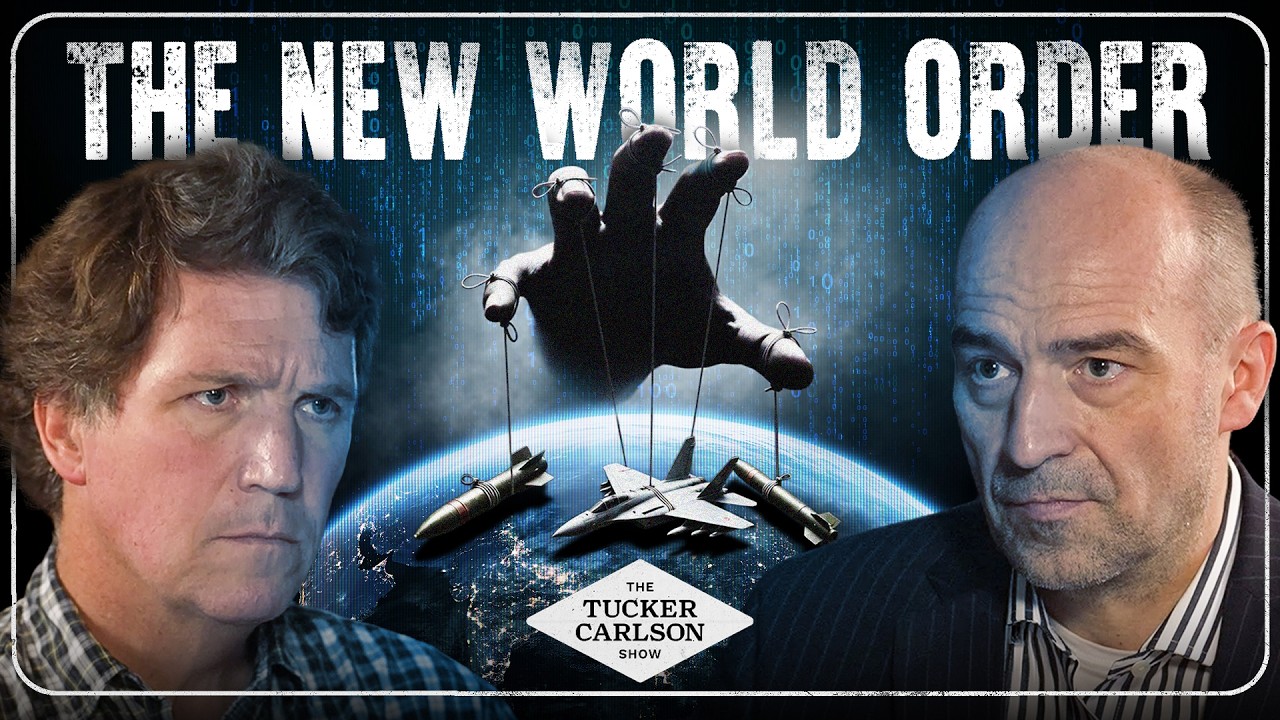
Every major war in modern history has been engineered under false pretenses, and the current conflicts with Venezuela and Iran are best understood as moves in a larger geopolitical contest targeting China — not as isolated events driven by nuclear proliferation, democracy promotion, or humanitarian concerns. The speaker, economist Richard Werner, argues that powerful central planners use wars, economic crises, and monetary system changes to restructure global power, and that ordinary people consistently fail to recognize these patterns because the idea of intentionally orchestrated mass harm is too dark to accept.
The Lusitania as a Blueprint for Engineered War
The sinking of the Lusitania in 1915 was a deliberately orchestrated false flag designed to draw the United States into World War I on Britain’s side.
Britain officially listed the Lusitania as an auxiliary military ship, knowing Germany would target it as a legitimate military vessel.
Germany placed ads in American newspapers warning citizens not to board the ship, but many major newspapers — controlled by pro-British interests — refused to publish them.
The ship likely carried military equipment, and the British had broken the German Enigma code, meaning they knew where German U-boats were.
Winston Churchill, then First Lord of the Admiralty, ordered the Lusitania to slow its engines in the vicinity of a German submarine, virtually ensuring it would be sunk.
The resulting anti-German media frenzy in America was instrumental in building public support for U.S. entry into the war in 1917.
This episode illustrates a recurring pattern: wars are not started by spontaneous aggression but by calculated provocations designed to manipulate public opinion and override the natural reluctance of ordinary people toward war.
The Real Cause of World War I: The Berlin-Baghdad Railway
The deeper cause of World War I was not the assassination of Archduke Franz Ferdinand but Germany’s plan to build the Berlin-Baghdad-Basra railway, which threatened British global hegemony.
Britain’s power rested on naval dominance and control of sea-based trade routes. The railway would have given Germany an independent continental transport system for raw materials and goods, bypassing British-controlled oceans.
Germany lacked domestic raw materials and was vulnerable to British naval blackmail — as demonstrated in 1919 when a British naval blockade after the armistice caused an engineered famine killing an estimated 1 million Germans.
British imperial planners identified the railway as an existential threat to their global dominance and concluded it had to be stopped by any means, including war.
Germany’s rapid economic growth, scientific leadership, and merit-based prosperity under Prussian leadership made it a rival that Britain was determined to destroy.
The lesson: hegemonic powers will go to war to prevent the rise of competitors who threaten their control over trade and resources, regardless of the human cost.
Venezuela and Iran: The Modern Sequel Targeting China
The U.S. interventions in Venezuela and Iran are connected strategic moves aimed at China, mirroring the pre-WWI strategy against Germany.
Venezuela has the world’s largest oil reserves. China has built the refineries to process Venezuelan heavy crude, making Venezuela a key energy partner.
Iran is another major oil supplier to China and a critical node in China’s Belt and Road Initiative (BRI).
The war on Iran has disrupted shipping through the Strait of Hormuz, restricting not only oil but also fertilizer shipments from the Middle East, with consequences for global agriculture in the coming growing season.
U.S. bombing campaigns in Iran have specifically targeted BRI infrastructure — bridges, railways, and supply chain components — confirming the strategic intent to disrupt China’s alternative trade network.
The shift from covert regime change (the old CIA model of “plausible deniability”) to open military intervention in Venezuela marks a significant turning point: the hegemon no longer feels the need to hide its actions.
The Belt and Road Initiative: China’s Berlin-Baghdad Railway
The Belt and Road Initiative (BRI) is China’s modern equivalent of the Berlin-Baghdad railway — a continental logistics network designed to reduce dependence on U.S.-controlled sea routes.
It provides developing countries with an alternative to the IMF-World Bank system, which the speaker argues is designed to keep developing nations poor and locked into low-value commodity exports.
Through BRI, China has invested billions in roads, railways, ports, and bridges across Africa, Central Asia, and the Middle East, enabling participating countries to develop their own industries.
It also allows China to diversify away from holding U.S. Treasuries — which the speaker notes are not even held directly by China but are held in custody by the Federal Reserve Bank of New York, meaning China cannot sell them without U.S. permission.
The BRI is linked to the petrodollar challenge: as China trades with BRI partners in non-dollar currencies, it undermines the dollar’s global dominance.
The U.S. and EU have pressured countries like Italy and Hungary to withdraw from BRI, recognizing it as a strategic threat.
The IMF-World Bank System as a Tool of Suppression
The IMF and World Bank function as modern instruments of colonial control, preventing developing countries from adopting the high-growth economic model.
Their policy conditionality — deregulation, liberalization, privatization, free trade — locks developing countries into exporting cheap raw materials while importing expensive manufactured goods.
This is not accidental: the terms of trade for commodity exporters deteriorate over time (the Prebisch-Singer hypothesis), meaning these countries get progressively poorer under this system.
The Asian financial crisis of 1997-98 was engineered through central bank policy: the Bank of Thailand, following IMF advice, maintained a fixed exchange rate while encouraging dollar borrowing, creating an unsustainable debt pile that collapsed when speculators attacked.
The IMF then demanded that Thailand sell its banks and industries to foreigners at fire-sale prices during the crisis — a deliberate transfer of ownership.
The high-growth model that built Prussia, Germany, Japan, and later China — based on decentralized banking, local credit creation, and productive investment — is actively suppressed by international institutions.
The Great Deception: How Economics Was Weaponized
Modern economics, founded by David Ricardo, is built on a deliberate logical trick: using mathematically consistent but empirically false assumptions to justify policies that benefit the powerful.
Ricardo’s theory of comparative advantage and free trade sounds logical but depends on assumptions (perfect information, complete markets, zero transaction costs) that are never true in reality.
The probability of all required assumptions holding simultaneously to produce “equilibrium” is less than 1% — meaning the entire framework is a fiction.
This “Ricardian vice” — making assumptions that guarantee desired conclusions — has been the foundation of economics ever since and is used to justify policies that impoverish developing nations.
The same simulation-based deception underlies the Club of Rome’s “Limits to Growth” (1972), climate scenarios, pandemic models, and population growth projections — all of which have been empirically wrong but serve to justify control policies.
Equilibrium economics hides the reality of power: in all markets, the “short side” (whichever quantity is smaller) has the power to pick and choose trading partners. In money markets, the supply side — banks and central banks — holds this power.
Central Banking as the Real Seat of Power
Monetary policy, not fiscal policy, is the primary lever of economic control, and bank credit creation is the mechanism through which entire economies are directed.
In Weimar Germany, Hjalmar Schacht — appointed by foreign powers through the JP Morgan reparations committee — controlled the Reichsbank and decided which companies lived or died by controlling credit.
Schacht later recommended Hitler to be chancellor and then, as central bank head, used early versions of quantitative easing to restore Germany to full employment by 1936 — three years after Hitler took power — through credit creation for productive business investment, not military spending.
The Reichsbank was made “independent” from democratic accountability while being 100% privately owned and controlled by foreign appointees — a model later revived in the European Central Bank.
The Bundesbank was a rare exception: accountable to parliament, mandated to consider employment, and successful in avoiding asset bubbles. It was deliberately destroyed when Germany adopted the euro.
The ECB was explicitly modeled on the Reichsbank, not the Bundesbank, and has produced exactly the crises predicted: asset bubbles, banking crises, and deep recessions in Ireland, Spain, Portugal, and Greece.
The ECB has overseen the disappearance of 6,000 banks in Europe, centralizing financial power and reducing economic growth.
The One Child Policy and the Club of Rome’s Influence on China
Deng Xiaoping’s one-child policy — economically irrational for a high-growth model that needs population growth — was adopted under the influence of the Club of Rome’s anti-population agenda.
Deng’s key economic advisor was Saburo Okita, a Japanese high-growth planner who had been recruited onto the executive committee of the Club of Rome — an organization founded with Rockefeller funding whose two main messages are that economic growth is bad and there are too many people.
The one-child policy was based on population simulations by a Chinese military mathematician using the Club of Rome’s model — the same model that has been empirically discredited.
The implication: Deng was allowed to implement the high-growth model (and attract American investment) on the condition that he adopt the Club of Rome’s population control agenda.
The Club of Rome’s agenda traces back to Thomas Malthus, who worked for the East India Company — the same entity that engineered famines in India while exporting food, operating on the principle that there were “too many useless eaters.”
Mao’s Famine: Intentional Mass Starvation as Policy
The Great Chinese Famine (1959-1961), killing an estimated 80 million people, was not a natural disaster but the result of a specific combination of policies that could only produce famine.
It began in a year of bumper crops — making the famine clearly policy-induced.
Key policies included: forcibly transporting millions of harvest workers from rural areas to cities during harvest time; launching a campaign to exterminate tree sparrows (the natural predator of locusts), resulting in locust swarms that destroyed crops; seizing all grain from farmers and exporting some to Romania; and punishing anyone who stored food as a “bourgeois hoarder.”
Mao was put in power by foreign (Soviet/Bolshevik) interests, and his policies consistently served to weaken China’s population and economic base.
The lesson: leaders are capable of intentionally killing tens of millions of people through policy, and the majority of people cannot bring themselves to believe this is possible.
The Path to World War III and the New Monetary System
The speaker argues that the current trajectory points toward a third world war, driven by the same forces that produced the first two.
The EU has official rearmament plans targeting readiness for war against Russia by 2028-2030, which would inevitably involve China as well.
America’s aggressive policies toward China — including the deliberate transfer of manufacturing and technology to build up China as a rival — mirror the pre-WWI pattern of building up an opponent to justify war.
The ultimate goal appears to be a one-world government with a new international monetary system, replacing the dollar with a centralized digital currency.
The coming monetary system will be based on central bank digital currency (CBDC) linked to digital identity — what the speaker calls “central bank digital control.”
Unlike existing bank digital money (which is decentralized and has protected transaction privacy), CBDC is centralized, programmable, and permission-based.
It would allow central planners to control what people buy, where they go, and when they can spend — effectively eliminating financial freedom and enabling totalitarian micromanagement.
The massive buildout of data centers and AI infrastructure is not about productivity but about solving the organizational challenge of controlling billions of people through the financial system.
CBDC would make fiscal policy and parliamentary budgeting obsolete, as the central bank would control everything — completing the takeover by monetary central planners.
The transition will likely be triggered by crisis — either a war, a banking crisis, or inflation — providing the justification for emergency measures.
Europe is already in a property bust engineered by the ECB, putting banks under pressure and creating conditions for a banking crisis that could be used to launch the digital euro.
A second bout of inflation, following the money creation of 2020-2021, is expected and would serve as further justification.
What Can Be Done
The speaker advocates for decentralization as the core principle of resistance: opposing digital ID and CBDC, supporting small local banks, and reversing the centralization of financial power.
The Prussian/German high-growth model — thousands of small local banks making decentralized lending decisions — is the proven alternative to centralized control.
There is some hope: Federal Reserve Vice Chair for Supervision Michelle Bowman is an advocate for small banks and should be supported.
The public must recognize that the majority of people are good, but a small number of powerful individuals are willing to engineer wars, famines, and economic crises to achieve their goals — and that studying history is essential to recognizing the patterns before it is too late.