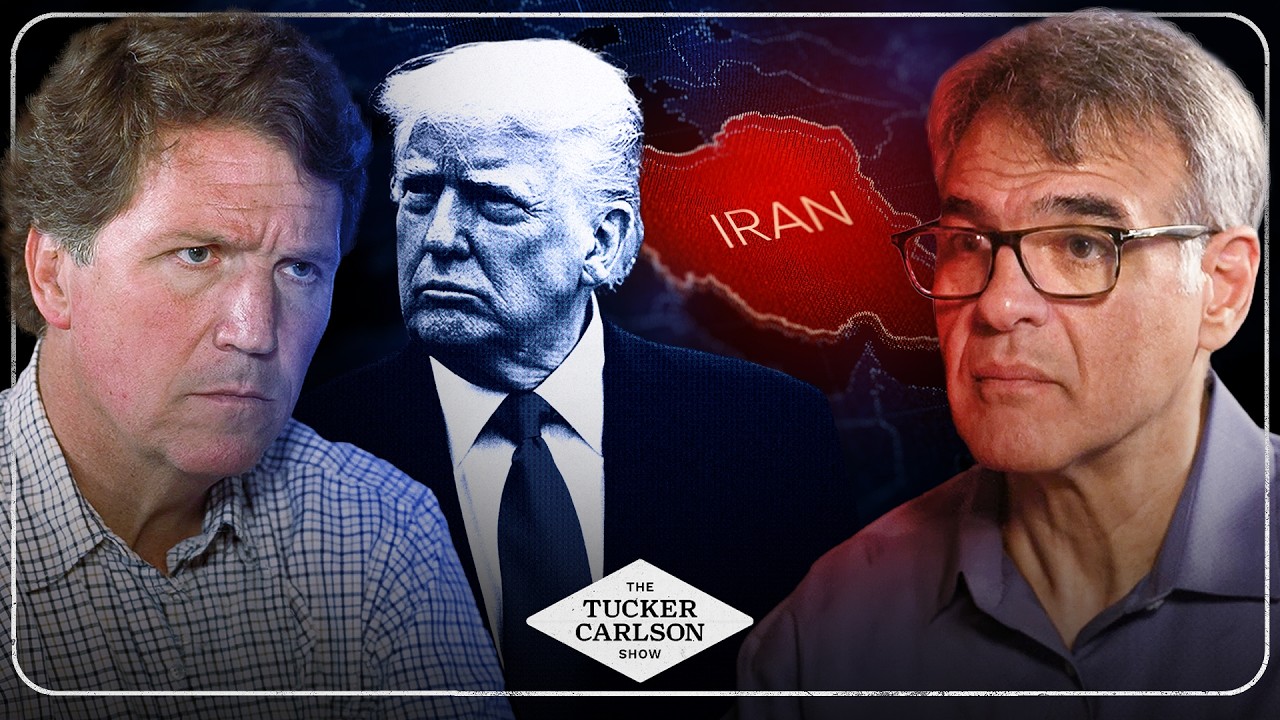
John Kiriakou, a former CIA counterterrorism officer and senior investigator for the Senate Foreign Relations Committee, argues that the U.S. war against Iran was driven not by American national interests but by Israeli priorities, and that the intelligence justifying the war was fabricated or misrepresented. He walks through how the U.S. government historically makes decisions about going to war, why this process was bypassed, how the CIA and intelligence community have become politicized, and why the war is both strategically unsound and morally indefensible. He also addresses the Charlie Kirk assassination, the Butler attempt on Trump’s life, the role of the MEK and Reza Pahlavi, and the broader question of whether the U.S. government still serves its own citizens.
How War Decisions Are Supposed to Work — and How This One Didn’t
A formal process exists for deciding whether to go to war: the president commissions National Intelligence Estimates, consults the State Department, Defense Department, National Security Advisor, and critically, talks to allies in Europe and the Gulf to build consensus and give them time to prepare for economic disruptions like oil and gas shortages.
In the case of the Iran war, the U.S. did not consult European or Gulf allies — they were simply informed after the decision was made. The only apparent consultation was with Israel, which had long pushed for the attack.
Kiriakou was in Ireland shortly after the war began and witnessed what was expected to be the largest demonstration in Irish history, driven by gas prices hitting $12.50 per gallon and skyrocketing home heating oil costs — a direct consequence of the conflict layered on top of existing energy disruptions from the Russia-Ukraine war.
He argues the U.S. acted in Israel’s interest, not its own, and that this represents a fundamental break from past practice. In the 1991 Gulf War and the 2003 Iraq War, the U.S. made decisions that served American interests even when Israel objected. That no longer appears to be the case.
The Iranian Nuclear Threat Was Fabricated
Two separate National Intelligence Estimates — representing the consensus of all 18 U.S. intelligence agencies — concluded that Iran does not have a nuclear weapons program. This has been the consistent analytic judgment for decades.
Iran’s Supreme Leader issued a fatwa in 2003 declaring nuclear weapons a sin, and the CIA has repeatedly assessed that Iran is not pursuing a bomb.
Iran has no delivery system capable of reaching the United States. Even when Iran stripped down two medium-range missiles to bare engines to maximize range, they barely reached Diego Garcia — and that was with zero payload. With any meaningful warhead, they could reach Cyprus, Israel, and Gulf states, but not the U.S.
The claim that Iran could launch an ICBM at Miami is false, yet people on Fox News and elsewhere repeated it as fact.
The intelligence claiming an imminent Iranian nuclear threat came from Israel, not from U.S. agencies, and Kiriakou finds it inexplicable that the president would trust a foreign intelligence service over his own — especially one with a clear vested interest in the U.S. doing its “dirty work.”
The CIA’s Real Priorities: Not What You Think
Kiriakou recounts his experience as a senior Senate investigator studying Afghanistan’s heroin poppy crop, which at the time produced 93% of the world’s heroin. A farmer told him that Americans in 2001 told him he could grow unlimited poppy if he revealed where Arab fighters were.
When Kiriakou wrote up his findings and sent them to a DEA contact for review, the contact told him the paper would never be published: the U.S. wanted heroin flowing to Iran and Russia to weaken their societies. Under the Taliban in 2000, Afghanistan produced zero heroin and was a net food exporter. After the U.S. takeover, poppy cultivation exploded.
The same logic applies today with fentanyl: Kiriakou believes the U.S. government tolerates the flow of Chinese and Mexican fentanyl because it weakens American society, just as heroin was used as a weapon abroad.
The CIA’s counter-narcotics mission has been gutted — the “Counter-Narcotics Center” was renamed the “Crime and Narcotics Center,” which Kiriakou calls “the graveyard where people’s careers go to die.” The agency historically cared only about communism, then Islamist threats, and was willing to work with drug cartels if they helped locate enemies.
The MEK and Reza Pahlavi: Manufactured Alternatives
The MEK (Mujahedin-e Khalq) is a group founded in the 1960s by a husband-and-wife team that carried out terrorist attacks deep inside Iran, including attempts to murder the U.S. ambassador and a three-star general. They are anti-American terrorists who later switched sides.
After being pushed out of Iraq by Saddam Hussein, the husband disappeared (conventional wisdom says the wife, Maryam Rajavi, killed him), and she took over the group. In 2009, the MEK hired top Washington lobbyists — including figures across the political spectrum like Howard Dean and Rudy Giuliani — and spent millions to get off the U.S. terrorism list.
The MEK is ardently communist, has no popular support in Iran, and exists primarily as a tool for Israel, which is believed to use them as assassins for hire. Kiriakou is disgusted that the U.S. now arms and supports them.
Reza Pahlavi, the son of the deposed Shah, is presented as a potential leader of Iran but is, by Kiriakou’s assessment, a playboy with no qualifications, no popular support in Iran (except among some Iranian Americans in Beverly Hills), and no real role in Washington. His brother committed suicide after turning to drugs; his wife is having a public affair with her personal trainer. He himself has said he doesn’t actually want to return to Iran.
The idea that either the MEK or Pahlavi could lead Iran is, in Kiriakou’s view, totally manufactured — driven by Israeli preferences, not Iranian reality.
Iran Is Not a House of Cards
Kiriakou pushes back on the characterization of Iran as a fanatical theocracy on the verge of collapse. Hillary Clinton herself concluded Iran was not a theocracy but a military dictatorship run by the IRGC, with a theocratic layer on top.
Iran is a country of 93 million people, the size of Western Europe, with a proud civilization stretching back millennia. It is one of the most durable states in the region. The idea that killing the Ayatollah would cause the government to collapse was always fantasy.
Kiriakou notes that even the most secular, liberal Iranians — including a butch lesbian with a nose ring photographed waving the Ayatollah’s picture after his death — rallied around their leadership once a foreign power attacked. This is human nature, not Iranian irrationality.
The U.S. has no viable military option. Bombing civilian infrastructure is a war crime. Bombing the IRGC hasn’t toppled the government. There is no exit strategy.
The Path Forward Is Diplomacy — and It Will Leave Iran Stronger
The only way to restore stability is through direct diplomacy with Iran, whether the U.S. or Israel likes it not. Any agreement will necessarily leave Iran in a stronger position than before the war.
The war has driven Iran into the arms of China, Russia, and India — a coalition the U.S. cannot meaningfully oppose. Iran is a BRICS member, and the movement toward a unified BRICS currency threatens the petrodollar system that underpins American hegemony. Kuwait has already sold oil to China for yuan; India recently paid for oil in yuan.
The U.S. has almost no ambassadors in the six GCC countries (Saudi Arabia, Kuwait, Bahrain, Qatar, Oman, UAE) — most were relieved of duty a year ago and never replaced, because they weren’t fully aligned with the president’s foreign policy. This means there are no diplomats positioned to do the work of building peace.
Charlie Kirk, the Butler Attempt, and the Deep State Question
Joe Kent, the head of the National Counterterrorism Center, resigned and told Kiriakou that he believes the Butler assassination attempt on Trump, a second attempt in Florida, breaches of Trump’s Secret Service detail, and Charlie Kirk’s murder were all used to convince the president to go to war with Iran — by people in his ear claiming Iranian cells were responsible.
Kiriakou confirms that people did tell the president Iran was behind the Butler attempt. But the theory falls apart with Charlie Kirk: leads suggesting foreign involvement in Kirk’s assassination were shut down and not investigated.
Kiriakou finds this inexplicable. If you’re the president and someone tried to kill you, why would you not investigate? Why would you keep the same Secret Service leadership in place after repeated security breaches? He draws a parallel to a Secret Service agent who was fired after failing to act on threats from Sarah Jane Moore — who then tried to assassinate President Ford two weeks later. That’s how normal governments respond. This is not.
He applies the same facts to a hypothetical leader of Bahrain and concludes: either the leader is weak and afraid, or something deeper in the system is preventing the investigation from moving forward.
The U.S. Has Adopted Israel’s Enemies as Its Own
Kiriakou served in Bahrain in the mid-1990s and had friendly, cooperative relationships with Canadian diplomats over even trivial disputes (like whether clams are fish or shellfish). Now the U.S. and Canada have an actively hostile relationship.
The countries the U.S. is closest to — the UK, Canada, Australia, New Zealand — are all English-speaking, share language, culture, and religion, and are all hated by Israel. The U.S. now hates them too. Kiriakou sees this as evidence that the U.S. has fully adopted Israel’s priorities as its own.
A senior MI6 officer told a mutual acquaintance: “We still love you. We just don’t like you very much.” The British are mystified that the U.S. invaded Iran without consulting them and then blamed them for not helping.
Kiriakou does not blame Israel for pursuing its interests — he blames U.S. government officials who decided to sell out their country.
The Israeli Lobby and the Question of Sovereignty
AIPAC only became a major political force around 1970, when Nixon formally changed U.S. policy to guarantee Israel’s security. John F. Kennedy tried to force AIPAC to register as a foreign agent — and it “didn’t work well for him.”
Kiriakou believes AIPAC must be forced to register as a foreign agent, just as he himself had to register with the Department of Justice when the Abu Dhabi Chamber of Commerce hired him to write op-eds.
He raises the USS Liberty incident — Israel’s 1967 attack on a clearly identified American warship, killing 34 sailors — and notes that Lyndon Johnson suppressed the criticism and punished the survivors who spoke out. He references credible reporting that Israel may have had advance warning of or involvement in the Kennedy assassination because Kennedy stood in the way of Israel acquiring nuclear weapons.
If the U.S. were to take an arm’s-length posture toward Israel, Kiriakou believes there would be no real consequences — Israel is a valuable ally, but so are many others, and it should not receive special treatment at the expense of all other relationships.
The CIA Is Broken Beyond Easy Repair
The CIA has become deeply politicized. When Kiriakou joined, a colleague was reprimanded for putting a Bob Dole bumper sticker in her cubicle. By 2020, 51 senior intelligence officers falsely signed a letter claiming the Hunter Biden laptop bore hallmarks of a Russian intelligence operation.
The CIA spied on the Senate Intelligence Committee — breaking into their computers to steal files about the torture program — and no one was ever prosecuted. Eric Holder dismissed the criminal referrals.
The intelligence committees in Congress are stacked with the “weakest, drunkest, most compromised” members, appointed by leadership, not elected by conference. They serve the CIA rather than overseeing it.
Kiriakou’s reform ideas: tear the CIA down to the studs and rebuild it with real, enforced rules against politicization, including a cooling-off period before former officers can lobby. He also suggests increasing political appointees to counterbalance the permanent bureaucracy — the CIA currently has only three or four, the fewest of any agency.
He has no optimism that this will happen. There are no more Frank Churches, Barry Goldwaters, or Bob Doles — the serious thinkers who held government accountable are gone, replaced by what he calls “flaccid thinking” born of affluence and comfort.
The Draft, the Midterms, and Democratic Accountability
Calls for a draft to support a land invasion of Iran are, in Kiriakou’s view, totalitarian — forcing people to die for a war they don’t support. He believes the votes don’t exist in the Senate (60 needed to break cloture), so it’s a non-starter.
The president appears not to care about the midterm elections, even though the public overwhelmingly opposes the war and the party waging it will likely be punished. This suggests either that elections don’t matter to those in power, or that something is preventing normal democratic accountability from functioning.
Kiriakou’s final note: he is seeking a pardon for his conviction (for revealing the CIA’s torture program) and believes he has reached the president through high-level supporters. He disagrees with the Iran policy but hopes that disagreement won’t affect his pardon — because punishing a citizen for their views of a foreign country is treason.