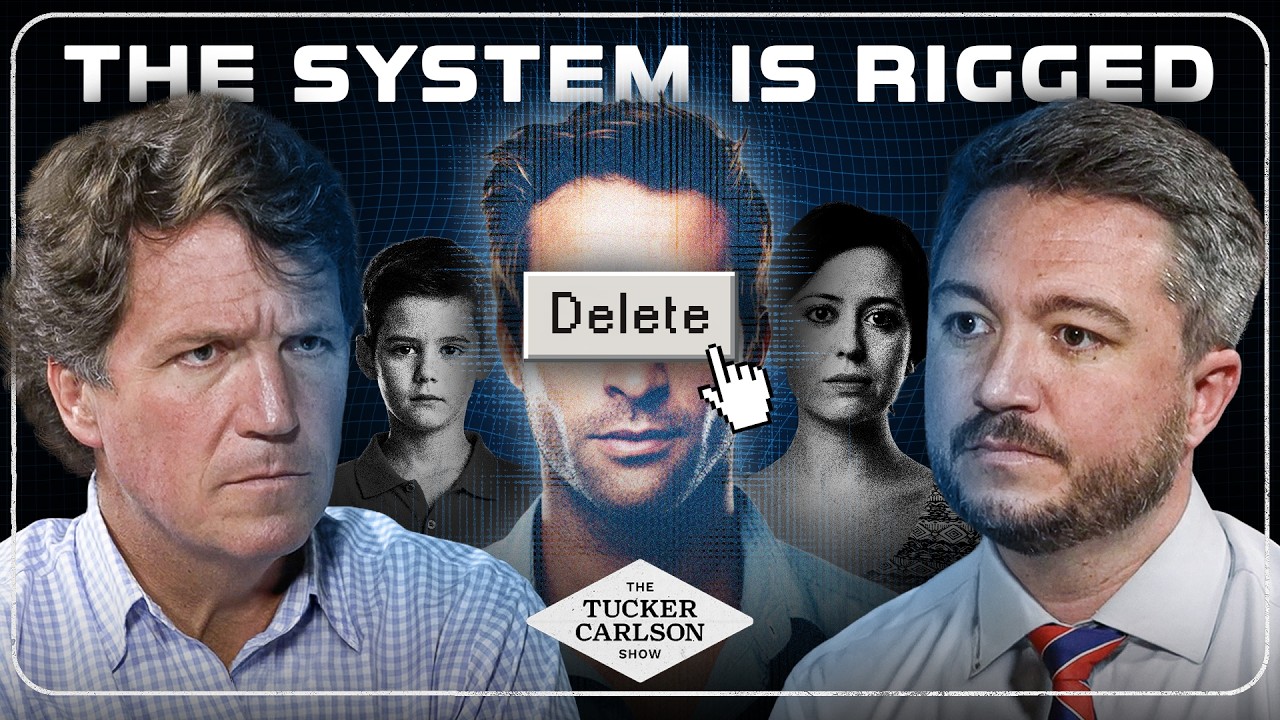
Terry Schilling, president of the American Principles Project and father of eight, joins Tucker Carlson to discuss fatherhood, the collapse of the family in America, and the systemic forces—corporate, cultural, and ideological—that he believes are deliberately undermining marriage, childbearing, and male responsibility. The conversation moves from deeply personal stories about his father’s crack addiction and redemption to broad critiques of elite institutions, AI, and the commodification of human life.
Terry’s Father: From Crack Addiction to Redemption
Terry is the oldest of ten children, raised in the Quad Cities (Western Illinois/Eastern Iowa), where his family owned a pizza restaurant called St. Giuseppe’s Heaveny Pizza.
Quad City style pizza is distinct: barley malt crust, fennel sausage, spicy red pepper sauce, toppings under the cheese, cut into strips.
The restaurant was named after St. Joseph, patron saint of fathers and workers—the foster father of Jesus.
Terry’s father was a top-performing insurance salesman at Prudential who became addicted to crack cocaine during the 1980s epidemic.
He would disappear for three days at a time, going straight from benders to work without coming home.
Prudential had no issue with his addiction because he remained productive—illustrating how corporations exploit workers regardless of personal destruction.
Terry’s mother filed for divorce while pregnant with their fourth child after another three-day bender.
The turning point came when Terry’s grandmother (who had herself divorced) confronted her son and told him she regretted not fighting to save her own marriage.
This prompted Terry’s father to choose his family over drugs, get clean through Narcotics Anonymous, and rebuild his life.
He went on to have six more children, integrate his family into his work life at the pizza shop, and later serve as a member of Congress.
Terry’s younger siblings (numbers five through eight) had no idea their father had ever been a crack addict—his transformation was that complete.
Terry only learned the full extent of the addiction as an adult, from his mother.
He publicly revealed the addiction at his father’s funeral with his father’s deathbed permission, stunning local political reporters who had never heard anything about it.
His father died of advanced intestinal cancer at 57, with all ten children at his side.
In his final hours, he asked for his family, for Jesus, and for last rites/communion.
Terry describes this as a “happy death,” invoking St. Joseph, who is also the patron saint of a happy death because he died in the arms of Jesus and Mary.
Terry believes the concept of a happy death has been lost in the West due to declining faith.
The Lies Undermining Men, Marriage, and Family
Terry argues that the entire structure of modern American life is designed to prevent people from forming families.
Work-life balance is a lie: Terry calls it a “false dichotomy” created by corporations to monopolize people’s lives. Companies offer token paternity leave or vacation time but ultimately demand maximum productivity, treating workers as interchangeable units of value.
Two-income trap: In the 1960s, 50% of income covered basic needs (mortgage, car, insurance); today it’s 80%. Families now need two incomes, which drives up housing costs in good school districts and makes families economically fragile.
Women in the workforce: Terry believes corporate America actively incentivizes women to delay or forgo motherhood through egg freezing, abortion tourism (companies paying for travel to obtain abortions), and career-first messaging. When women out-earn men, marriage rates collapse—this is self-reported by women in surveys and has already devastated Black America and is now hitting rural white America.
Federal spending is upside-down: Welfare and entitlement spending goes five-to-one to people 65 and over versus young families. The “Big Beautiful Bill” gave $6,000 checks to senior citizens who already hold most of the nation’s wealth and multiple homes, while young families can’t afford $750,000 townhomes in DC.
Boomer generation as Absalom: Terry and Tucker discuss the Baby Boomers as a selfish generation that inherited prosperity from the Greatest Generation and squandered it. They drew an analogy to Absalom, King David’s undisciplined son who rebelled and was destroyed. Boomers are sitting on multiple homes, benefiting from property tax freezes, and leaving young people with no opportunity—which is driving radical politics among Gen Z.
No-fault divorce: Terry calls it the “least important agreement” in modern America—you can walk away from a marriage easily, but you can never default on credit card debt. He sees this as a fundamental inversion of values.
The Ideological Roots of Anti-Family Thinking
Terry traces anti-family ideology through centuries:
The Albigensians (12th century heretical cult): Believed the soul was pure but the body and physical world were corrupted. Marriage and procreation were sins because they trapped pure souls in corrupted bodies. Pleasure of any kind—good food, sex—was sinful. Terry argues their ideas are everywhere today, just in different forms.
Thomas Malthus: Believed people were pollution.
Paul Ehrlich (author of The Population Bomb, 1968): Advocated forced sterilization, tax incentives for sterilization, and requiring licenses to have children. None of his catastrophic predictions came true. He also advised media to depict only small families—advice the entertainment industry followed.
Francis Bacon: Father of modern science who believed nature was meant to be conquered and altered by humans. Terry sees this as the philosophical root of AI, gender transitions, and the rejection of natural law.
Terry argues these ideas “shape-shift” across eras—Albigensian, Marxist, Green, AI—but are always fundamentally anti-human and anti-God.
AI, in particular, reflects the belief that humans need a smarter overlord to process data and run their lives—a digital version of playing God.
Gender transitions for children represent both the ancient temptation (becoming your own god, rejecting God-given biology) and the new (technology enabling hormone manipulation and surgical mutilation that previous societies couldn’t achieve).
What Makes a Good Father
Terry defines fatherhood as self-sacrifice, which is the essence of love.
He points to Christ on the cross as the ultimate model: fighting and struggling all the way to Calvary, submitting to God’s will through effort, giving up everything for others.
Fathers must be merciful but just.
Citing Pat Fagan: The devil always deviates from the law and shows no mercy when you break it. Christ never deviates from the law but shows infinite mercy when you apologize. A father should hold the rules firmly but be merciful to his children.
Fathers must spend one-on-one time with each child.
Even brief trips (5–10 minutes to 7-Eleven for snacks) allow kids to open up. Terry does this individually with all eight of his children.
Fathers instill empathy in children.
A study in Reason magazine found that fathers, being naturally more self-focused, lecture kids about consequences (e.g., “I worked hard for that $400 drill”), which teaches children to think about others. Mothers tend to cushion blows and build self-esteem. Both roles are important, but empathy specifically comes from fathers.
Matriarchal societies (few fathers present) have far higher crime rates and are far less empathetic than patriarchal societies.
Terry’s father taught him to be present in the delivery room for every child.
He advises all fathers: watch your child be born. You’re the first to see their face. Your wife is going through hell—the least you can do is witness and participate.
Terry’s father’s paranoia about his kids using drugs (he once unrolled his son’s dollar bills looking for cocaine) was actually an expression of love born from his own experience.
Terry is grateful for this background because it helps him relate to Gen Z kids being raised by mothers on amphetamines, SSRIs, and Xanax—pharmaceutical dependence being the modern equivalent of his father’s drug crisis.
The Crisis Facing Young People
40% of Gen Z says they don’t want to get married; 43% don’t want children.
Terry sees this as a sign of despair, not liberation.
Young people are being radicalized because they’ve been denied opportunity.
Most are products of the “divorce generation”—compound dysfunction from parents’ and grandparents’ divorces.
Without stable families, young people lack the ballast that keeps politics moderate and life purposeful.
Terry interviewed Nick Fuentes and concluded that radical politics among the young is a direct consequence of ignoring their grievances and stripping their opportunity.
If you want moderate politics, you need more fathers and mothers—family formation is the stabilizing force.
Public parks as a symbol: In previous decades, parks were built for children (playgrounds, swings). Now inner cities build dog parks and senior exercise equipment. Terry sees this as a statement of national priorities—resources directed away from the next generation.
Hong Kong’s birth rate is approximately 1.09; its parks are for the elderly. The U.S. is heading the same direction.
Corporate Predation and the Commodification of Human Life
Terry argues that industries treat humans as “hogs in a machine”—units to extract value from.
Credit card usury (20% interest) is legal for banks but would be RICO-level crime for the Mafia. Terry has publicly suggested mass non-payment of credit card debt as a form of collective negotiation.
When Trump capped credit card interest at 10%, libertarian and free-market think tanks criticized him—revealing that the right is often more loyal to corporations than to people.
IVF and artificial wombs represent the “commodification of the human person”—treating children as products to be manufactured.
Terry is not against all IVF but is deeply critical of the broader system that treats babies as commodities, especially when combined with egg freezing and abortion access that keeps women in the workforce.
Hope and the Path Forward
Despite the darkness, Terry sees signs of hope:
Christians are still having children at higher rates than liberals and progressives. This is a good sign for the country’s future.
He believes the current lies (men and women are identical, a career is more meaningful than children, Microsoft matters more than five kids) are so obviously false that they must eventually crumble.
He couldn’t have said these things out loud ten years ago—the crisis wasn’t as apparent. Now it’s undeniable.
Terry and his wife remain open to more children.
“Every new baby is a sign from God that he wants the world to continue.” He references the proverb that children are God’s helpers, sent with different skills and dispositions.
“Blessed is the man whose quiver is full”—children are a blessing, and you want them around you, especially in hard times.
Terry’s deepest conviction: sitting at the head of a table surrounded by your descendants is the greatest joy a man can experience—greater than any luxury, travel, or career achievement.
The single, childless life is “innocuous” like weed: it seems harmless and comfortable, but people look back after 40–50 years and realize they can’t remember anything meaningful.
The elites have sold young people a lie that being single and child-free equals prosperity and flourishing. In reality, it serves the state and corporate masters by keeping people productive, dependent, and alone.