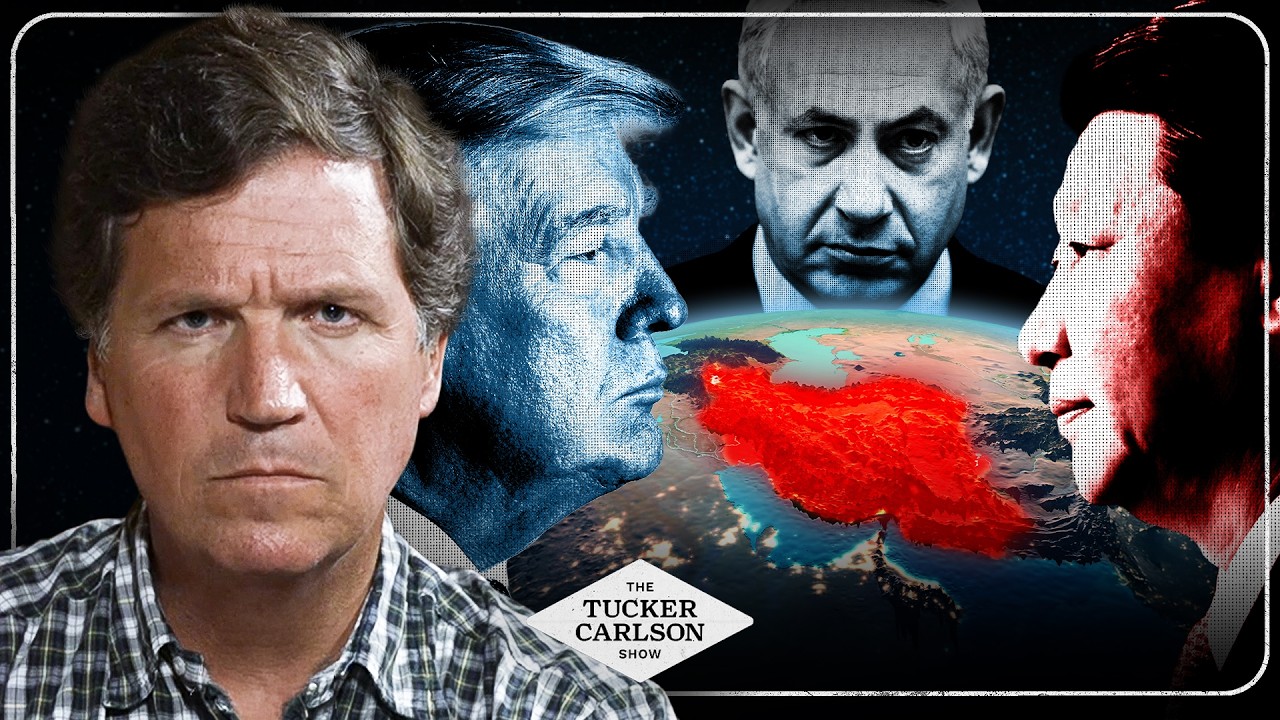
Colonel Lawrence Wilkerson, former chief of staff to Secretary of State Colin Powell and a veteran of the highest levels of American power, argues that the U.S.-Israel war against Iran is rapidly escalating into a confrontation with China that the United States cannot win, driven by a combination of strategic bombing of Chinese infrastructure, a collapsing global economy, and a dangerous ideological drift within the U.S. military and government.
China’s Role and the Bombing of the Belt and Road Railroad
The U.S. and Israel have begun bombing a recently completed Chinese railroad that is part of the Belt and Road Initiative, a route running from China’s Pacific ports through Iran toward the Caucasus and Europe.
This railroad is a game-changer: it cuts shipping time for Chinese goods to Europe from 12–13 days by sea to 16 hours by land, undermining the strategic importance of maritime chokepoints like the Strait of Hormuz, Bab el-Mandeb, the Suez Canal, and even the Panama Canal.
The route follows the same corridor the U.S. used to supply the Soviet Union during World War II, a supply line without which Stalingrad could not have held out.
Wilkerson believes the Pentagon is targeting this railroad to signal to China that the U.S. recognizes and opposes its geostrategic ambitions, but that this risks provoking a much deeper Chinese involvement in the conflict.
He notes that the U.S. no longer controls these overland lines of communication, which would be essential in any war with China.
China’s Strategy: Winning Without War
China’s grand strategy, consistent since Deng Xiaoping, is to surpass the U.S. in every dimension of power—technological, cultural, economic, military—without fighting a war.
Xi Jinping’s latest edict, largely missed by the American press, declares that China is now triumphant in every element of global power except one: financial control.
China aims to replace the U.S. dollar with the renminbi as the world’s reserve and transactional currency, targeting 60–70% of global transactions, dismantling the Bretton Woods system and SWIFT, and eliminating the U.S. ability to impose sanctions.
Wilkerson emphasizes that U.S. sanctions have killed an estimated 38 million people since the turn of the century, mostly civilians, and that China views ending this capability as both a strategic and moral imperative.
He warns that once the U.S. loses the power to sanction foreign governments, the same tools will be turned domestically against American citizens through programmable digital currency.
The Empire’s Need for an External Enemy
Wilkerson draws on the “Report from Iron Mountain,” a controversial Cold War-era study, to argue that empires like the United States require a constant external threat to maintain internal cohesion, obedience, and tax compliance.
Figures like Dick Cheney and Donald Rumsfeld wanted a new Cold War with China not because they desired a hot war, but because the pressure of an external enemy was seen as the only way to sustain the empire domestically and justify the military-industrial economy.
George W. Bush, whom Wilkerson describes as a genuine Christian, resisted this impulse and instead empowered Colin Powell to manage the China relationship economically rather than militarily, including reining in Chen Shui-bian’s independence rhetoric toward Taiwan.
The JFK Assassination and the Pattern of Political Killings
Wilkerson, drawing on his expertise as a weapons specialist, is certain that Lee Harvey Oswald did not kill John F. Kennedy, citing the inadequacy of Oswald’s weapon and the impossibility of replicating the shooting under the conditions described in the Zapruder film.
He believes the assassination was carried out by a combination of CIA, mafia, and Pentagon dissenters, motivated by Kennedy’s pursuit of détente with the Soviet Union after the Cuban Missile Crisis and the Berlin crisis, as well as his June 1963 American University speech calling for an end to the Cold War.
He draws a parallel to the assassination of Charlie Kirk, noting that the official narrative does not hold up to scrutiny and that lone gunmen who kill lone gunmen are rarely acting alone.
The Economic Clock: Recession, Depression, and Dollar Collapse
Wilkerson warns that if global shipping is not restored to normal by the end of June, the world will be in a global recession; if the disruption continues through August, a global depression is likely.
At that point, Xi Jinping would have a powerful incentive to accelerate the replacement of the dollar with the renminbi, potentially triggering economic chaos.
He recalls a 2009 oil disruption simulation in Beijing in which a terrorist attack on Ras Tanura (8 million barrels per day) sent oil prices toward $200 and required the U.S. Navy to secure the Strait of Hormuz—the last time he saw genuine cooperation between Chinese and Western officials.
Israel’s War in Lebanon and the Future of the Jewish State
Wilkerson argues that Israel’s real policy toward Lebanon has been to periodically destroy its economic capacity, preventing Lebanon from becoming a successful rival economy in the Eastern Mediterranean.
He describes the current bombing campaign—targeting dry cleaners, bars, restaurants, hotels, and killing 200–300 civilians every 48–96 hours—as unconscionable and unsustainable.
He believes Israel cannot survive long-term in the Levant as a Jewish state and that its only viable future would be as a true democracy including Palestinians, Arabs, and Christians, but that the current leadership is sealing its own demise.
The massive U.S. embassy in Beirut, he notes, was built not for diplomacy but as a fortified intelligence hub for Mossad, MI6, and CIA, positioned as a strategic centerpiece against China and Russia in the Eastern Mediterranean.
Charlie Kirk, Israel, and Shifting American Opinion
Wilkerson connects Charlie Kirk’s assassination to Kirk’s evolving public skepticism about the U.S.-Israel relationship, which Kirk had begun to recognize as poisonous to American interests, particularly among younger MAGA supporters.
He believes the investigation into Kirk’s murder has been inadequate and that the official narrative is not credible.
He argues that America’s relationship with Israel cannot remain the same after this war, especially as younger Americans increasingly oppose it.
AI, Nuclear Weapons, and the Risk of Imperial Self-Destruction
Wilkerson is deeply concerned about artificial intelligence, citing an AI pioneer who sold his work to Google and then received a phone call from his own AI checking up on him—an experience he described as a moment of terrifying clarity.
His former students, now working in high-level positions around the world, share his anxiety, fearing not just job loss but the elimination of human autonomy and the possibility of conflict between AI-controlled robots and humans.
He notes that the U.S. currently has no nuclear arms control treaties in force—ABM, New START, and all others are gone—and that no empire in 5,000 years has ever possessed the technological means to destroy itself.
He considers it wishful thinking to believe the U.S. will not attempt to use nuclear weapons to save the empire as it declines.
The Corruption of Christianity and the Militarization of Religion
Wilkerson is alarmed by what he sees as a long-standing effort to create an American Catholic Church with an American pope, free from Rome’s authority—a movement he says has existed for at least a hundred years among a powerful minority of American Catholics.
He is particularly critical of Pete Hegseth, who has been holding weekly OSW protocol prayer services at the Pentagon with reserved seats for general officers and admirals, by invitation only, which Wilkerson calls “uncommonly un-American.”
Hegseth is also accused of “preacher packing”—purging flag officers who might oppose making the military a defender of Christianity as a national religion—and of exceeding Congress’s 4% cap on mental category 4 recruits by teaching them to pass the entrance exam, effectively lowering the quality of the force.
He describes baptisms of new soldiers at Fort Jackson, where chaplains tell recruits rising from the water that they are now “soldiers for Christ,” and Hegseth’s desire to change the military oath from allegiance to the Constitution to allegiance to Jesus Christ.
He condemns Franklin Graham’s sermon in the Pentagon courtyard, in which Graham cited Genesis to justify killing men, women, and children, calling it blasphemy.
He also mocks Ted Cruz for citing Genesis as a basis for national security policy while being unable to identify which book of the Bible it comes from.