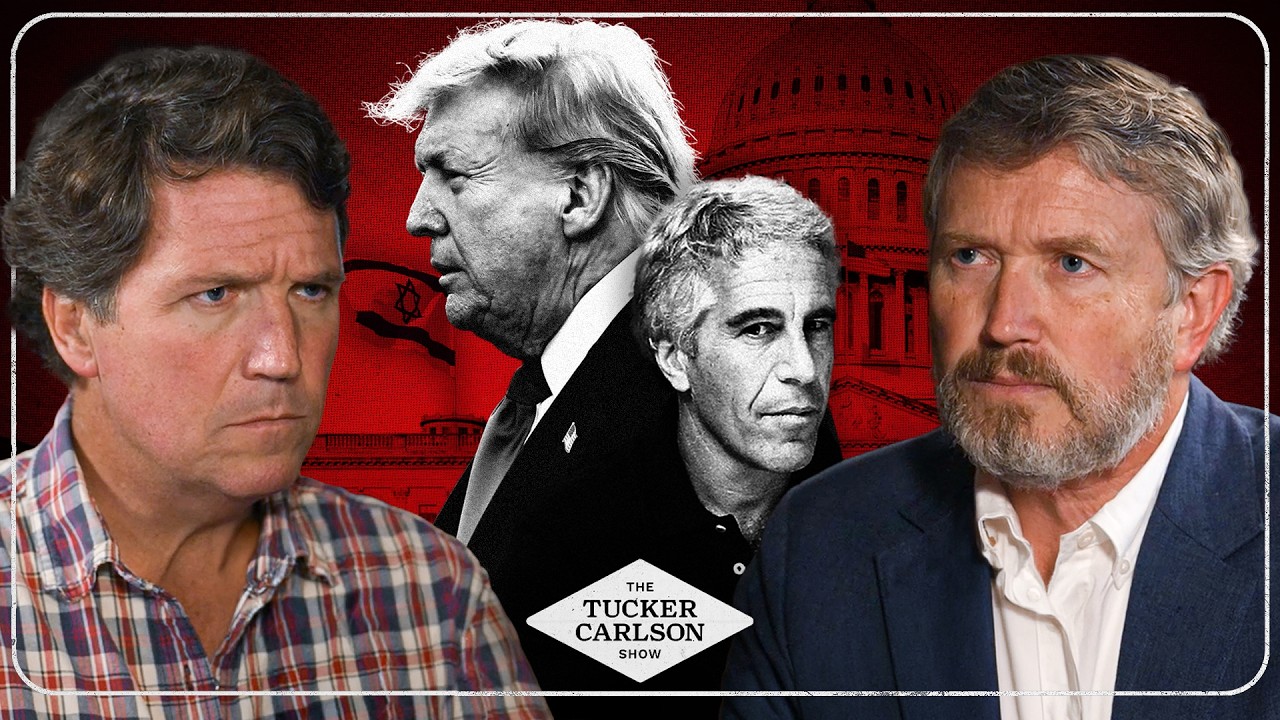
Thirteen days from the recording, U.S. Representative Thomas Massie of Kentucky faces the most expensive Republican congressional primary in state history, a race that has become a referendum on whether pro-American, anti-foreign-lobby politics can survive inside Donald Trump’s Republican Party. Massie, who has won his previous three primaries by margins of 75–81%, now trails or is within a single point of his opponent after $10 million in outside spending—95% of it from the Israeli lobby—has flooded the district. The race crystallizes a broader pattern: a Republican administration that campaigned on draining the swamp, ending foreign wars, and releasing the Epstein files has instead become the most aggressive champion of the very forces it once opposed, while the one congressman who kept those promises faces annihilation.
The Iran War and Who Benefits
The war with Iran, launched at Israel’s urging, has been a disaster for most Americans and the world—thousands killed, a dozen countries bombed, hundreds of thousands in the UK pushed into poverty, and rising global oil prices threatening famine in Africa through increased fertilizer costs—but enormously profitable for a small class of people.
Hedge fund manager Bill Ackman called it “a very good war” on CNBC, reflecting a class of people insulated from its costs who have personally benefited.
A recurring pattern has emerged where certain news outlets predict imminent peace deals between the U.S. and Iran; each prediction triggers massive moves in energy and equity markets, and large bets on oil futures consistently appear just before these announcements, suggesting insider knowledge or market manipulation.
This mirrors pre-9/11 put options placed against airline and bank stocks—the FBI identified who did it but never disclosed their identities, and no one was ever held accountable.
Oil prices remain under $100/barrel despite the Strait of Hormuz being effectively closed for months, a price level that is irrational and suggests markets are being manipulated or suppressed.
At $100 oil, people worldwide are already worrying about famine; the president casually said he thought oil could hit $200–$300/barrel, which would mean economic destruction on the scale of a national disaster.
The president justified the war by claiming Iran had nuclear weapons, but all 18 U.S. intelligence agencies concluded Iran had no nuclear weapon, no ICBM to deliver one, and no active nuclear weapons program.
The American Economy on the Eve of AI
White House economic advisor Kevin Hassett pointed to surging credit card spending as a sign of economic health, but this actually signals desperation: 111 million American adults (40%) cannot pay off their credit card balances, carrying an average interest rate of 23%, with rates going up to 36%.
People with money spend money; people without money spend on credit for essentials.
This indebtedness is occurring just before AI is expected to eliminate roughly half of all American white collar jobs within the next two to three years, based on forecasts from the technology’s own developers.
Massive data centers are being built across the country—destroying farmland, consuming enormous energy, providing almost no local jobs, and raising utility costs for residents—all to facilitate AI deployment.
No one in authority is explaining how this benefits ordinary Americans; the focus is on building quickly and extracting profits before the disruption hits.
The long-term trend of upward wealth concentration means a huge number of Americans have negative net worth, no vested interest in the system, and no future they can see for themselves—a recipe for social and political volatility.
Thomas Massie: The Man and the Record
Massie is a self-reliant congressman from Kentucky who built his own off-grid home with his hands, lives with his family on a farm, and has maintained a consistent America-first voting record across his entire career.
He has 80% approval among young voters in his district and has never made Israel a focus of his political career—he is not anti-Israel but simply refuses to prioritize any foreign country over American interests.
He has never voted for foreign aid to any country—not Israel, not Egypt, not Ukraine—and has offered amendments to defund such aid since arriving in Congress in 2013.
He votes with his party approximately 90% of the time but refuses to compromise on warrantless surveillance, foreign aid, spending, and transparency.
His core appeal is honesty and consistency: he explains every controversial vote on social media, reads the actual bills, and cannot be bribed or intimidated because he is financially self-sufficient and ideologically grounded.
The AIPAC Revelation That Started It All
Nearly two years before this recording, Massie appeared on this show and casually described how AIPAC operates in Congress: they approach candidates and ask them to write position papers on Israel, essentially doing “homework” for a foreign lobby, and those who comply as candidates are expected to comply as congressmen.
He described refusing to do this homework, joking that AIPAC told him to just copy Rand Paul’s paper and put his name on it, and he refused that too.
He noted that AIPAC assigns “minders” to members of Congress who take them to dinner in D.C. and back home in their districts—a system of conditioning and accountability to a foreign interest.
In the two years since that interview, not a single colleague has disputed his description; many have privately confirmed it, and Jewish friends jokingly volunteer to be his “AIPAC person.”
The crime was not opposing Israel but exposing the process publicly—transparency is what made him a target.
The Money Behind the Campaign Against Massie
Three billionaires are primarily funding the effort to defeat Massie through a super PAC called “MAGA Kentucky” (neither MAGA nor from Kentucky): Miriam Adelson, Paul Singer, and John Paulson.
Miriam Adelson is an Israeli-born gambling magnate who now makes most of her money from Chinese gambling operations, has given over $200 million to Trump, and publicly told the president she is more loyal to Israel than to the United States.
She has never been to Kentucky and is attempting to buy a congressional seat there.
Paul Singer is a distressed-debt hedge fund manager who bought Venezuela’s nationalized oil company (SICKO) for pennies on the dollar just weeks before the U.S. government overthrew Maduro—a regime change that could net Singer billions.
John Paulson was listed in Epstein’s phone book and has been implicated in the Epstein files.
These three donors have also funded transgender activism, abortion candidates, and Democratic politicians including Chuck Schumer and Liz Cheney—they are not ideological conservatives but members of what Massie calls the “Epstein class,” a trans-partisan billionaire class above party, above courts, above normal rules.
AIPAC donors are funneling money to Massie’s opponent through Democracy Engine, a Democratic-leaning payment processor founded by one of the creators of ActBlue, disguising the foreign origin of the funds.
Approximately $1 million per quarter of the opponent’s $1.2 million quarterly fundraising is coming through this AIPAC/Democracy Engine pipeline, not from ordinary grassroots donors.
The opponent himself is a Navy Seal veteran who left the Republican Party during Trump’s presidency and only returned after Biden won; he has refused all eight debate requests, won’t fill out questionnaires from pro-life or pro-Second Amendment groups, and his own campaign ads don’t feature him speaking.
85% of his donors have also given to Democratic candidates, compared to 37% of Massie’s donors.
The super PACs running against Massie include the United Democracy Project, a pro-abortion, pro-gay-rights leftist super PAC—meaning actual liberals are trying to defeat one of the most most conservative members of Congress by running a liberal candidate funded by liberal money and calling him a conservative.
An AI-generated attack ad depicts Massie in a threesome with Ilhan Omar and Alexandria Ocasio-Cortez, with a disclaimer in font too small for anyone over 65 to read.
The Epstein Files: Why the Cover-Up?
Massie introduced the Epstein Files Transparency Act as a discharge petition, eventually securing enough signatures to force a vote—the first time in history a law (not a subpoena or committee investigation) was passed to compel the release of documents in a criminal case.
The law passed the House 427 to 1 and was passed by unanimous consent in the Senate before it even arrived there, after months of Mike Johnson calling it “dog crap” and blocking it at the president’s request.
The law is permanent—it never expires, unlike subpoenas, which die at the end of each Congress—and requires the DOJ to release not just final documents but internal memos and emails about prosecutorial decisions.
Three women in Congress were brave enough to sign the discharge petition and suffered for it: Nancy Mace, Marjorie Taylor Greene, and Lauren Boebert.
Marjorie Taylor Greene and her children received death threats from the right, not the left; when she told Trump, he said “that’s your fault” and warned her she was hurting his friends.
Lauren Boebert was taken to the White House Situation Room and pressured to remove her name from the petition; Trump later vetoed a water bill for Colorado over the Epstein dispute.
The released files have implicated people globally—Prince Andrew lost his title, the British ambassador to the U.S. resigned, the former prime minister of Norway was indicted, France’s minister of culture is under investigation—but no one in the United States has been held accountable.
Significant categories of files remain unreleased or were taken down after being briefly posted:
Internal DOJ/FBI memos about decisions to prosecute or not prosecute are being withheld under “deliberative process privilege,” which Massie’s law explicitly overrides.
Files implicating co-conspirators like Leslie Wexner (the billionaire who funded much of Epstein’s operation) have been specifically redacted in the one place where Wexner is named as a co-conspirator, while his name appears thousands of times elsewhere in unredacted form.
FBI 302 forms summarizing survivor testimony are missing from the released files entirely.
The DOJ claims some documents were already redacted when received, but has not gone back to the original U.S. attorneys or FBI agents to obtain unredacted versions.
Massie believes Epstein was not a lone operator but a purveyor of access—someone who provided physical proximity to powerful people (market makers, foreign officials, hedge fund managers) for the purpose of blackmail or intelligence gathering, and that his operation spanned at least four presidential administrations.
A recording exists of Epstein advising Ehud Barak on how to monetize his government service by getting on corporate boards of people who owed him favors—revealing Epstein’s role as a connector between power and money.
FBI Director Kash Patel testified in the Senate that Epstein acted alone, then testified in the House that there was no evidence of co-conspirators other than Ghislaine Maxwell—statements that contradict each other and the evidence, and that constitute perjury.
Massie’s theory for why Trump has made the Epstein issue his red line: the billionaires funding Trump’s ballroom, his arch, and the Kennedy Center rebranding are the same people in the Epstein files, and they are the same people funding Massie’s opponent.
FISA and Warrantless Surveillance
Massie was the only Republican to object to a clean 45-day reauthorization of FISA Section 702 (warrantless surveillance of Americans) that was supported by virtually every Republican and Democrat, including both Jim Jordan and Jamie Raskin.
This forced a debate on a Friday when most members had already left for their flights home.
Jim Jordan, who had previously made support for FISA warrants a condition of serving on the Judiciary Committee, spoke in favor of the clean reauthorization and tried to give half his debate time to Jamie Raskin—the ultimate symbol of bipartisan unity in favor of spying on Americans.
Massie was ultimately given 20 minutes to debate alone against the combined establishment of both parties, joined only by Keith Self, Chip Roy, and Warren Davidson.
The FBI has used FISA 702 to run dating app prospects through surveillance databases, to spy on members of Congress, on the president, on political parties, and on journalists.
Massie’s question: If Democrats truly believe Trump is an authoritarian threat, why are they giving him the power to spy on Americans without a warrant? The answer is that both parties serve the same permanent government and the same foreign interests.
Evidence shows the DHS X (Twitter) account was set up using an IP address and Android app purchased in Israel, suggesting Israeli access to U.S. government communications infrastructure.
Spending, Debt, and the Farm Bill
The national debt has increased $2.7 trillion in the 16 months since Republicans controlled the White House, House, and Senate—there is no one else to blame.
The “Big Beautiful Bill” added hundreds of billions in spending to Joe Biden’s baseline budget rather than resetting spending levels.
Massie was the only Republican to vote against Mike Johnson for Speaker (twice) and the only Republican to vote against the Big Beautiful Bill, which is why he is called an obstructionist.
In the farm bill, Massie fought against a provision that would have granted pesticide and herbicide manufacturers immunity from state-level liability lawsuits—even if a state determined a product caused cancer.
This would have violated the First Amendment (states’ right to warn citizens), the Seventh Amendment (right to a jury trial), and the Tenth Amendment (states’ rights).
The DOJ actually joined German company Bayer/Monsanto in arguing before the Supreme Court that a German corporation should be immune from lawsuits by Americans harmed by its products.
Massie worked with Democrats to strip this provision from the farm bill and succeeded because the bill’s passage margin was so narrow.
Massie’s PRIME Act, included as a pilot program in the farm bill, allows small farmers to sell beef, pork, and lamb locally through local processors without USDA inspection, as long as local health requirements are met—breaking the industrial meat complex’s regulatory stranglehold on small producers.
The White House has announced plans to break up big meat packers using the DOJ, but without allowing small packers to operate, this will only raise prices and increase imports from Brazil and Argentina.
Glyphosate and the Chemical Industry
Massie does not seek to ban glyphosate but opposes both mislabeling and the immunity provision; he personally would not spray it on food crops, particularly the practice of spraying it on ripe wheat to dry it out before harvest—a practice banned in Europe.
He is more concerned about the farmers who apply it than the consumers who eat it.
The EPA, which was created to protect people and the environment, has instead become a mechanism for granting corporations immunity from liability through favorable labeling decisions.
Corruption, Data Centers, and the Control Grid
The U.S. government took a 10% stake in Intel and bragged about making money on it—Massie argues this fundamentally corrupts the relationship between government and private enterprise, as the government now has a financial interest in that company’s success over its competitors.
Twice Massie has stopped special legal provisions for data centers from being inserted into federal law:
In the Big Beautiful Bill, a provision would have given data centers immunity from all state and local law, including planning and zoning—allowing them to be built anywhere, including on farmland, over local objection. Marjorie Taylor Greene and Massie got it removed.
In the Judiciary Committee, a bill would have given data centers immunity from environmental lawsuits. Massie identified the five main beneficiaries (Oracle, Amazon, AWS, and two others) in real time via tweet, drafted an amendment to exclude data centers built on farmland, and the bill was pulled before it could be voted on.
Massie argues these data centers will be obsolete within 10–20 years (Elon Musk already plans to move them to space), and the country will be left with decaying shells that destroyed farmland and landscapes.
The Infrastructure Investment and Jobs Act under Biden mandated that every car manufactured from 2027 be equipped with technology to judge whether the driver is impaired and to shut the car off mid-drive.
The technology uses cameras to monitor gaze, pupils, posture, and hand position; at 99.9% accuracy, a million cars per day would be wrongly shut down.
There is no appeal process—a mother stranded on a highway with children in the minivan cannot plead with an AI to restart her car.
Massie has forced two votes on repealing this provision and failed both times, with 50 Republicans voting to keep it—votes that are now public record.
The coalition supporting this includes Mothers Against Drunk Driving, which brings bereaved parents to congressmen’s offices to make opposition politically impossible, even though the technology doesn’t work and the U.S. doesn’t meaningfully prosecute illegal aliens for DUI.
The Stakes of the Race
Massie’s polling shows an 80–20 advantage among voters under 40, strong performance among 40–65 year olds, and weakness among those 65 and older—a gap he attributes to Fox News blocking him from appearing on any of its programs for 18 months because the network prioritizes White House access over platforming someone the administration considers an enemy.
His supporters are 33,000+ small-dollar donors giving an average of $94; his opponent’s money comes from billionaires and AIPAC.
Massie frames the race as a referendum on whether democracy has any meaning: if a foreign lobby can spend $10 million to defeat the most popular congressman in Kentucky for the crime of telling the truth, then the system lacks all legitimacy.
If he loses, no one will be in Congress to force votes on FISA, to block special interest provisions in must-pass bills, to demand transparency on Epstein, or to challenge the spending.
The lesson for the country is that no matter who you vote for, the same forces control outcomes—and if there is no pressure relief valve in the system, people radicalize.