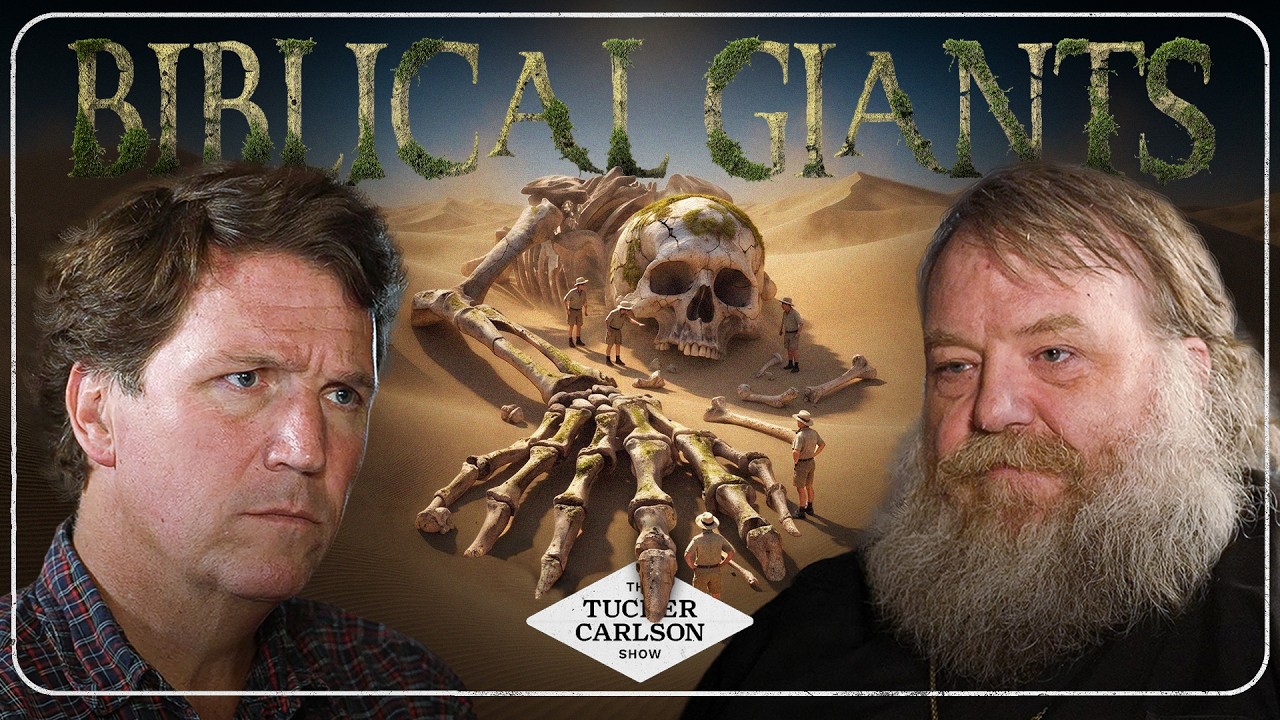
This episode explores the biblical and historical reality of the Nephilim—hybrid beings produced by the union of spiritual entities (“sons of God”) and human women before the Great Flood—and traces how the rituals and worldview behind them have persisted across civilizations and into the modern era.
The conversation centers on Genesis 6:1–4, a brief but deeply strange passage describing how “the sons of God saw that the daughters of humans were beautiful and married any of them they chose,” producing the Nephilim, described as “the heroes of old, men of renown.”
The guest, an Orthodox priest and scholar, argues that this is not myth but reflects a real spiritual phenomenon: demonic spirits mating with humans to produce a hybrid ruling class—beings who were physically and spiritually distinct, tyrannical, and fully aligned with demonic purposes.
The episode connects this ancient pattern to post-flood civilizations, secret rituals involving temple prostitution and human sacrifice, and even modern practices like the Japanese emperor’s ceremonial union with the sun goddess up through Hirohito.
The broader theme is that humanity is always participating in one of two spiritual realities: growing toward God’s likeness through love and community, or being shaped by demonic forces through power, blood, and control—and that the latter has been the consistent underpinning of every civilization that rejects God.
What Are the Nephilim?
The word “Nephilim” likely derives from an Aramaic root meaning “giant,” and in context refers not just to physical size but to a type of person: a thuggish, tyrannical ruler.
The Hebrew word is reflexive (“those who fall upon”), suggesting aggressors rather than passive victims.
In Greek translations, the word is rendered as gigantes, the root of the English word “giant,” but the ancient concept combined physical stature with authoritarian brutality—like calling a dictator a “strongman.”
The Nephilim are described in Genesis as “men of renown”—figures celebrated by pagan cultures as divine heroes and founders of civilization.
Genesis deliberately inverts the pagan narrative: what the ancient world saw as a golden age of divine kingship, Scripture recasts as an era of profound wickedness led by demonized humans.
The Advanced Pre-Flood Civilization
Every ancient civilization from Greece to Mesopotamia to Egypt shared a memory of a prior, more advanced world destroyed by a flood.
The guest places the flood around 10,000 years ago, corresponding to the end of the last ice age, when melting glaciers caused massive sea-level rises and submerged coastal settlements—archaeological remains have been found at the bottom of the Black Sea.
This pre-flood world had knowledge (metallurgy, astronomy, sorcery, divination) that later civilizations believed was revealed to them by spirits who had lived before the flood.
The Bronze Age global economy—spanning from Cyprus to Afghanistan—was built on the legacy of this lost world.
Hammurabi’s Babylonian Empire, founded by the Amorites, attributed its success to secret wisdom obtained from pre-flood spirits.
This was not seen as mere legend; it was understood as ongoing spiritual contact with beings from before the deluge.
Was Human Lifespan Longer Before the Flood?
The extraordinary ages in Genesis genealogies (e.g., Methuselah at 969 years) are likely encoded using base-60 Babylonian mathematics rather than literal counts.
For example, Enoch lives 365 years—the number of days in a solar calendar—and is the seventh from Adam, mirroring the Sumerian King List where the seventh king invents the solar calendar.
There is no credible evidence that humans lived for thousands of years; the numbers appear to carry symbolic or calendrical meaning.
Actual lifespans in antiquity were shorter on average due to high infant mortality and disease, but those who survived childhood could live into old age—making it difficult to assess true maximum lifespan from archaeological remains.
Technology as a Demonic Gift
The ancient worldview held that all technological and intellectual advances came from the spiritual realm—not from human invention.
In the genealogy of Cain, his descendants invent metallurgy (and weapons), music (used for seduction), and divination—all associated with demonic influence.
The pattern is consistent: knowledge is revealed prematurely, before humanity is spiritually mature enough to use it rightly, leading to destruction.
The serpent’s offer in Eden—“you will be like God, knowing good and evil”—is the prototype: a shortcut to knowledge that bypasses the necessary growth.
The atomic bomb is a modern example: nuclear technology was not used first for clean energy but to destroy two Japanese cities, including Nagasaki, the most Christian city in Japan.
How Someone Becomes Fully Demonized
The guest describes a progression of sin that leads to full demonization:
A thought enters the mind (not yet sin).
The thought is entertained and dwelled upon.
It becomes a plan, then an action.
The action becomes a habit, then a compulsion (the person becomes passive to it).
Demonic possession: a spirit takes control.
Full alignment: the person willingly embraces the demonic spirit, rejoicing in chaos and destruction.
The Nephilim represent the end of this process—beings who are not merely influenced by demons but are genetically and spiritually hybrid, produced by the direct union of spiritual entities and humans.
The Mechanics of Hybridization
Genesis 6 describes “sons of God” (angelic or spiritual beings) mating with human women, producing offspring who are not fully human.
The text implies coercion: “they married any of them they chose.”
This mirrors the pagan myth of divine-human unions (e.g., Gilgamesh being two-thirds divine), but inverts it: the Nephilim are two-thirds demon, not two-thirds god.
The Book of the Giants, found among the Dead Sea Scrolls, lists Gilgamesh as one of the Nephilim—confirming that this figure was understood in Jewish tradition as part of this hybrid lineage.
The physical evidence for such beings is debated:
Goliath is described as either 6’6” (in the Greek Old Testament) or 9’9” (in the Hebrew text)—the latter clearly symbolic of supernatural stature.
Reports of 9-foot skeletons in 19th-century America (e.g., Nevada caves) are unverified and often linked to hoaxes like the Cardiff Giant.
No fossil evidence confirms the existence of a distinct race of giants.
The Ritual Production of Kings
After the flood, the pattern of producing hybrid rulers continued through ritual practices:
When a king died in Ugarit (ancient Syria), sacrifices and magic rituals were performed to appease the spirits of dead kings (the Rephaim) so the new king could safely pass into the underworld.
The new king was produced through ritual sex between the reigning king and a temple prostitute (a “shrine prostitute”) who was believed to be possessed by a spirit—creating a being with three parents: the human king, the human woman, and the spirit.
This mirrors the two-thirds divine, one-third human formula of Gilgamesh.
A ritual bed matching the dimensions of Og’s bed (Deuteronomy 3:11) was found in Babylon’s great ziggurat, confirming the ritual’s reality.
Og, king of Bashan, is described as “the last of the Rephaim”—a giant slain by the Israelites during the conquest of Canaan.
The Rephaim are referenced in Isaiah 14 (the fall of Satan), Psalm 88 (in the underworld), and elsewhere as spirits of dead giant-kings.
The Japanese Emperor and the Sun Goddess
Until the end of World War II, the Japanese emperor’s coronation ritual included spending the night with the sun goddess—a practice directly parallel to ancient Near Eastern temple prostitution.
The emperor would enter a chamber with concubines embodying the sun goddess, reenacting the divine-human union.
Hirohito was the last emperor to undergo this ritual before the Japanese government claimed the sexual element was removed post-1945.
Similar practices existed among the Khmer Empire in Cambodia and in parts of Asia, suggesting a shared spiritual source rather than cultural diffusion.
Why Every Culture Shares the Same Dark Themes
The guest argues that the recurrence of the same motifs across unrelated cultures—human sacrifice, blood rituals, spirit-human unions, technology from the spiritual realm—points to a real, external spiritual source: demonic beings.
These practices are not coincidental inventions but reflections of a consistent spiritual reality.
The experience of collective consciousness (e.g., in crowds, stadiums, worship) shows that humans naturally participate in spiritual realities larger than themselves.
Angelic and demonic beings are understood as levels of consciousness above the individual human—not projections of the human mind, but entities that exist independently and can be embodied by humans.
The Purpose of Humanity
Humanity was created to continue God’s work of ordering the world and filling it with life (Genesis 1:28).
By participating in God’s love, humans are transformed into His likeness—this is what it means to become truly human.
By participating in demonic spirits, humans are transformed into something inhuman—a physical and metaphysical change visible even in a person’s face.
The Nephilim represent the anti-saint: the end result of giving up humanity in favor of demonic power.
The Spirits of the Nephilim After the Flood
According to the Book of Jubilees (a Second Temple Jewish text), when the Nephilim were destroyed in the flood, their leader Mastima bargained with God to allow 10% of them to remain on earth to torment the wicked—with the purpose of driving them to repentance.
This is reflected in the Gospels when demons say to Jesus, “Have you come to torment us before the time?”—acknowledging a temporary reprieve before final judgment.
Jesus, whose name is Joshua, parallels the biblical Joshua who fought giant clans to purify the land—Christ as the true Joshua purifying the world from the same evil.
Human Sacrifice and Cannibalism
The ongoing ritual life of Nephilim-worshipping cultures involved human sacrifice and cannibalism.
The guest clarifies that ancient sacrifice was not primarily about killing but about eating—the offering was consumed as a form of communion with the divine.
Blood drinking and cannibalism were practiced in Mesoamerica and elsewhere, which is why blood consumption is forbidden throughout the Bible.
This pattern persists covertly: the guest notes that modern secular ideologies also demand human sacrifice—through war, abortion, and other forms of killing—in exchange for peace, prosperity, and power.
Genealogy vs. Ritual Incorporation
Ancient peoples had no concept of genetics or DNA; belonging to a people was defined by participation in initiation rituals and ongoing communal worship.
In ancient Israel, being Jewish was defined by circumcision (for males) and eating the Passover (for all).
Caleb, one of the two faithful spies, was a Kenizzite—a member of a Canaanite giant clan—but was incorporated into the tribe of Judah through faith and ritual participation, becoming a descendant of Judah in the eyes of the community.
Matrilineal descent (requiring a Jewish mother) was only formalized after the Babylonian exile as a way to ensure lineage when intermarriage became common.
The Unforgivable Sin
The blasphemy against the Holy Spirit (Matthew 12:31–32) refers to attributing the work of God’s Spirit to demonic forces.
When Jesus performed miracles, His opponents accused Him of casting out demons by the power of Beelzebul—calling the Holy Spirit a demon.
The unforgivable sin is the refusal to recognize and submit to God’s work in the world; if you reject the only source of healing, you cannot be healed by definition.
The Modern Moment
The guest sees the current era as spiritually analogous to the pre-flood world: widespread demonization, open celebration of evil, and technology (especially AI) being developed without moral framework.
The end times are consistently compared in Scripture to “the days of Noah”—a time when humanity had fully given itself over to wickedness.
Yet the guest does not respond with fear but with clarity: the open revelation of evil creates an opportunity for people to recognize their need for salvation.
The church is described not as a courtroom but as a hospital—a place for healing, not judgment.
Confession, community, and spiritual fatherhood (a trusted guide) are essential to the process of being set free from bondage.
The Failures of Modern Christianity
Much of contemporary Christianity has been secularized—focused on this-worldly goals (prosperity, political power) rather than union with God.
Both liberal and conservative branches have fallen into this: the former seeking social justice as the gospel, the latter preaching prosperity theology.
The guest contrasts this with the Lincoln quote: “The question is not whether God is on our side, but whether we are on God’s side.”
True Christian practice involves submitting to what God is already doing in the world, not trying to command God to support our agenda—which the guest equates with ancient magic.
Pornography and the Crisis of Embodiment
The most common sin the guest encounters in confession today is pornography addiction, which has replaced interpersonal sexual sin as the dominant struggle.
The average age of first exposure to hardcore pornography in the United States is now eight years old.
Pornography creates profound distortions in sexuality and gender identity, especially when exposure occurs before a person has a developed sense of self.
Recovery requires re-embodiment: spending time in real community with real people, not online avatars—something increasingly rare among younger generations who socialize entirely through screens.
Final Reflection
The guest’s overall message is one of sober hope: evil is real, ancient, and persistent, but so is God’s power to heal and restore.
The path forward is not isolation or denial but participation in a spiritual community grounded in honesty, confession, and love.
Every person is capable of great evil (“there but for the grace of God go I”), but also of great transformation through submission to God’s work in the world.