-
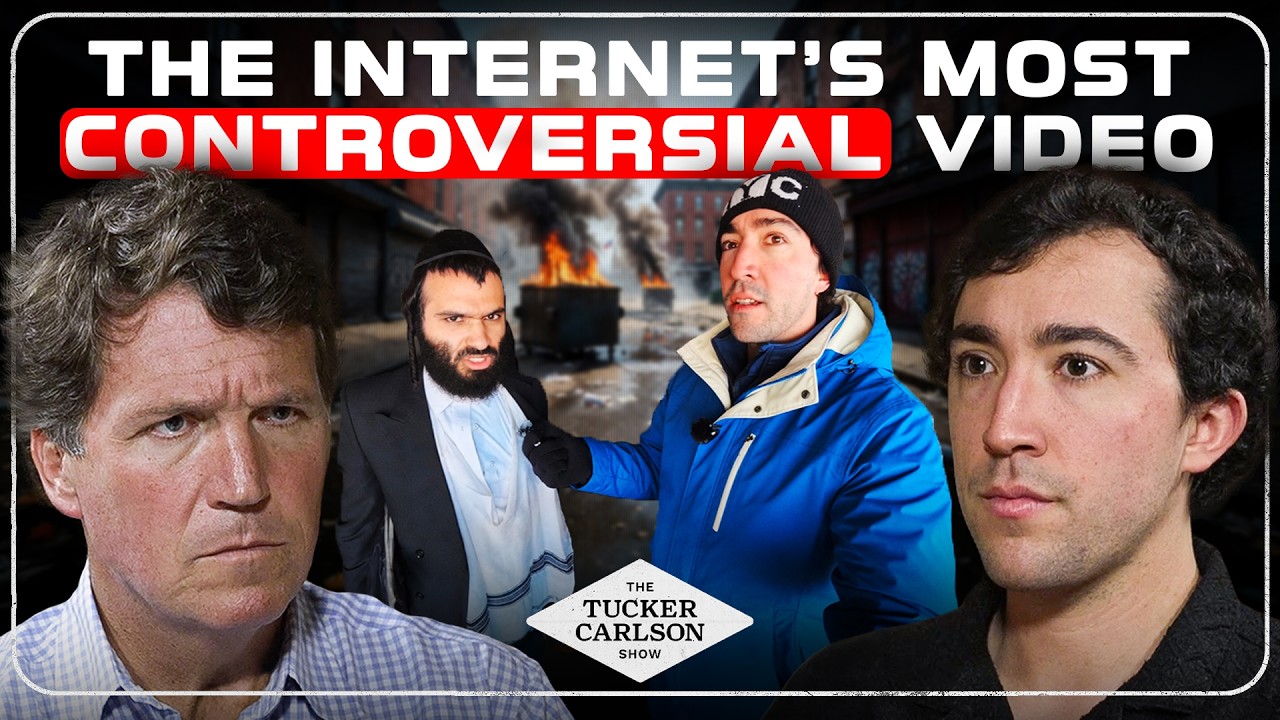
Tyler Oliveira is a 26-year-old independent YouTuber from Modesto, California, who dropped out of college after three months and built a massive channel doing what he calls amateur investigative journalism — self-funded, no investors, just him and a small team. He started with goofy content but pivoted to serious on-the-ground reporting after driving to East Palestine, Ohio, to cover a train derailment the mainstream media was ignoring. That video got 3-4 million views and validated his approach: show up, ask questions, and package real stories for YouTube audiences.
-
Oliveira’s core interest is what happens when America’s generosity is systematically exploited. He has covered ethnic enclaves across the country — white supremacists in Arkansas, black supremacists in Harlem, Muslim communities in Dearborn and Hamtramik, Michigan, and Somali communities in Minneapolis — always asking the same questions: How do you make money? How many kids do you have? Are you on welfare? He treats it as a universal principle: when a country’s decency is leveraged against it, the result is the same regardless of who is doing it.
-
In December 2025, he released a video on Somali welfare use in Minneapolis, focusing on demographic change in what was historically a Scandinavian-American state. Republicans praised it. Then he applied the exact same lens to Kiryas Joel, an Orthodox Jewish village in upstate New York — at one point the poorest town in America, with 40% below the poverty line, the highest fertility rates in the country (7-10+ kids per family), and anomalously high rates of Medicaid, SNAP, Section 8 housing vouchers, and other welfare dependency. He found a community whose entire lifestyle is designed to extract maximum value from the welfare system, by design and not by accident.
-
The response exposed a deep hypocrisy. The same Republicans who celebrated his Somali exposé attacked him for the Jewish one. The ADL said his video “hearkened back to anti-Semitic stereotypes” — even though every statistic he cited was publicly available and every claim was verified by asking residents directly. An advertiser pulled out of the video within hours of learning its topic. His Patreon — the engine of his business — was deleted within 24 hours for alleged “bullying,” despite years of far more confrontational videos targeting Christian megachurch pastors, pedophiles, pimps, and gangsters that never triggered any action. He then built his own Patreon-clone website in a couple of days, only to be kicked off two different web hosting servers within a week each, again citing hate speech and “circumvention.”
-
Oliveira then went to Lakewood, New Jersey — the most populous Orthodox Jewish town in the US outside Brooklyn — after residents invited him to document what was happening there. What he found was a pattern of political takeover: Orthodox communities move in, vote themselves onto school boards, zoning boards, and township councils, then redirect public resources. In East Ramapo, New York, they defunded after-school programs for public school kids, closed public schools, and sold the buildings at discounted rates to yeshivas. In New Jersey, the state funding formula means public school money follows enrollment, but Orthodox kids attend yeshivas — yet the public system must still fund gender-segregated busing and special education for those private schools. Heritage residents described being priced out and watching their children’s education deteriorate.
-
In Lakewood, Oliveira was treated as a threat. Residents were told via group chats not to talk to him. A volunteer community patrol called Shomrim — which functions as de facto law enforcement, drives cars with red and blue lights, and runs red lights — showed up to follow him and told people they didn’t have to answer his questions. Local police pulled him over without probable cause, saying he was a “suspicious person” for filming on a sidewalk. Rabbis told him to leave parking lots. When residents did engage, their justification was legalistic: “The law says we qualify, therefore we deserve it. If you don’t like it, move to a different country.” Oliveira’s response: “Go move to a different country. I pay taxes here.”
-
Israelis largely loved the video, saying the same dynamic drains their welfare system — ultra-Orthodox communities there also don’t serve in the military, don’t contribute economically, and have enormous fertility rates. Secular Jews in America were more divided, with some expressing frustration at the Orthodox but many closing ranks tribally. Oliveira noted that every time he has complimented Orthodox Jews in the past, it was secular Jews who pushed back hardest — yet when he criticized them, secular Jews were among his most vocal defenders of the community.
-
The broader lesson Oliveira draws is that there are groups in America you cannot criticize without consequences — not because the criticism is false, but because of who is being criticized. He has confronted Benny Hinn on stage at a megachurch service, interviewed pedophiles in Miracle Village, Florida, and covered murderers and gangsters without any platform taking action. But criticizing Orthodox Jews triggered a coordinated response across multiple platforms within days. He sees this as a violation of the foundational American principle of equal treatment and free speech.
-
Oliveira also sees a demographic and political crisis unfolding for his generation. Gen Z faces useless college degrees, competition from an infinite globalized labor force, H-1B visa holders used as wage suppression, and a political system where neither party represents them. The Trump administration, elected partly to end identity politics, has engaged in aggressive identity politics on behalf of roughly 2% of the population while mocking and accusing the one group — high-achieving white Christian kids — that is provably underrepresented. Young men are becoming incels, opting out, decaying in their parents’ basements. Oliveira believes this energy has to go somewhere, and if the current two-party system doesn’t channel it, something more radical will.
-
He is not a white supremacist or a radical. He describes himself as someone who was politically illiterate until age 22, who believes in universally applicable principles, and who simply holds every group to the same standard. He supports religious freedom, including the right of the Orthodox to practice however they want — as long as taxpayers aren’t funding it. He supports the Amish model of self-sufficiency. His frustration is not with any religion or ethnicity but with the double standard that allows some communities to exploit the system while being immunized from criticism, and with a country that seems to be Balkanizing along every identity line except the one group that is not allowed to have an identity at all.