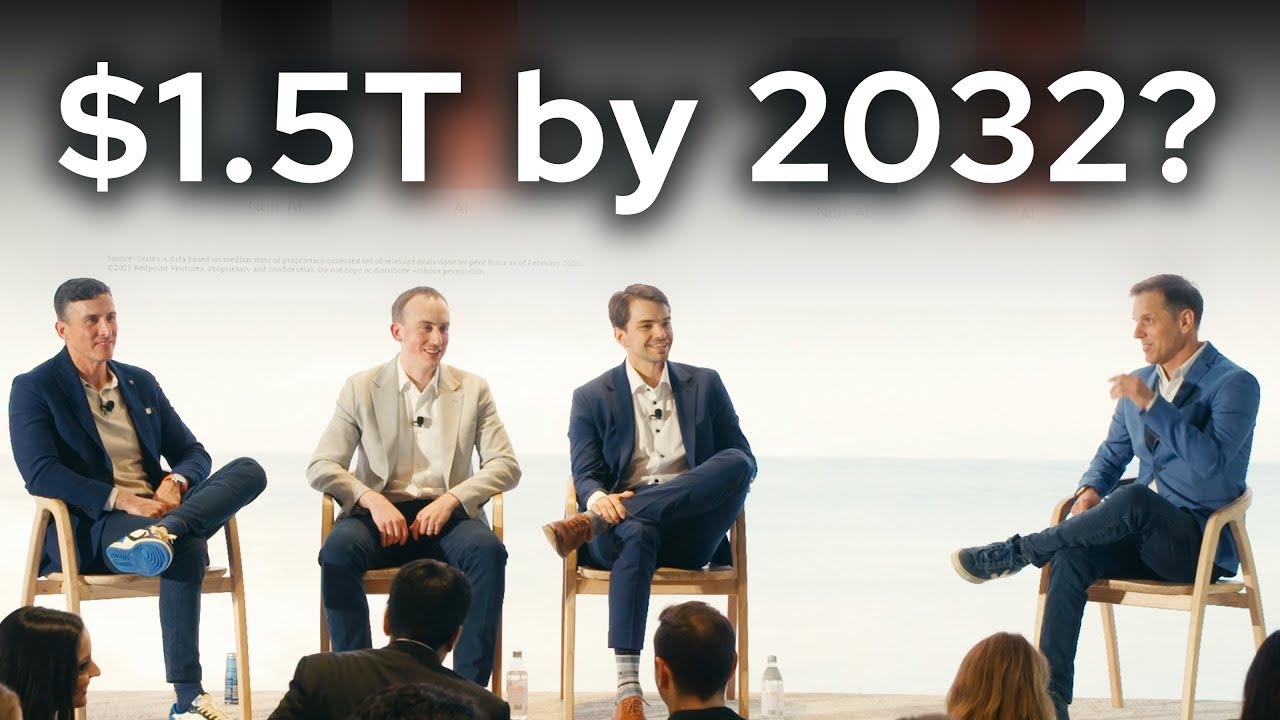
Redpoint Ventures partners Scott Raney, Alex Bard, Patrick Chase, and Jacob Effron discuss how the firm is navigating AI investing, covering where value is accruing across the AI stack, how startups can compete against incumbents, what separates enduring AI companies from hype, and how high valuations are reshaping venture fund strategy.
-
The scale of the AI opportunity is staggering, but the investment thesis rests on a massive bet
- NVIDIA’s data center division is projected to generate $177 billion in revenue in 2025, roughly 5.5x the size of the entire personal computing CPU market ($32 billion).
- To justify that level of capex with a reasonable ROI, the market needs to generate ~$1.2 trillion in AI revenue by 2030 and ~$1.5 trillion by 2032.
- That $1.5 trillion would be built in about 10 years, compared to the existing enterprise software market of ~$1.1 trillion, which took 50 years to build.
- Alex Bard argues the number may even be understated because AI unlocks labor budgets that are an order of magnitude larger than traditional software budgets (e.g., customer service software is $35B vs. $450B in human labor costs), and because AI can penetrate markets historically too small or unsophisticated for traditional SaaS.
- The investment is a strategic imperative for big tech regardless of ROI—no company can afford to be left behind.
-
The model layer is commodizing, but the top model companies can still build durable businesses
- Foundation models are the “brains” powering AI applications. The cost of training and inference is dropping roughly 10x per year, which benefits application-layer companies through better margins.
- DeepSeek demonstrated that scale alone is not an enduring moat—within weeks of its release, many Redpoint portfolio companies switched from Anthropic to DeepSeek, cutting inference costs by 80–90% with minimal switching costs.
- Model companies are responding by building moats through distribution (OpenAI launching consumer and enterprise apps/agents) or specialization (robotics, biology, materials science—areas requiring different data than LLMs).
- Redpoint sees adjacent model categories like robotics (investment in Physical Intelligence) and biology as more interesting for new investment than foundation LLMs, where the capital requirements are now prohibitively expensive.
-
The infrastructure layer has been slower to develop than expected
- Redpoint initially expected infrastructure to be a major investment area, as it was during the cloud wave, but activity has been limited.
- Two reasons: the model layer changes so fast (new models every ~3 months) that builder patterns haven’t stabilized, and early AI adoption has been in “use case discovery mode” where developers default to the most powerful brand-name models (OpenAI, Anthropic) rather than building on new infrastructure tooling.
- Data centers and inference infrastructure (investments in Modal, Livekit) have been bright spots. The firm believes agent emergence this year will create more common patterns and infrastructure needs.
-
The application layer is where the most excitement is, especially vertical AI SaaS
- Alex Bard draws a parallel to the early SaaS wave: just as cloud combined a technology shift (on-prem to cloud) with a business model shift (subscription vs. perpetual license), AI combines a technology shift with a new business model—charging for work done rather than per seat.
- This creates a window for startups to disrupt incumbents, particularly in horizontal markets (AI-native CRMs going after Salesforce, like Adio) and vertical markets.
- There has been a “Cambrian explosion” of ~500 vertical AI SaaS companies, with thousands more expected. Redpoint evaluates these using three questions:
- Is there a real wedge with product-market fit (not just experimental budget)?
- How much more can the company do beyond replacing one FTE? (They prefer large industries like healthcare, law, finance.)
- How much does quality matter? (In regulated industries like healthcare or law, “80% good enough” solutions face reputational risk, creating pricing power for best-in-class products.)
- The irony: the easiest budgets to capture are often outsourced/BPO work, but those buyers have already demonstrated willingness to trade quality for cost, making them the worst markets for defensible AI businesses.
-
Startups vs. incumbents: the battle is more nuanced than it appears
- Incumbents like Salesforce have massive distribution advantages, existing customer relationships, proprietary data, and strong AI narratives (Agentforce). Mark Benioff is making Salesforce synonymous with agents just as he did with cloud.
- However, incumbents face structural problems: they sit on old databases, old infrastructure, and UX built 20+ years ago. AI requires rethinking core workflows (e.g., customer service routing engines built on thousands of lines of logic-tree code), and incumbents can’t easily remove these without disrupting existing customers.
- Startups have an advantage when workflows fundamentally change. When workflows stay roughly the same (AI-native Notion, AI PowerPoint), incumbents can absorb the innovation.
- The real loser in this dynamic is BPOs and legacy services firms—both startups and incumbents are eating into that budget.
- Alex Bard notes that Salesforce now looks more like a private equity firm with 10 products than an innovation company, creating openings for focused startups to carve out pieces.
-
First mover advantage is unusually powerful in AI, but moats look different than expected
- Companies can become synonymous with a category in 6–9 months (e.g., Abridge in healthcare AI). This creates a self-reinforcing loop: early customers, partnerships, capital, and model-side opportunities all flow to the perceived category leader.
- Contrary to expectations, data moats have not proven decisive. The real moat in AI applications ends up being the “thousand little things”—UX, product breadth, integration depth—similar to traditional SaaS.
- At the earliest stages, Redpoint indexes on founder-market fit (deep domain expertise in the target market) over pure AI technical expertise. Examples include Motif, co-founded by the former co-CEO of Autodesk, building an AI-native Autodesk 2.0.
- Product depth matters: companies where the solution is ~80% workflow and ~20% model (like Motif) are much harder to replicate than companies that are ~80% model and ~20% workflow.
-
Many AI startups will fail because they’re easy to replicate and easy to rip out
- Common failure pattern: companies with early traction that hit a wall because they weren’t deeply integrated, had low gravity, and were replaced by the next “latest and greatest” solution. AI SDRs are a notable example—every company tried them, but many were ripped out quickly.
- Redpoint distinguishes between experimental budget (everyone is told by their boss to try AI) and business line budget (durable, committed spend). The key signals are end-user engagement and usage metrics—“users never lie.”
- The old Series A benchmark was $1M ARR; AI companies are now going from $0 to $3–10M ARR quickly, but that doesn’t necessarily indicate durability or corporate maturity.
-
Valuations are high and require new approaches to fund construction and diligence
- Series A valuations for AI companies are substantially higher, with larger round sizes. On the growth side (Omega fund), companies are returning to raise sooner and at 3–4x the multiples seen historically.
- The justification: AI companies can access larger markets (labor budgets), grow faster, and may require less future capital because AI-native operations allow companies to reach hundreds of millions of revenue with 20–40 employees, reducing dilution.
- The risk: revenue maturity is incongruent with corporate maturity. A company doing $8M ARR with 10 people at 8 months old hasn’t built the systems, processes, or team that traditionally accompany that scale.
- Redpoint’s response:
- Be highly selective—fewer bets, focusing on markets with massive tail opportunities rather than crowded verticals ranked 21–50.
- Co-process more deals between the early-stage and growth funds, with both funds investing simultaneously, because companies are raising their first institutional rounds with meaningful traction but at growth-stage valuations.
- Emphasize first-principles diligence over hype, focusing on engagement metrics, customer calls, and whether revenue is durable versus experimental.
- The partners acknowledge this is the hardest environment they’ve navigated, requiring constant debate and discipline to avoid false positives from companies that spike quickly but flatten out.