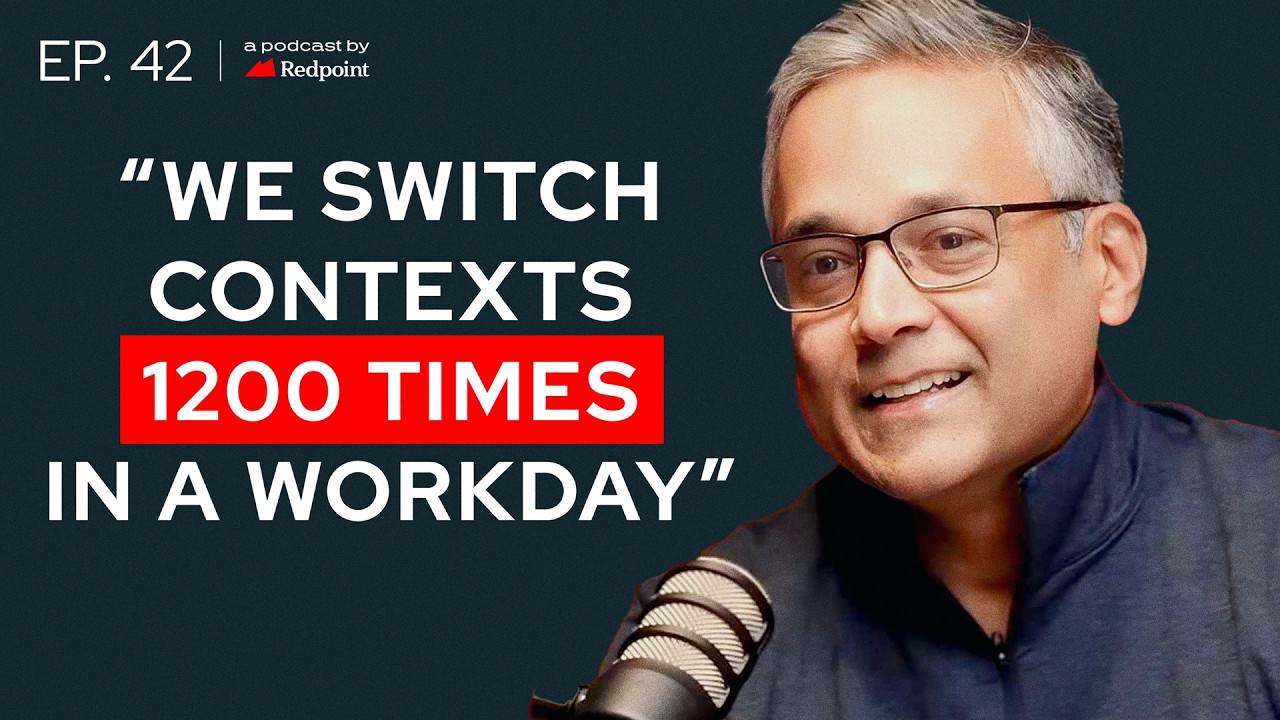
Rahul Roy-Chowdhury, CEO of Grammarly, discusses the future of AI-assisted writing, Grammarly’s product evolution, and how AI will reshape human communication, enterprise productivity, and education. Grammarly is a personalized AI writing assistant with over 30 million daily active users, a $13 billion valuation, and a 15-year track record of building AI productivity tools. The conversation covers Grammarly’s product roadmap, the limitations and fine-tuning needs of LLMs, competitive dynamics, enterprise adoption, AI in education, and Rahul’s broader views on where AI is overhyped and underhyped.
The Future of AI in Human Communication
Rahul envisions a future where AI removes the drudgery of day-to-day communication, enabling people to focus on creativity, synthesis, and deeper human connection.
The goal is not more content but better content: fewer emails and documents, but each one more meaningful, evocative, and precise.
He argues humans should push toward a world where AI reduces volume and increases value, rather than a dystopian scenario where AI both generates and consumes ever-growing amounts of content.
Writing and communicating are fundamentally human activities that should not be outsourced to AI.
Grammarly’s Product Evolution
Grammarly was founded in 2009 and has evolved from rule-based NLP to deep learning to LLMs and generative AI, always matching technology to user needs.
Rahul frames the communication lifecycle in four stages: ideation, composition, revision, and comprehension.
Historically, Grammarly focused on the revision stage—helping users correct, polish, and align text with style guides and tone.
Going forward, LLMs enable two major shifts:
Strategic alignment: Suggestions tied to business outcomes (e.g., adding a call to action, explaining why an event is worth attending), with correctness and polish increasingly auto-applied.
Full lifecycle coverage: Grammarly will assist with ideation, composition, revision, and comprehension (e.g., summarizing long email threads and surfacing action items).
Limitations of LLMs and Quality Bar
LLMs are powerful but not plug-and-play; Grammarly invests heavily in fine-tuning, quality evals, and safety evals before shipping features.
False positives or safety issues carry real consequences because Grammarly operates at scale and supports high-stakes communication.
Quality is context-dependent and use-case-dependent, not a single universal threshold.
Grammarly uses a multi-dimensional evaluation process:
External benchmarks closest to their use cases
Safety evals informed by real-world user feedback and false positives
Side-by-side comparisons by linguistic experts rating LLM output vs. human-curated output
Live experiments with real users, tracking acceptance, rejection, and engagement
Example of learning from edge cases: a police department used Grammarly for crime reports and asked Grammarly to stop suggesting “sound more positive” for serious, sensitive content—leading to better suppression logic for sensitive text.
Impact of ChatGPT and Model Improvements
ChatGPT was a watershed moment for Grammarly, but the speed and scale of improvement surprised even a company already experienced with AI.
Grammarly sees itself as a domain expert in communication that harnesses whatever technology is best available—NLP at launch, now LLMs.
Early GPT-3 side-by-side tests showed NLP had far better precision, but LLM quality has improved dramatically and is now largely on par with rule-based systems for Grammarly’s use cases.
Each new model is idiosyncratic and requires significant custom work to fit Grammarly’s use cases—models are not interchangeable.
Product Roadmap and Model Dependency
Grammarly’s roadmap is driven by user problems and brand promise, not by waiting for future models.
Safety, for example, cannot be punted to the future; Grammarly does extensive fine-tuning and post-processing because current models are not safe enough out of the box.
On-device inference is an area of active exploration: smaller, more efficient models could enable on-device processing, improving latency, cost, security, and privacy.
The most exciting near-term model capability is multi-step reasoning, which could enable agentic workflows where Grammarly helps orchestrate complex communication tasks (e.g., pulling context from marketing, engineering, and PR to draft a board email).
Fine-Tuning and Personalization
Grammarly processes 75 billion user events per day, giving it a large, high-quality dataset for fine-tuning models across use cases.
Models are fine-tuned on use cases, then layered with organization-specific knowledge (style guides, brand tone, compliance rules).
Example: a loan officer communicating with customers must follow strict regulatory rules; Grammarly can ingest those rules and enforce them in the flow of communication.
Personalization for individual users (capturing their voice) is still somewhat manual but will become increasingly automated.
Competitive Landscape
Rahul welcomes competition (Apple Intelligence, Google Docs, Notion, etc.) because it brings attention to the problem space and drives users back to Grammarly.
Grammarly’s key differentiators:
User data flywheel: massive, fresh, high-quality data used in a continuous loop to improve product quality.
Ubiquity across tools: Grammarly operates across 200+ B2B SaaS apps (Gmail, Word, Slack, Salesforce, etc.), sitting in the flow of work rather than trying to replace existing tools.
Grammarly’s mission is to make all existing tool investments better, not to sell a new platform.
Team Structure
Grammarly uses a hybrid model:
A core research team explores longer-horizon capabilities (e.g., on-device inference, data infrastructure gaps) looking 18–24 months out.
AI engineers are embedded in product and feature teams, working as full-stack teams to ship features with front-end, back-end, and AI capabilities together.
Enterprise AI Market
Rahul sees enterprise AI as a multi-year transformation journey, not a one-time deployment.
Enterprises are focused on selecting AI vendors they can trust for the long term.
Actual productivity gains outside a few core use cases (code generation, customer support, internal search) remain elusive despite massive investment.
Grammarly emphasizes measurable value: the average organizational user saves 19 days per year, a concrete metric that demonstrates business impact today.
AI in Education
Grammarly has worked with educators and institutions like the University of Texas to bring AI into classrooms responsibly.
Initial reactions of banning AI have largely given way to a focus on equipping graduates with AI skills for the workforce.
Citations feature: students can cite where they used AI in a work product, distinguishing between a student who had AI write an entire essay and one who used AI as a co-pilot for feedback and improvement.
Authorship feature (launching imminently): provides provenance for every piece of a document—showing what was manually written, copy-pasted and paraphrased, or AI-generated—giving educators and students transparency and tools to set their own guardrails.
Rahul views AI as a great leveler: for students without access to teachers or resources, AI can be the difference between studying and not studying.
Over-hyped and Under-hyped
Overhyped: chat interfaces, which Rahul sees as a suboptimal command-line-like UI that should disappear into the background.
Underhyped: AI as a tool to upskill and uplevel people globally—both in education and in the workforce—acting as a democratizer of skills and a force multiplier.
Biggest Surprise and Changed Mind
The tone detector feature has resonated far more than expected; users frequently stop Rahul on the street to share how it helped them in high-stakes situations.
Rahul initially saw Grammarly’s consumer and Enterprise businesses as separate but has reversed that view: the distinction is artificial, as many “consumer” buyers use Grammarly at work. The company is building a seamless user journey from free to premium to self-serve team licenses to full Enterprise deployment.
Most Exciting AI Startup Outside Grammarly
Rahul is most excited about AI for healthcare, citing Alpha Fold’s work in drug discovery and Grammarly customer ModMed, which uses AI to improve patient outcomes—tangible, life-changing impact.