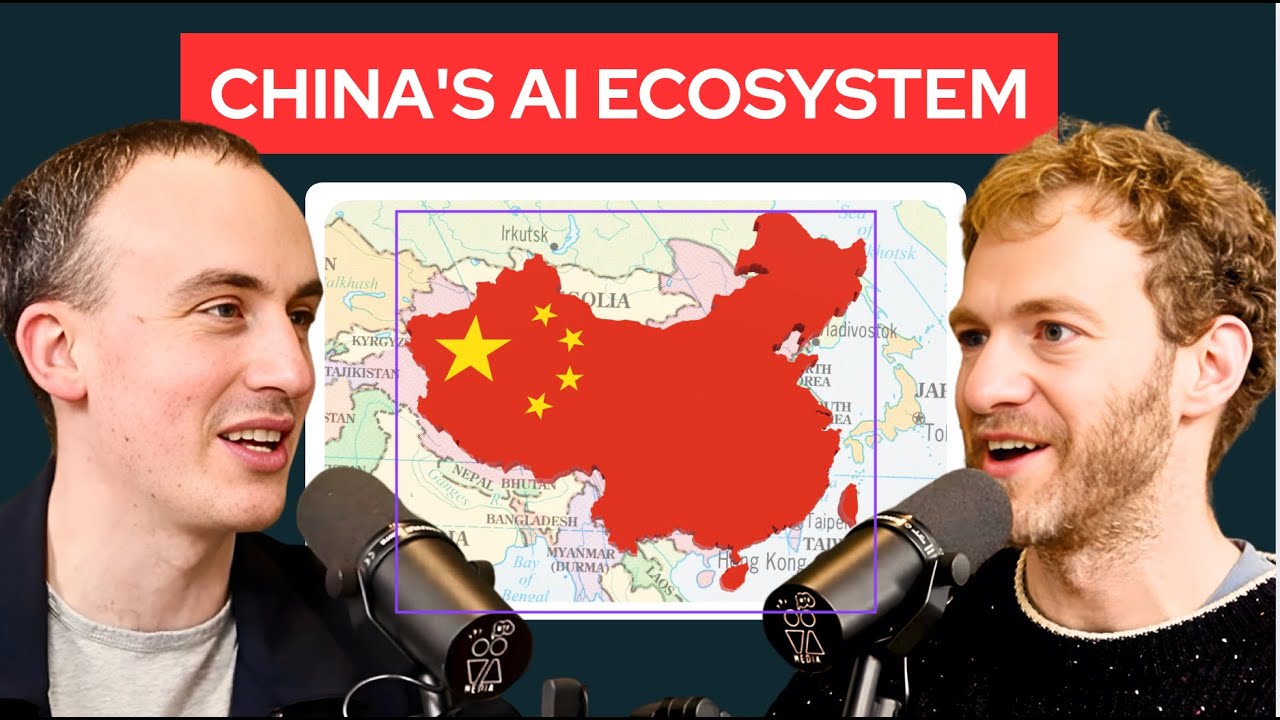
Jordan Schneider, host of the China Talk podcast and newsletter, joins Jacob Effron for a wide-ranging discussion on the Chinese AI ecosystem, US-China tech competition, semiconductor export controls, and the geopolitical dynamics around Taiwan and compute. Jordan is one of the foremost English-language analysts on Chinese technology policy and US-China relations.
The Chinese AI Ecosystem: Pre- and Post-ChatGPT
Before ChatGPT, China’s AI ecosystem was focused on computer vision and applied AI, not the transformer/scaling-laws paradigm that defines the current LLM era. Chinese firms were not investing heavily in large language models.
ChatGPT was a wake-up call: it energized a Chinese tech ecosystem that had been demoralized by COVID, a regulatory crackdown on big tech (Ant Financial, Didi, etc.), and a broader “tech lash” from 2018–2022.
Starting in 2023, roughly 12–15 credible AI labs spun up in China, driven primarily by private capital and talent rather than top-down government coordination.
The Chinese government has historically favored hardware over software in its industrial policy. Software companies were not seen as contributing to national power, which is partly why the crackdowns happened. The post-ChatGPT AI boom was largely VC- and private-sector-driven.
The Chinese government banned Western closed models from deployment in China early on, creating a protected domestic market—a dynamic seen in other Chinese tech sectors over the past 30 years.
Key Players and Funding Models
DeepSeek: An outlier founded by a hedge fund manager (Liang Wenfeng) who bought large quantities of Nvidia chips before export controls tightened. He focused on hiring domestic talent, believing it was underpriced. His English reportedly wasn’t strong enough for top Western grad schools.
Alibaba (Qwen): China’s largest cloud provider and e-commerce platform, with sufficient capital and compute to compete. Motivated partly by not wanting ChatGPT to dominate the buying/payments ecosystem.
ByteDance (Doubao): Had talent, capital, and compute. Oracle reportedly powers much of ByteDance’s US operations.
Smaller labs: A handful raised VC funding (eight to low nine figures), often founded by researchers with pedigrees from Western labs (Google, DeepMind, Meta, OpenAI, Anthropic). Many have since consolidated; the field has narrowed from ~15 labs to roughly 5–6, most now aligned with Tencent or Alibaba.
OpenAI-scale independent labs have not really emerged in China. The firms closest to the frontier are large companies with other profitable businesses subsidizing AI development.
Talent and International Collaboration
Many top Chinese AI researchers have Western academic or industry credentials (Carnegie Mellon, Microsoft, Google), which serves as a signal to both employers and funders.
DeepSeek is an exception, deliberately hiring only domestic talent.
Chinese-born researchers make up roughly a third of top Western AI lab staff; about two-thirds to three-quarters of those grew up in mainland China.
Cross-border research collaboration continues despite geopolitical tensions, but it is under strain: NeurIPS 2024 had to spin up a second off-site in Mexico because Chinese researchers struggled to get US visas.
Jordan notes a one-directional “looking glass”: Chinese media organizations closely follow and translate Silicon Valley AI discourse, while only a small handful of US analysts cover the Chinese ecosystem in depth.
Open Source Models in China
There has been a collective movement toward open-sourcing models in China. The logic is partly a market adoption and race-to-the-bottom strategy: if a strong model is free, it’s hard to sell a closed model that’s only marginally better.
The technology reached a point where very good models could be trained without tens of billions of dollars, making the open-source approach viable.
Most Chinese firms are still trying to figure out business models. The initial “let’s just do research” phase is giving way to commercial pressure.
Jordan expects the Chinese LLM market to consolidate around a few large players (Tencent, Alibaba) rather than producing independent labs on the scale of OpenAI or Anthropic, because China lacks the deep VC funding ecosystem that supports such independence.
The Chinese Government’s Role
The government’s involvement in AI has been relatively low-touch compared to its heavy-handed approach to semiconductors.
Published policy documents contain relatively anodyne goals (e.g., 70% AI adoption in companies by 2035) without dramatic top-down directives.
A leadership “study session” on AI in May 2024 featured relatively mainstream experts and did not reveal extreme anxiety or doomerism.
The government’s framework for evaluating AI is primarily about national power and political stability, not AI safety in the Western sense.
There is awareness of potential job displacement/social dislocation from AI, but confidence in the system’s ability to absorb it (compared to the SOE reforms of the 1990s).
Some Chinese AI leaders (e.g., at Alibaba) are publicly discussing AGI and grand scientific vistas, in discourse remarkably analogous to Silicon Valley.
The government has learned from the rocky experience of semiconductor industrial policy (where a $100B fund’s top seven officials were jailed for corruption in 2021–2022, reportedly due to frustration over slow progress in indigenization) and is being more hands-off with AI software.
Founder Attitudes and Competitive Pressure
The dominant sentiment among Chinese founders and builders is intense competitive pressure to survive. The competition is described as “incredibly hardcore,” with labs adopting grueling “996” work schedules.
There is a humanistic strand (visible in DeepSeek founder interviews) of excitement about advancing science and opening new frontiers.
A central tension: many leading Chinese tech figures hold globalist, cosmopolitan, even liberal perspectives, but operate under a system that constrains them. Jordan cites the example of ByteDance founder Zhang Yiming, who in the late 2000s posted liberal views but in 2018 issued a public apology at 5:12 AM for failing to properly moderate content and “serve the party.”
As AI becomes more central to national power, Jordan expects the operating space for positive-sum US-China interaction to shrink under the current Chinese leadership.
The Compute Constraint and Hardware Gap
Jordan’s “net assessment” of China’s AI inputs: talent is abundant, energy is sufficient, but compute is the binding constraint.
The Trump administration has continued Biden-era policies restricting China’s access to the best Nvidia chips.
Chinese firms can still access compute abroad (training in Malaysia, Singapore, etc.), but this is limited by capital and by data privacy laws governing cross-border cloud usage.
The real question is whether Western finance + TSMC + the global semiconductor equipment supply chain can outscale China’s domestic capability. Jordan estimates Huawei is roughly 10–15x behind in manufacturing capacity, with a 15:1 production ratio persisting for at least the next three years.
China has poured more money into semiconductor indigenization than any industrial policy project in human history, but global capitalism can mobilize even more. Nvidia’s market cap ($4–5T) dwarfs Alibaba’s ($200B).
Jordan does not expect a “cavalry” from technological defections (e.g., Japan switching sides) that would close the gap.
US Export Control Policy: Evolution and Current State
Late Obama through Trump 1.0: A consensus shift toward viewing China as a strategic competitor. Focus initially on telecommunications and Huawei.
Biden administration (2021–2022): A small group of AI-literate officials at NSC (Jason Matheny, Ben Buchanan, Chris McGuire, Tarak Shah) recognized the importance of compute. In October 2022—one month before ChatGPT—the US imposed sweeping export controls on AI chips and semiconductor manufacturing equipment.
The controls were iteratively tightened: Nvidia would design chips just under the threshold, then the government would close the gap. Coordination with the Netherlands (ASML) and Japan (Tokyo Electron) was difficult and delayed.
A major scandal involved TSMC selling large volumes of wafers to a Huawei cutout.
Trump 2.0: Initial continuity, then drama. David Sachs exited; Laura Loomer pushed out China hawks; Jensen Huang gained influence. The H20 (a restricted chip, one generation behind) was approved for sale to China, but the Chinese government refused to buy it—reasons debated (bad information from Huawei lobbyists, negotiating ploy for Blackwell chips, or strategic preference for domestic chips).
Ahead of the Trump-Xi summit in Seoul, Trump got on the plane and markets rose 10% on expectations he’d approve chip sales, but Lutnick, Rubio, Bessent, and Grewal reportedly lobbied him on Air Force One not to. He didn’t. Now there are reports they’re considering selling a version again.
The Trump administration rescinded the Biden-era “diffusion rule” (which restricted chip sales to third countries) in a BIS FAQ but hasn’t formally repealed it, reflecting an internal fight.
Jordan characterizes Trump-era policy as “optimizing for vibes” rather than grand strategy, with frequent reversals.
The Argument For and Against Selling Chips to China
For selling (Jensen Huang’s argument): AI accelerators are not just hardware but software (CUDA ecosystem). Thousands of Chinese engineers are trained on Nvidia. Denying them chips risks pushing that engineering energy toward improving Huawei’s software ecosystem instead.
The “Goldilocks” scenario: Sell enough chips to keep Chinese firms dependent on Nvidia without giving them the cutting edge. Howard Lutnick has said the goal is to “get them addicted to American chips.”
Against selling: China’s indigenization drive is inevitable given the choke points that have been raised. Huawei went from a second-source nobody to front-and-center because of export controls. Giving them a bridge of Nvidia chips provides breathing space. The Chinese hardware ecosystem is not capital-constrained—it has unlimited attention, energy, and money. The marginal revenue to Nvidia (~$50B over 5 years) may not outweigh the strategic cost.
Jordan notes he has been unable to find an expert arguing for selling chips who doesn’t have a financial interest in the outcome.
Current status: Chinese firms can rent compute abroad and train on Nvidia chips in third countries. They can also access smuggled chips. The practical constraint is capital and the cost of serving inference at scale, not absolute inability to access any compute.
Huawei’s Manufacturing Challenge
Huawei’s chip designs are competitive with Nvidia’s. The problem is manufacturing at scale.
Without EUV lithography (controlled by ASML), Huawei is stuck at 7nm and pursuing less efficient technological paths that the global ecosystem already abandoned.
The Biden controls caused a short-term boom in Chinese semicap equipment stockpiling (Semiconductor Manufacturing International Corporation, or SMIC, saw a wave of investment), but the fundamental gap remains.
Loopholes exist: subsidiaries 49% owned, fabs on one side of a street controlled and the other not, and a lag between US, Dutch, and Japanese implementation.
Jordan estimates a 15:1 ratio of Western to Chinese compute manufacturing for at least the next three years, with some knobs that could move it to 10:1 or 13:1 depending on assumptions about high-bandwidth memory access and Huawei design improvements.
The ASML/Netherlands/Japan Dimension
ASML machines contain significant American technology (lenses, components), giving the US latent leverage.
The Biden administration chose to work through allies (“the nice way”) rather than unilaterally forcing compliance (“the hard way,” invoking extraterritorial mechanisms like a direct foreign product rule).
This led to a frustrating dynamic: Chinese firms bought tens of billions of dollars of DUV (deep ultraviolet) equipment—which was not initially controlled—powering much of Huawei’s current buildout.
The Trump administration had been expected to tighten controls on semiconductor manufacturing equipment, but the US-China rare earths dispute has put those plans on ice.
What Jordan Would Prioritize Policy-Wise
The CHIPS and Science Act (2022) had two components: subsidies for domestic fab construction (Arizona, Texas) and $13 billion for basic and translational semiconductor R&D.
The Biden administration was slow to spend the R&D money and failed to build strong industry partnerships. The Trump administration recently canceled the nonprofit entity the Biden team had set up to run it.
Jordan’s top policy priority: ensure that $13 billion is spent on basic research. Such large-scale public R&D investments are rare in the American political system and will matter enormously over a 10–20 year horizon in the compute competition.
He hopes the Trump administration will find creative and impactful ways to deploy that money, whether through a new nonprofit structure, corporate R&D subsidies, or other mechanisms.
Taiwan
US policy has long been “strategic ambiguity”—not committing to defend Taiwan but not ruling it out. Biden ad-libbed several times that the US would defend Taiwan.
There is a debate on the American right: some (e.g., Elbridge Colby) argue Taiwan is the single most important place in the world (it makes all the chips); others say it’s irrelevant and the US should focus on the Western Hemisphere.
There was concern Trump would “fold” on Taiwan during the Seoul summit, as he was expected to on chips. He didn’t, but the risk is nonzero.
Taiwanese domestic politics is a critical and underappreciated variable: the KMT (historically more Beijing-friendly) has been resurgent, which reduces Beijing’s anxiety; the DPP (more independence-leaning) has held two terms, and Beijing may be losing patience.
Jordan’s assessment: Xi is not the type to invade willy-nilly. He has been in power over a decade with no major military adventurism (unlike Putin, who invaded Georgia, Crimea, and Syria before Ukraine). Provocations (Scarborough Shoal, Himalayan border clashes, fighter jets in Taiwanese airspace) are not comparable to Putin’s pre-invasion pattern.
A Taiwan blockade scenario over unfavorable election results is nonzero but Jordan puts it in the single digits over a five-year span. The downside risks to the Chinese economy and party stability are severe.
The “Ben Thompson argument”—that if America gets too far ahead in AI, China might bomb fabs or data centers—is noted but not something that keeps Jordan up at night. The US and China will each comprise roughly a quarter of world GDP for the foreseeable future.
Underdiscussed Topics: Robotics and Military AI
Robotics: China’s robotics ecosystem is undercovered. China has a proven playbook for scaling manufacturing (drones, EVs) that the West has not replicated. If manufacturing robots at scale cheaply is key to the 21st century, China has a real edge. Data collection from deployed robots in China is already happening at scale, which compounds the advantage. The counter-argument is that the economic prize for deploying robots in the US (where labor is expensive) may be large enough to overcome manufacturing disadvantages. But dependence on Chinese robots raises uncomfortable questions for Western policymakers.
Military applications of AI: Jordan has been studying historical case studies of military technological adaptation (the machine gun in WWI, precision warfare in the Gulf War). The key insight: militaries are poorly suited to rapid technological change, and there is enormous “technological overhang”—existing capabilities that organizations haven’t yet figured out how to use doctrinally. The Ukraine war has shown radical shifts in just three years (drones, electronic warfare, command and control) without any fundamental technological breakthroughs—just organizational adaptation. Jordan recommends John Ellis’s The Social History of the Machine Gun as a concise case study of how a revolutionary technology diffused through acquisition, tactics, and organizational change, and how institutional inertia slowed adaptation even when the writing was on the wall.