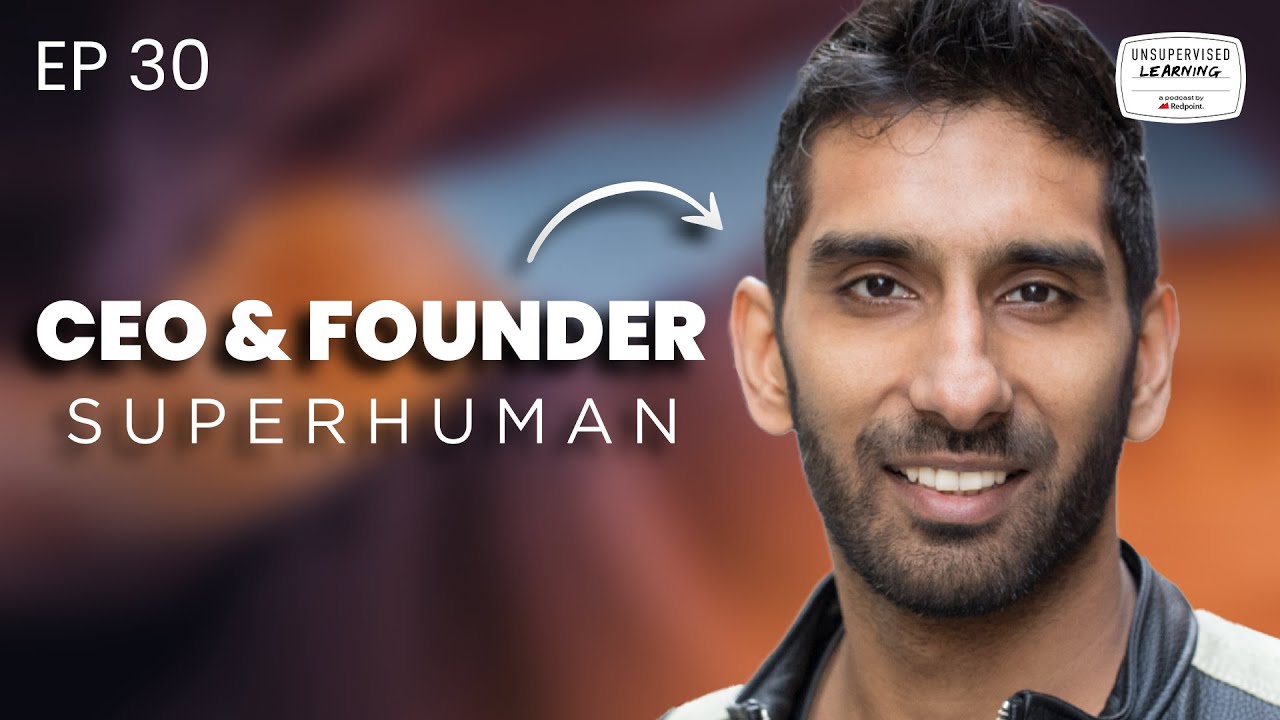
Rahul Vohra, CEO of Superhuman, discusses the future of email, AI-powered features, and how agents will reshape work. Superhuman is a premium email client ($30/month) used by founders, VCs, and outbound professionals, now processing 4 billion emails with AI features like Auto Summarize and Instant Reply. The conversation covers product design, AI strategy, competing with incumbents, and the emerging agentic AI ecosystem.
Why email will never die
Email addresses are foundational infrastructure: when you join a company, you get an email address because the company needs a way to address you that it owns. Your email address is also the login for most enterprise tools (SSO, HR systems, etc.), making it deeply embedded in how organizations function.
Email itself will evolve significantly, with two major forces shaping its future:
AI agents that act on your behalf—triaging, drafting, scheduling, and even sending emails autonomously
Collaboration features like shared threads, comments, team read statuses, and team reply indicators, moving email closer to a team workspace
Superhuman’s three flagship AI features
Write with AI (launched summer 2023): Users jot a few words and the system turns them into a fully written email, matching the user’s voice and tone from previously sent emails. Users can then shorten, lengthen, fix mistakes, or translate. This was an on-demand feature—users had to remember to use it.
Auto Summarize (launched fall 2023): A one-line summary appears above each conversation, updating instantly when new emails arrive. Users can expand to a bullet-point summary. This is an always-on feature that changed how people work—many emails can be handled from the summary alone without reading the full thread.
Instant Reply (launched early 2024): Every email arrives with a pre-generated draft reply. Users edit and send, or sometimes just send as-is. Users who adopt Instant Reply write emails twice as fast. It also serves as inspiration—seeing three possible replies lowers the activation energy to respond to emails people would otherwise sit on.
Superhuman’s AI product strategy: three phases
Phase 1 — On-demand AI features (e.g., Write with AI): Easy to build, cheap to run, require user intent. Good for testing whether users love the technology.
Phase 2 — Always-on AI features (e.g., Auto Summarize, Instant Reply): Much harder to build, expensive to run at scale, but deliver transformative value. Superhuman has processed 4 billion emails since launching these—many orders of magnitude more than the typical training corpus (~500K emails).
Phase 3 — Agentic AI: The future where autonomous agents handle goals (not just tasks), plan subtasks, resolve ambiguity by asking questions, interrogate internal APIs/CRMs, and interact with other agents. This phase is being architected now.
How ChatGPT changed Superhuman
When ChatGPT launched, Rahul wasn’t immediately sure how to prioritize AI. He took time at the Lobby conference in Hawaii to zoom out and realized LLMs would change everything.
The challenge was that AI features were hard to prioritize using normal frameworks—it was unclear how valuable they’d be for users (since quality was unpredictable) or for the business (since revenue impact was unknown).
Rahul used “founder Fiat” to set a philosophical stance: LLMs would change everything, and the company needed to move in that direction immediately.
He had just hired Paul Tessier as President (former CPO twice over), and together they created a new operating model:
Alpha mode: Default. Teams operate autonomously with goals. Normal business.
Theta mode: Used for existential projects. An embedded executive (Rahul) works alongside the team as an individual contributor. The project cannot fail. Moves extremely fast.
The AI team started in Theta mode in February 2023 with ~5 people (1 designer, 1 marketer, 2-3 engineers).
Design decisions behind Instant Reply
Visibility timing: Initially Rahul thought replies should only appear after the user starts replying (to avoid clutter). He realized half the value is inspiration—seeing possible replies before you start writing lowers the barrier to responding. The final design shows them immediately.
Minimal visual design: Superhuman’s principle is “there when you want it, out of the way when you don’t.” The team iterated extensively; no users have complained the feature is too intrusive.
Reply length: Write with AI generates medium-length replies (a paragraph or so). Instant Reply was initially designed the same way, but Rahul realized there was an impedance mismatch—when moving fast, users want short, snappy replies (1-2 sentences) that don’t require proofreading. The final design keeps replies very short.
Interaction design: Early versions required arrow keys to select replies. Switching to Tab+Enter made the feature 10x more usable because arrow keys involve shoulder/elbow motion and can cause RSI. Tab+Enter is finger-only and much faster.
Prompt engineering: The prompt for Instant Reply is enormous—Rahul says OpenAI told them they have the biggest prompt of any partner. It includes multi-shot learning from the user’s previous emails to match their voice. They specifically instruct the model to avoid corporate jargon.
How Superhuman personalizes email voices
They avoid fine-tuning because it’s slow, expensive, and doesn’t transfer well across model versions.
Instead, they push prompt engineering and multi-shot learning as far as possible—feeding the model examples of the user’s previous emails so it learns their voice from context.
This is a structural advantage for email startups: users want AI to sound like them, and Superhuman has the data to make that happen.
Model selection and cost
Superhuman chose OpenAI because:
OpenAI is 6-9 months ahead on model quality
They’re competitive on speed (critical for real-time features)
They’ve demonstrated aggressive cost reduction
Deep collaboration: OpenAI’s engineering team actively helps optimize prompts
Cost management: Instant Reply and Auto Summarize are bursty—everyone sends emails at 8:55 Monday morning, creating massive queue spikes. GPT-4 can’t handle the throughput; GPT-3.5 Turbo can. Even if costs dropped 100x, throughput and latency constraints would remain. Rahul believes edge/on-device LLMs may solve this in 2-3 years.
Superhuman charges $30/month (unchanged for 8 years). The revenue that once funded concierge onboarding (85% concierge in early days) now funds AI infrastructure (85% self-service today).
Teaching users new AI workflows
Start with always-on features (Auto Summarize, Instant Reply) that require no user education—they’re always visible and working.
Then connect them to on-demand features. For example: after inserting an Instant Reply, offer buttons like “Shorten,” “Lengthen,” or “Custom” that lead into the full Write with AI prompt, with a tip like “Next time, hit Command J to get here fast.”
This bridges users from passive AI consumption to active AI use without requiring them to learn new workflows from scratch.
Competing with incumbents
Rahul is bullish on going against incumbents (Gmail, Outlook) for several reasons:
One-size-fits-all: Incumbents serve hundreds of millions to billions of users, making it easy to find underserved segments. Superhuman initially targeted founders and VCs, then expanded to all “outbound professionals” (sales, recruiting, BD, consulting).
Product speed: Superhuman was built from scratch in JavaScript as a web app, enabling sub-100ms interactions. Incumbents built on legacy client-server architectures can’t easily make this switch.
Design: Conway’s Law means incumbent products reflect their organizational structure, not user needs. Rahul points to Google Workspace’s navigation as an example—features are organized by team ownership, not user workflows.
Launch culture: Incumbents reward launching, not outcomes, leading to repeated reboots of the same product (Google Meet/Hangouts/Chat/Spaces).
Market size is rarely a question for email: ~1 billion professionals spend ~3 hours/day on email = 3 billion hours/day. At $30/month, you need only ~300K subscribers to reach $100M ARR.
The agentic AI future
Rahul envisions a world where everyone has multiple AI agents that interact with each other. Example: planning for pregnancy, an executive agent queries the HR/benefits agent (via Rippling), which checks open enrollment dates, health insurance details, and recommends a plan—all instantaneously through natural language, no meetings or phone calls.
Superhuman’s strategic advantage: it’s one of the few “3-hour-a-day products” (alongside WhatsApp, iMessage, Slack). This pane-of-glass position makes it a natural hub for orchestrating agents.
Rahul doesn’t think Superhuman needs to own every agent—every company will build domain-specific agents. Superhuman’s email agent would triage, draft, schedule, and interact with other agents, with users interacting via a sidebar or voice.
The ecosystem questions are still TBD: How do agents authenticate? How do they communicate? Is there a federating service? Who has context and memory about the user?
Email’s advantages (subject lines, archiving, snooze, assignment) are why it persists despite Slack’s rise. But email has its own problems: immutable subject lines, immutable messages, fully decentralized storage.
Rahul would redesign Slack by combining the best of both: subject lines, archive, snooze, assignment, inbox zero—plus chat as an optional modality, not a free-for-all.
He sees a future for a “work agent” that knows what’s important across Slack, email, and calendar, and organizes what you should do next.
Rahul’s personal productivity philosophy
He eliminated decision anxiety by committing to only do what his calendar tells him to do next. His executive assistant tracks company priorities and his preferences (what he likes to do on planes, mornings, evenings) and structures his day accordingly.
Superhuman’s mission is not about email—it’s to help professionals feel happier, more productive, and closer to achieving their potential every day.
Overhyped and underhyped in AI
Both overhyped and underhyped: AI coming for jobs.
Underhyped: Most people outside tech don’t see how fast it will happen for specific roles (entry-level customer support, sales). It only needs to be 80% as good at 10% of the cost.
Overhyped: People think their own jobs are safe. Rahul believes AI will eventually do most of his CEO job better than he does, and he’s fine with it.
Work will always exist in some form—a thousand years ago, people would think today’s jobs aren’t real work. Post-AGI, future humans will still find ways to work, stress, and play status games, even if the activities look like leisure to us.
Other companies worth building AI features at
Besides Superhuman, the most interesting companies to build AI into are the other 3-hour-a-day products: Slack and Microsoft Teams.
Rahul would first fix their fundamental product problems, then make them AI-enabled—AI wouldn’t be the point of the product.