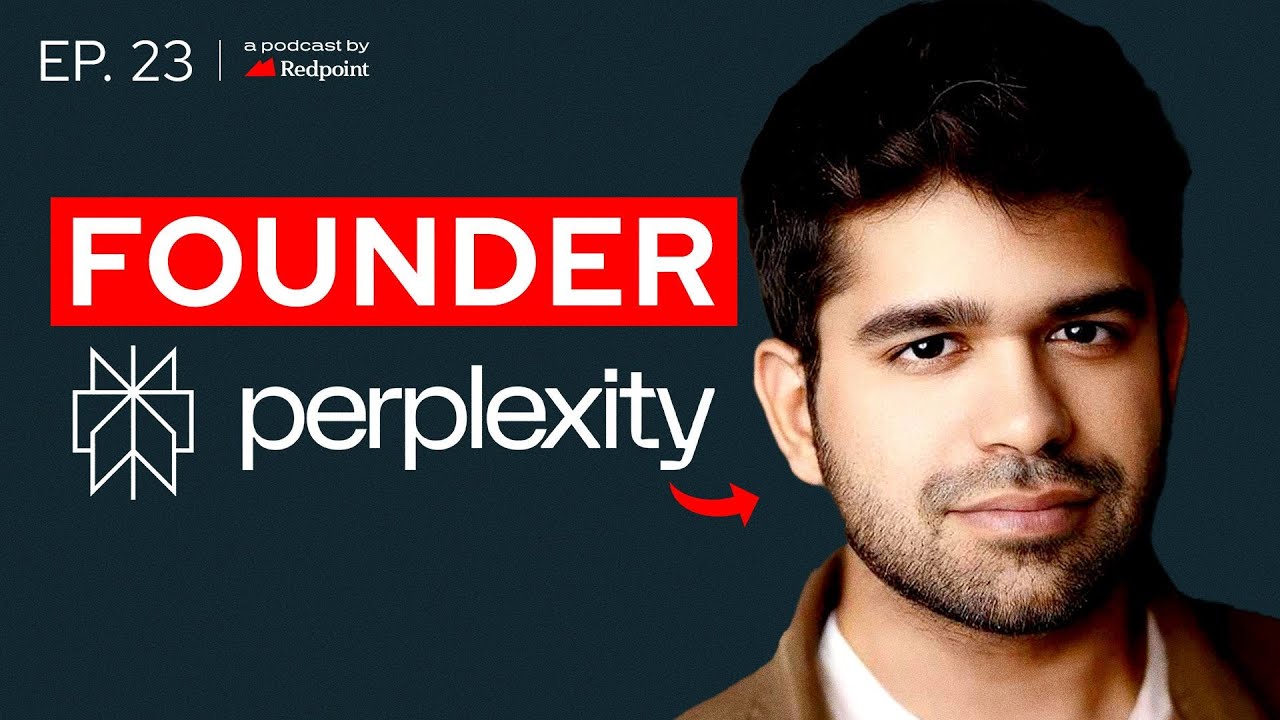
Perplexity AI is a next-generation search product that provides concise, cited answers to queries, challenging Google’s link-based model. It has gained rapid traction with 1 million installs on both Android and iOS within eight months of launch and recently raised funding at a $500 million valuation. CEO Arvind Seros discusses the company’s philosophy, technical approach, and vision for the future of search and AI.
The simplicity of Perplexity
The product appears simple but requires excellence across five dimensions: accuracy, reliability, latency, delightful UX, and iterative improvement (including personalization). Achieving all five simultaneously is rare—Arvind estimates the odds at roughly 1 in 10 billion—but necessary to build a multibillion-dollar company.
Behind each query, Perplexity reformulates the question, selects relevant web pages, determines which parts of those pages to use, decides how to render the answer (paragraph, bullets, etc.), attaches citations to each sentence, minimizes hallucinations, and sometimes includes images or videos.
A key innovation was making answers shareable via permalinks, a feature later adopted by Bing, Google, and others.
Follow-up questions are critical because most users struggle to articulate precise queries. Perplexity introduced “co-pilot” mode to ask clarifying questions and guide users toward better answers, inspired by Larry Page’s philosophy that “the user is never wrong”—if a search fails, it’s the system’s fault, not the user’s.
How Perplexity allocates resources
The company is vertically integrated: designers, product engineers, and backend teams work closely together. For example, a design choice can help mine more user interaction data, which improves the AI and the product.
Core company values—quality, truth, and velocity—mirror the product’s goals. Decisions are not consensus-driven; the team has strong opinions and heated debates, but everyone shares a commitment to great design, fast and reliable answers, and continuous improvement.
Don’t waste your time building your own models
Perplexity started with off-the-shelf OpenAI models, then fine-tuned smaller and faster models, and now increasingly uses open-source models (like Llama and Mistral) and has released its own fine-tuned models.
Arvind’s advice to founders: if you’re product-focused, start with someone else’s models. Don’t waste time building your own until you have product-market fit, users, and returning users. Almost half your problems are solved once you clear that barrier.
The harder problem than raising capital is recruiting great engineers. Top engineers won’t join a company without a product that has users (unless it’s an infrastructure play, which requires hundreds of millions in funding and world-class AI researchers—who are scarcer than GPUs).
Perplexity waited for key technological waves before making major investments: the arrival of Llama (open source) and NVIDIA’s TensorRT library for fast, efficient inference. Arvind’s approach is to anticipate waves (like Jeff Bezos) and position the company to take advantage of them when they arrive.
Being a “wrapper” for OpenAI
Arvind embraces the “wrapper” label: he’d rather be a wrapper with 100,000 users than have a proprietary model nobody uses. Many companies that built their own models have been overtaken by Llama or Mistral.
The model landscape is consolidating: on the closed side, it’s OpenAI and Anthropic; on the open-source side, it’s Llama and Mistral. Perplexity’s stance is to be model-agnostic—use whatever model gives the best answer—while retaining the option to control their own destiny by serving their own models.
Users don’t care which model powers their answer; they just want the best answer. Perplexity’s long-term moat comes from its data flywheel, query understanding, summarization quality, and search index—not from owning a foundation model.
The future of Quora and Wikipedia
Quora and Wikipedia were built to maximize the total knowledge of the internet. Perplexity aims to maximize “knowledge velocity”—the rate at which a user can access personalized, relevant knowledge.
Wikipedia offers one static article for everyone; Quora requires waiting for a human to respond. Perplexity delivers personalized, sourced, concise answers in seconds—adapting depth to the user’s interest (e.g., a nerd wants deep physics; a casual reader wants celebrity gossip).
Perplexity started with a narrow focus (knowledge and research) but plans to expand to serve all of human curiosity. Arvind cites Marc Andreessen’s advice: don’t build a vertical search engine for a specific domain; instead, build end-to-end experiences (like Booking.com or Airbnb) that go beyond search.
What does it take to compete with Google
Perplexity benefited from rare timing: Google was not the leader in AI for the first time, and OpenAI made powerful models accessible via APIs. Previous Google competitors (like Neva) failed by trying to replicate Google’s architecture (crawler, indexer, ranker) exactly.
Privacy-focused search engines (DuckDuckGo, Brave) succeeded by obsessing over go-to-market, branding, and positioning rather than building superior search technology. They leveraged existing infrastructure (Bing) and focused on browser distribution.
Arvind’s key insight: if you build the same technology as Google, they’ll always do it better and faster. You need a clever positioning strategy and a differentiated product.
What does search look like in 10 years
Search will be about answers, not links. It will involve agents that perform tasks for you, and the interface will be conversational—like talking to a friend.
Voice-to-voice is not the answer yet because eyes read faster than ears listen. Current voice interfaces (like ChatGPT’s) are fun when concise but frustrating when verbose. The key is conciseness.
Showing users that Perplexity is more than a “wrapper”
To earn user trust, Perplexity is demonstrating it can build its own infrastructure. They released their own fine-tuned models (based on Llama and Mistral) that rival GPT-3.5 Turbo for their use case, with updated information and fewer hallucinations.
Paul Graham’s thesis: the only AI companies that will survive are those that can ship their own models without users noticing—or where users notice an improvement. Perplexity is transparent that they’re not at GPT-4 level but are closing the gap by fine-tuning open-source models (like the upcoming Llama 3) for search-specific tasks.
Serving your own models on someone else’s infrastructure (e.g., Fireworks, Anyscale, Replicate) still makes you a “wrapper.” Perplexity’s goal is to be a search-focused business that controls its own inference stack.
RAG solutions and solving hallucinations
Perplexity is very good at RAG (retrieval-augmented generation) for web search, but Arvind cautions that this doesn’t translate directly to enterprise search. Google, the king of web search, has terrible internal search (Google Drive) because indexing, embeddings, snippet extraction, and ranking are fundamentally different across use cases.
Solving RAG requires more than a good embedding model. Ranking must incorporate signals beyond vector dot products, and these signals depend heavily on the end use case. Even long-context models can hallucinate more when given too much information, so the retrieval component must be highly selective.
Arvind is skeptical of claims that any company has “solved” RAG broadly; it’s use-case-specific.
Guiding users’ questions
Perplexity’s co-pilot mode asks clarifying questions to refine queries (e.g., “Which sites do you want to see in Kyoto?” or “What season?”). This contrasts with approaches where the AI figures everything out from a single prompt.
The sweet spot is for the AI to magically know when to clarify, when to stay out of the way, and when every user wants the same thing. This will only be figured out through iterative deployment.
Arvind dislikes toggles; the ideal is one mode of usage where co-pilot is seamlessly integrated. But user feedback is mixed: some love co-pilot for thoroughness, others find it slows them down.
Discover tab
The discover tab curates interesting content and queries. Arvind and a team of editors curate it by scraping the web and deciding which queries to feature.
A key growth lesson from Facebook: optimize for the new visitor, not just power users. Facebook’s key metric was how many real-world friends a new user already had on the platform—the strongest predictor of retention. Similarly, Perplexity must ensure the landing page is intuitive for first-time users, even if power users want more features.
Attracting new users vs. pleasing “power users”
There’s a tension between listening to power users (who demand features and threaten to leave) and maintaining simplicity for new users. The YC mantra of “ship what users works” for early product-market fit but becomes dangerous at scale.
Perplexity’s approach: respect user feedback but maintain a strong product vision. The landing page must not be cluttered with sign-up modals or features that intimidate new users. Google itself now struggles with this, blasting “stay signed in” modals that annoy users.
Arvind cites Apple as the only company that nails this balance, but Apple has the advantage of distribution and lock-in.
How Perplexity landed on search
Arvind initially pitched a vision-based search (glasses with AirPods reading answers aloud) but was advised to narrow the focus. He first built a text-to-SQL tool for enterprise database search, but feedback from Databricks’ chief architect revealed that 80% of revenue-generating SQL is pre-written and run as periodic jobs, and most new queries are created via drag-and-drop tools (Power BI, Tableau), not text.
He also built a Twitter graph search (finding connections, searching tweets by specific authors) and a summarization-based search tool. The summarization tool started as an internal Slack bot for answering technical questions and proved most useful to real people.
Perplexity launched the Twitter search first, which went viral when Jack Dorsey quote-tweeted it. Users searched their own handles, and when handles weren’t in the index, the system fell back to summarizing their social media presence across platforms—spooking users and creating screenshot virality similar to ChatGPT’s launch.
Usage spiked during the winter vacation, convincing Arvind the product was real. The team then pivoted to focus fully on consumer-facing search.
Overhyped and underhyped in AI
Overhyped: the obsession with building AI-native vertical applications. Arvind hasn’t seen an AI-native product truly take over a vertical yet.
Underhyped: building delightful user experiences. Too few companies focus on this, even though it’s a key differentiator.
What didn’t work at Perplexity
The “collections” feature (organizing threads into research collections) hasn’t taken off as expected. Tens of thousands are created daily, but users don’t want to manually organize threads. It needs more automation and seamless backend work to become a collaborative research tool.
Open source vs. closed models
Arvind believes anything possible with GPT-4 today will eventually be possible with open-source models at lower cost and faster latency. But each new model generation enables previously impossible capabilities (like co-pilot, image-based homework help, video analysis, or agentic task execution).
The cycle continues: open-source catches up, then a new frontier opens.
Should AI be regulated
Arvind thinks regulation is premature. The widespread economic benefits of AI haven’t been realized yet, and the social media analogy is flawed.
AI safety work requires building real systems first—you can’t safeguard what doesn’t exist. Slowing down development is counterproductive; finding problems faster allows fixing them faster.
The regulatory approach is dangerous because it concentrates power: requiring licenses for large-scale training effectively limits AI development to a few well-funded organizations. If AI is truly dangerous, you want as many people working on it as possible, not decisions made in “three or four rooms.”
What other company would Aravind work at
If not at Perplexity, Arvind would work at companies like Eleven Labs or Runway, which are doing cutting-edge work in AI-generated speech and video.
His personal passion project: recording hours-long conversations with his parents about their lives, then using AI to preserve their voices and personalities so he could “talk to them again” even after they’re gone. He sees generative AI as a way to reduce the marginal cost of creative production (movies, visualizations) and to preserve human memory and emotion.
OpenAI
Arvind previously worked at OpenAI. He believes the company has two schools of thought—move fast vs. move cautiously—and that the recent turmoil means OpenAI won’t be the same company. It can’t simultaneously run an app store, first-party products, infrastructure, enterprise, and cutting-edge research with limited GPUs.
He still considers OpenAI the world’s leading AI organization but thinks it will need to focus on three or four priorities rather than trying to do everything.
Where to learn more
Arvind’s recommendation: use Perplexity to learn about anything—including himself, his co-hosts, or Red Point Ventures mentors. It provides links, summaries, answers, and follow-up questions.