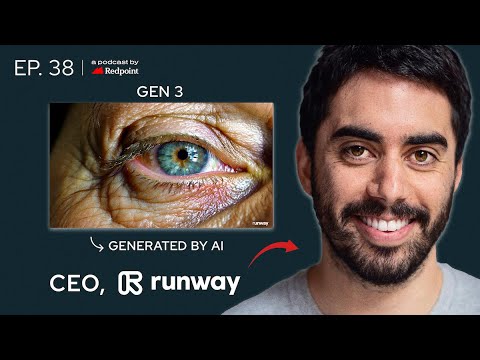
Cris Valenzuela is co-founder and CEO of Runway, a company building state-of-the-art AI video generation models (most recently Gen-3 Alpha) used by Hollywood studios, enterprises, and individual creators worldwide. Runway has raised hundreds of millions of dollars and is reportedly in discussions to raise at a $4 billion valuation. The conversation covers where AI creative tools stand today, how Runway structures its research and product teams, the philosophy behind its pricing and UI decisions, competitive dynamics with companies like OpenAI (Sora), and Cris’s vision for a new art form emerging from these tools.
How early are we in AI for creative tools?
We are still in the very early stages — what models can do today is just the beginning of what will emerge over the next several months.
Key upcoming milestones Cris is excited about:
Real-time generation — inference times dropping dramatically
More customization — finer control over specific art directions, styles, and mood boards
Multi-modal controls — generating video sequences from audio inputs, not just text or images
Gen-3 Alpha already supports fine-tuning with specific art styles, but better control tools, longer generations, and improved consistency are still needed.
Cris’s personal testing philosophy: come in with a loose concept (a character, a camera angle, a theme) rather than a rigid prompt, then iterate and let the model surprise you. Speed of generation (seconds) enables rapid exploration.
He describes the experience as “going to the gym for the mind” — exercising creative parts of the brain you didn’t know you had, not to win awards but for the intrinsic joy of expression.
Who uses Runway?
A wide spectrum: from professional studios, production teams, filmmakers, art directors, and editors on one end, to casual creators working from their bedrooms on the other, plus everything in between.
Cris sees no real tension between serving sophisticated professionals and novice users — the core need is the same (telling a story), with differences mainly in output format, quality, and consistency requirements.
Long-term, he expects entirely new types of creative professionals to emerge that don’t fit any existing category, similar to how VFX and CGI roles were unthinkable 40 years ago.
How Runway teaches new users
The biggest lesson: ideas and taste matter more than anything else. Having great ideas and knowing how to convey them is most of the journey.
Common misconception: people approach video generation like a chatbot — type a prompt, expect a perfect word-for-word result. When it doesn’t match their mental image, they blame the model.
Reality: it’s an iterative process. You prompt, evaluate, adjust, and repeat. This is true of every creative tool — having a camera doesn’t make you a filmmaker; knowing when and why to press record does.
For enterprise users, Cris recommends starting with recreating work they’ve done before in traditional tools (3D software, editing suites) to build intuition within familiar constraints.
Does UI matter?
Cris’s provocative claim needs nuance: UI matters, but over-engineering UI is less impactful than scaling better models. There’s a common temptation to believe that the right interface will unlock more value than simply improving the underlying model — he’s made that mistake himself and learned from it.
A better long-term vision: dynamically generated interfaces. Instead of designers and engineers pre-defining every slider and control primitive, the model itself should generate the interface based on what you’re trying to do. A 2D animated film needs different controls than a hyper-realistic 3D short.
This reflects a broader philosophy: don’t over-invest in product features around today’s model capabilities, because those capabilities will look very different in 12–18 months.
Runway’s research-product integration
Runway’s core advantage: it builds both the models and the product, and the two inform each other deeply.
The key is finding people who speak both the language of art and the language of science. At Runway’s best, top researchers sit alongside experienced VFX artists and editors, and they think about problems in the same way.
Evaluation approach: beyond standard benchmarks and human preference studies (which Cris finds somewhat flawed), Runway relies heavily on taste — having the most discerning people judge outputs. If something is interesting and novel even if it doesn’t top benchmarks, that signals value.
Resource allocation across time horizons: the research team is split into pre-training (baseline models), controllability (steerability), quality and safety, and fine-tuning (custom models for studios). Teams are given autonomy to organize around a shared vision rather than being given hyper-specific short-term goals.
Cris emphasizes that most things they try don’t work — that’s the nature of science. The key is maintaining a mindset of iteration and being comfortable with uncertainty.
Organizational philosophy: ensembles and wandering
Runway organizes teams into small “ensembles” rather than large, prescriptive structures. This is intentional: when you don’t know exactly what will be possible in the next phase, rigid planning kills invention.
Marginal improvements require prescriptive structure; true invention requires the right people with first-principles thinking and the freedom to explore.
Example: Runway’s “Motion Brush” tool (brush over a subject in an image and define its motion) emerged from a researcher and an editor tinkering together — not from a 60-page plan.
As the team has grown, Cris has become more conscious of keeping teams small enough to maintain creative freedom. He looks for people who are extremely comfortable with uncertainty and who understand that everything at Runway will change.
Pricing philosophy
Current pricing reflects a world still in the discovery and exploration phase, not yet the optimization phase. Cris knows costs will come down significantly as inference becomes cheaper.
Right now, the goal is unit economics that allow users to experiment and explore freely. Optimizing for the lowest price too early would miss the discovery phase.
The broader pattern Cris sees: technology moves in two waves — first expansion (discovering what’s possible), then optimization (driving down costs). Video AI is still in expansion mode.
Competitive landscape
When OpenAI released Sora, Cris tweeted “game on” — he sees competition as healthy and invigorating, not threatening.
Runway is a small fraction of OpenAI’s size but has managed to build strong models and products. Cris believes long-term success is less about any single model and more about the vision for how to use these models in compelling ways.
He expects the market to consolidate to a small handful of winners capable of building large-scale models with large-scale offerings.
On whether there will be one dominant model or a distributed landscape: Cris leans toward consolidation, similar to how most markets work. He prefers the term “media models” over “video models” because the future is multi-modal — pixels combined with audio, text, and other inputs in a sequence-to-sequence framework.
IP and enterprise partnerships
Runway is already working with studios and IP holders to create custom-trained models. These models are often used internally and never made public, which is why consumers may not have seen them yet.
Cris’s vision: eventually we should stop distinguishing between AI-generated and non-AI-generated content. It’s just content. People watch movies because the story is good, not because of how it was made.
The future of storytelling
Cris draws a parallel to the invention of cinema in the early 1900s: pioneers like the Lumière brothers thought film was a gimmick with no future, and critics dismissed it as inferior to painting. A new art form emerged over time.
Similarly, AI video tools are in their early exploration phase. The first instinct is to compare outputs to traditional filmmaking, but the truly interesting developments will be things that have never been seen before.
Early glimmers of a new art form:
New camera angles and perspectives that are extremely difficult or impossible with traditional filmmaking
Personalization and customization — rendering things unique to each individual
Real-time generation combined with the above, enabling entirely new media formats
Cris is from Chile, where the media industry is small. One reason he started Runway is that so many good stories worldwide are constrained not by ideas but by capital, resources, and access to tools. He wants to lower those barriers.
Over-hyped and under-hyped
Over-hyped: text-to-video systems as the primary interface. Prompting is the wrong paradigm — what matters is whatever input or control mechanism works best for the creator.
Under-hyped: what models like Gen-3 Alpha can do for simulation systems and engines — understanding fluids, dynamics, and physical world behavior. This is largely unexplored and will be surprising.
Biggest surprises building Runway
You don’t need tens of billions of dollars to make state-of-the-art models. A very focused team with clear goals and diligent execution can do it.
Cris has changed his mind repeatedly. What he thought was obvious about the trajectory of these tools has proven less obvious to most people than he expected — there’s still a lot of work to do in helping people understand where this is going.
He believes a “ChatGPT moment” for creative AI is still coming — when hundreds of millions of people start making things, we’ll see content and creators we’ve never encountered before.
Advice for art students
Explore weird stuff. Focus on ideas more than tools — tools are an extension of yourself.
Be original, authentic, and weird.
Personal note
Cris’s favorite story is the story of building Runway itself — coming from Chile with no Silicon Valley experience, no fundraising background, and no precedent for the kind of research they do, and repeatedly doing things that seemed impossible. The story isn’t finished yet.