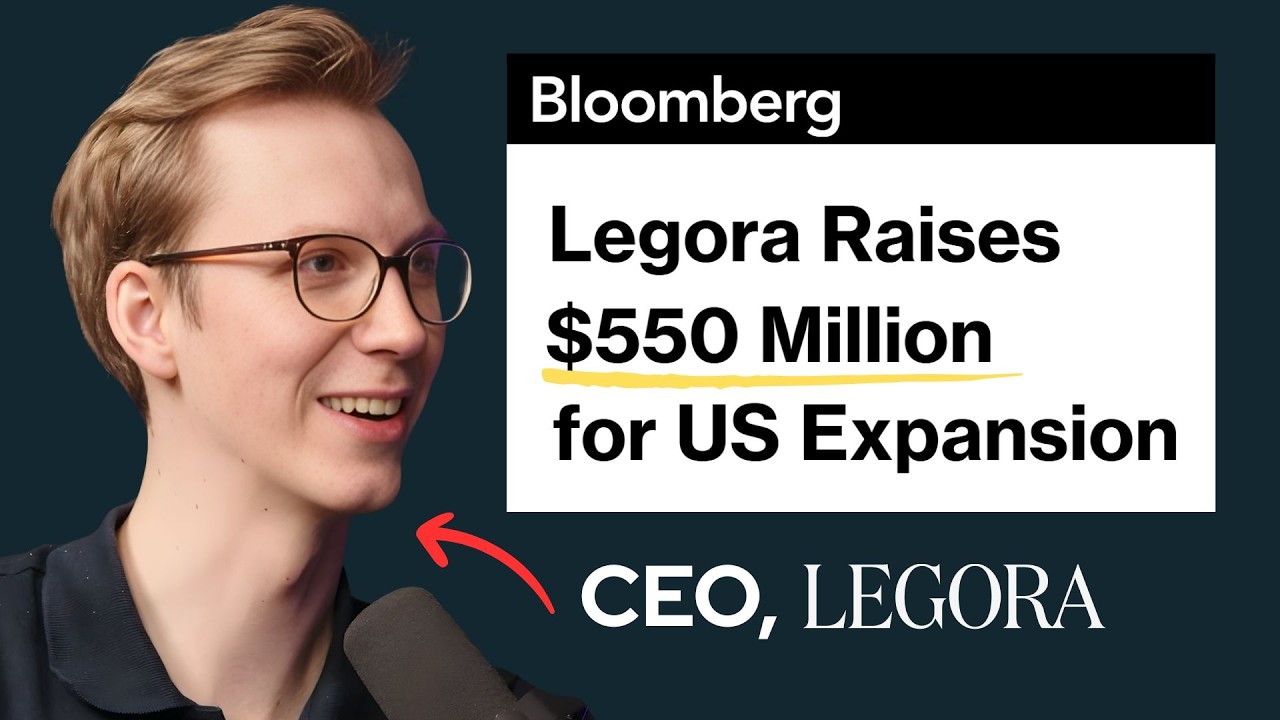
Legora, an AI-powered legal technology platform, just raised a $550M Series D at a $5.5B+ valuation, led by Accel, in what CEO Max Junestrand believes is the largest round ever in legal tech. The company has been doubling revenue every quarter since late 2024 and is scaling from ~400 to ~900 employees this year. The episode covers how Legora thinks about competition from foundation models, the shift in law firm economics, building an AI-native company, and the US expansion strategy.
The Series D and What It Signals
The round saw $1.5B+ in demand, which Junestrand interprets as the market distinguishing between traditional SaaS companies (lacking AI velocity) and AI-native companies like Legora that are growing 10x year over year.
He views the funding as validation but emphasized internally that it doesn’t help customers directly — the product does. The real risk is that everything built can be “washed away” if the team doesn’t keep moving.
The company launched in the US in March 2025 (New York Legal Week), grew the US team to 100 people, and is now expanding into Denver, Chicago, Houston, and more hubs.
Why Foundation Models Entering Legal Helps Legora
When Anthropic launched Claude for Legal and Thomson Reuters stock dropped, Junestrand saw it as a market correction: traditional SaaS companies without AI velocity should be less valued, while AI-native companies like Legora become more attractive.
He argues that even if models can do ~80% of legal work out of the box, the last 20% takes 99% of the time and requires taste, maintainability, and domain-specific product infrastructure.
Legora’s team is dedicated full-time to tracking model capabilities and applying them to legal workflows — something most organizations can’t do internally.
He draws an analogy to AWS offering a database: if that’s all you offered, you’d be toast, but there’s a whole set of things cloud providers don’t want to build. The same dynamic applies to foundation models vs. vertical AI companies.
The Step-Function Nature of AI Capabilities
Junestrand describes AI progress as a step function, not linear: a task goes from “can’t be done” to “conquered” once the model crosses a threshold.
Concrete example: In summer 2024, Legora was 60% accurate on automating limited partnership agreement key term reviews. By the end of that summer, they hit 100% accuracy, and the client completely shifted from a 3-day associate task (billable hours) to a 5-hour turnaround with fixed fees.
The December 2025 release of Opus 4.5/4.6 was another major unlock — agents began proactively asking for missing context, making interactions feel more human and reducing friction dramatically.
Law Firm Economics Are Shifting
Law firms initially adopted AI defensively: “If my competitor has it, I need it.” The low level of differentiation in legal work means the equilibrium breaks when one firm offers faster, cheaper service using AI.
Now enterprises (banks, insurance companies, pharma) are waking up and demanding that their law firms use AI to serve them more effectively. This client-side pressure is driving real behavioral change.
Junestrand sees a Jevons paradox dynamic: AI lets top firms scale their expertise. Partners who were limited by their 14-16 hour workday can now serve more clients by encoding their IP and knowledge into tools.
He predicts the emergence of “firm AI” — systems that leverage a firm’s precedents, organizational memory, and ways of working, similar to how skills work in The Matrix (download a capability and the model can execute it).
Pricing: Seats vs. Outcomes
Legora still primarily sells seats. Junestrand acknowledges outcome-based pricing is appealing in theory but extraordinarily difficult in practice because legal work varies wildly by jurisdiction, deal size, and complexity.
He notes that customer support is the one market where outcome-based pricing has gained traction.
With agentic features consuming far more tokens (planning, double-checking, reflecting, memory updates), the company is beginning to rethink how tokens get transacted on the platform — but it’s TBD.
Building an AI-Native Company
Low ego is essential. Junestrand stresses that teams must be willing to work on something for 9 months that then gets completely replaced. The product built in 2023-2025 largely doesn’t exist anymore.
Lead from the front. Leaders must personally use AI tools (Claude Code, Cursor) and optimize their own workflows. He runs internal leaderboards on AI tool usage.
Speed vs. enterprise expectations. Legora maintains a bias to action and fast iteration, but now serves top-50 law firms and top-10 banks that expect enterprise software cadence. The balance is moving fast while managing bigger customers.
Culture at scale. With half the team having less than 3 months of tenure, culture carriers from the early days need to be visible and vocal. The company is 5 days in-office with daily dinners together — a deliberate choice that competitors don’t match.
One Legora feeling. All onboarding happens in Stockholm regardless of where employees are based. Junestrand himself embedded in New York to transplant the culture.
Hiring and Talent
Legora pioneered the role of “legal engineers” — ex-practitioners who understand the pain of legal work firsthand and now reinvent it with technology. They serve as the glue between the product team and customers, acting as buddies who guide clients through the AI transition.
The company looks for people who are both collaborative (fighting for clients) and competitive (helping clients get to where they need to be).
Junestrand values “AI native, high IQ, doesn’t respect authority” profiles combined with experienced operators who know how to run large organizations.
Product Development in the Agent Era
The product team continuously tests new models against customer pain points through evals and by pairing engineers with lawyers for intensive week-long sprints (e.g., a capital markets task that cost ~$500 in tokens but produced remarkable results).
The challenge is generalizing from specific breakthroughs to broader product capabilities across practice areas (capital markets, M&A, litigation, in-house).
Junestrand distinguishes between incremental improvements and iteration cycles — he optimizes for iteration speed while inserting bold ideas when model capabilities cross thresholds.
The UX of collaborating with agents on legal matters is still less defined than in software engineering (where agents submit pull requests), so there’s significant product work to be done around the systems surrounding agents.
AI-Enabled Services vs. Software
On the trend of AI-native law firms: Junestrand is skeptical. He argues established firms like Kirkland or Goodwin could offer AI-empowered services using Legora, and it’s unclear why a new entrant with no distribution would win.
Legora’s strategy is explicitly to be a software provider, not a service provider.
Stockholm Startup DNA
Junestrand attributes Stockholm’s startup success to: strong technical talent (laptops in school curricula), role models like Spotify and Skype, a culture of “how hard can it be?” and low respect for authority, and a very pro-tech, Americanized society.
The company’s US expansion was deliberate: they refused to open a US office until they could serve two top firms (Cleary Gottlieb and Goodwin Procter) remotely from Stockholm, proving the product worked before committing.
What Changed His Mind
Junestrank was surprised by how quickly capable agents became at doing extended work and being “right on the money” when they finish. This changed his view on how fast organizations should move toward having agents do work on their behalf.